Department of Chemistry and Biochemistry, Texas State University, San Marcos, TX 78666, USA.
BMC Genomics. 2013 Apr 15;14:251. doi: 10.1186/1471-2164-14-251.
Efficient mechanisms for rejoining of DNA double-strand breaks (DSBs) are vital because misrepair of such lesions leads to mutation, aneuploidy and loss of cell viability. DSB repair is mediated by proteins acting in two major pathways, called homologous recombination and nonhomologous end-joining. Repair efficiency is also modulated by other processes such as sister chromatid cohesion, nucleosome remodeling and DNA damage checkpoints. The total number of genes influencing DSB repair efficiency is unknown.
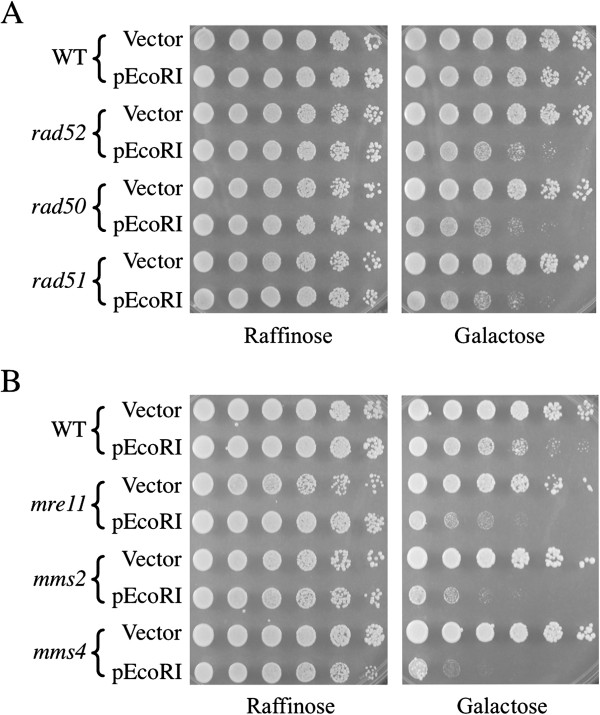
To identify new yeast genes affecting DSB repair, genes linked to gamma radiation resistance in previous genome-wide surveys were tested for their impact on repair of site-specific DSBs generated by in vivo expression of EcoRI endonuclease. Eight members of the RAD52 group of DNA repair genes (RAD50, RAD51, RAD52, RAD54, RAD55, RAD57, MRE11 and XRS2) and 73 additional genes were found to be required for efficient repair of EcoRI-induced DSBs in screens utilizing both MATa and MATα deletion strain libraries. Most mutants were also sensitive to the clastogenic chemicals MMS and bleomycin. Several of the non-RAD52 group genes have previously been linked to DNA repair and over half of the genes affect nuclear processes. Many proteins encoded by the protective genes have previously been shown to associate physically with each other and with known DNA repair proteins in high-throughput proteomics studies. A majority of the proteins (64%) share sequence similarity with human proteins, suggesting that they serve similar functions.
We have used a genetic screening approach to detect new genes required for efficient repair of DSBs in Saccharomyces cerevisiae. The findings have spotlighted new genes that are critical for maintenance of genome integrity and are therefore of greatest concern for their potential impact when the corresponding gene orthologs and homologs are inactivated or polymorphic in human cells.
高效的 DNA 双链断裂 (DSB) 修复机制至关重要,因为这些损伤的错误修复会导致突变、非整倍体和细胞活力丧失。DSB 修复由两种主要途径中的蛋白质介导,称为同源重组和非同源末端连接。修复效率也受到其他过程的调节,如姐妹染色单体黏合、核小体重塑和 DNA 损伤检查点。影响 DSB 修复效率的基因总数尚不清楚。
为了鉴定影响 DSB 修复的新酵母基因,我们测试了先前全基因组调查中与γ辐射抗性相关的基因,以评估它们对体内表达 EcoRI 内切酶产生的特定部位 DSB 修复的影响。RAD52 组 DNA 修复基因(RAD50、RAD51、RAD52、RAD54、RAD55、RAD57、MRE11 和 XRS2)的 8 个成员和另外 73 个基因被发现需要用于有效修复 EcoRI 诱导的 DSBs 在利用 MATa 和 MATα 缺失菌株文库进行的筛选中。大多数突变体对致裂化学物质 MMS 和博来霉素也敏感。一些非 RAD52 组基因以前与 DNA 修复有关,超过一半的基因影响核过程。许多由保护基因编码的蛋白质以前在高通量蛋白质组学研究中已被证明彼此以及与已知的 DNA 修复蛋白相互物理结合。大多数蛋白质(64%)与人类蛋白质具有序列相似性,表明它们具有相似的功能。
我们使用遗传筛选方法来检测酿酒酵母中 DSB 高效修复所需的新基因。这些发现突显了新的基因,这些基因对于维持基因组完整性至关重要,因此当相应的基因直系同源物和同源物在人类细胞中失活或多态性时,它们的潜在影响最为重要。