Mulhem Elie, Lick David, Varughese Jobin, Barton Eithne, Ripley Trevor, Haveman Joanna
Department of Family Medicine, Oakland University William Beaumont School of Medicine, Rochester, MI 48314, USA.
Int J Family Med. 2013;2013:901845. doi: 10.1155/2013/901845. Epub 2013 Mar 26.
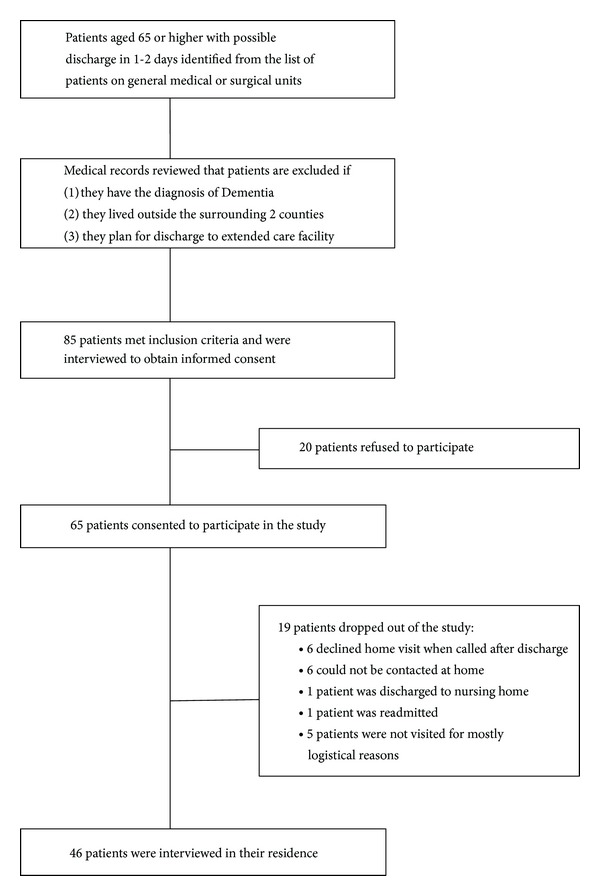
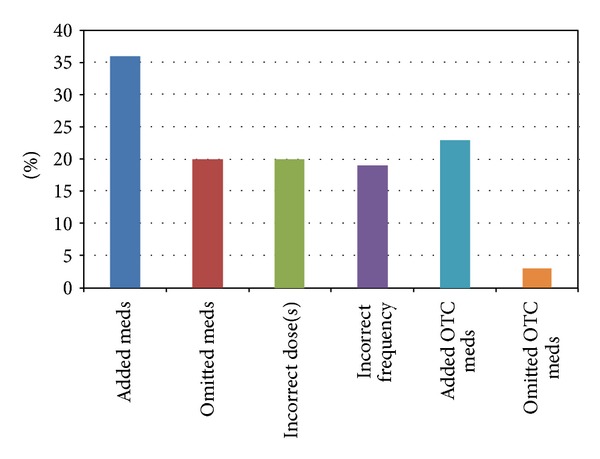
Objectives. To evaluate the adherence rate to prescribed medications in elderly patients 24-48 hours after being discharged from the hospital. Methods. Family medicine residents visited patients over the age of 65 years at their homes one to two days after being discharged from the hospital and documented all the medications that they were taking since coming home from the hospital. The list of medications was later compared to the medications recorded in hospital discharge instructions. Results. Complete data was available for 46 participants. The average patient age was 76 years; 54.4% were women. Only three patients (6.5%) adhered completely to the discharge medication list found in the medical record. Thirty-six patients (78.2%) reported taking at least one additional prescription medication, twenty patients (43.4%) missed at least one prescription medication, twenty patients (43.4%) reported taking the wrong dose of at least one medication, and nineteen patients (41.3%) reported taking medications at an incorrect frequency. Conclusion. The vast majority of elderly patients in our study did not adhere to the medication regimen in the first two days after hospital discharge. Cost-effective improvements to hospital discharge processes are needed to improve adherence and reduce preventable posthospitalization complications.
目的。评估老年患者出院后24至48小时内对医嘱用药的依从率。方法。家庭医学住院医师在65岁以上患者出院后的一到两天内家访,并记录他们自出院回家后所服用的所有药物。随后将药物清单与出院医嘱中记录的药物进行比较。结果。46名参与者有完整数据。患者平均年龄为76岁;54.4%为女性。只有三名患者(6.5%)完全遵守病历中出院用药清单。36名患者(78.2%)报告至少额外服用了一种处方药,20名患者(43.4%)至少漏服了一种处方药,20名患者(43.4%)报告至少有一种药物服用剂量错误,19名患者(41.3%)报告用药频率错误。结论。我们研究中的绝大多数老年患者在出院后的前两天未遵守用药方案。需要对出院流程进行具有成本效益的改进,以提高依从性并减少可预防的出院后并发症。