Spatial Ecology and Epidemiology Group, Tinbergen Building, Department of Zoology, University of Oxford, South Parks Road, Oxford OX1 3PS, United Kingdom.
Sci Rep. 2013;3:1671. doi: 10.1038/srep01671.
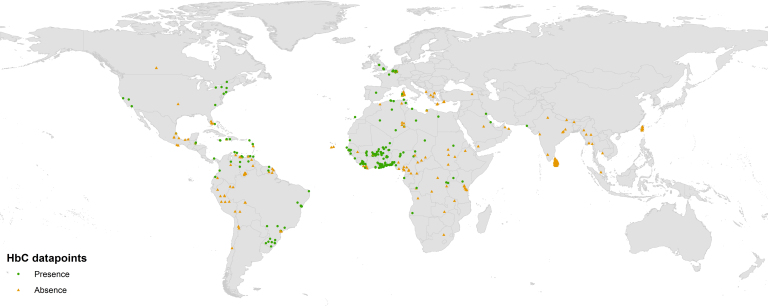
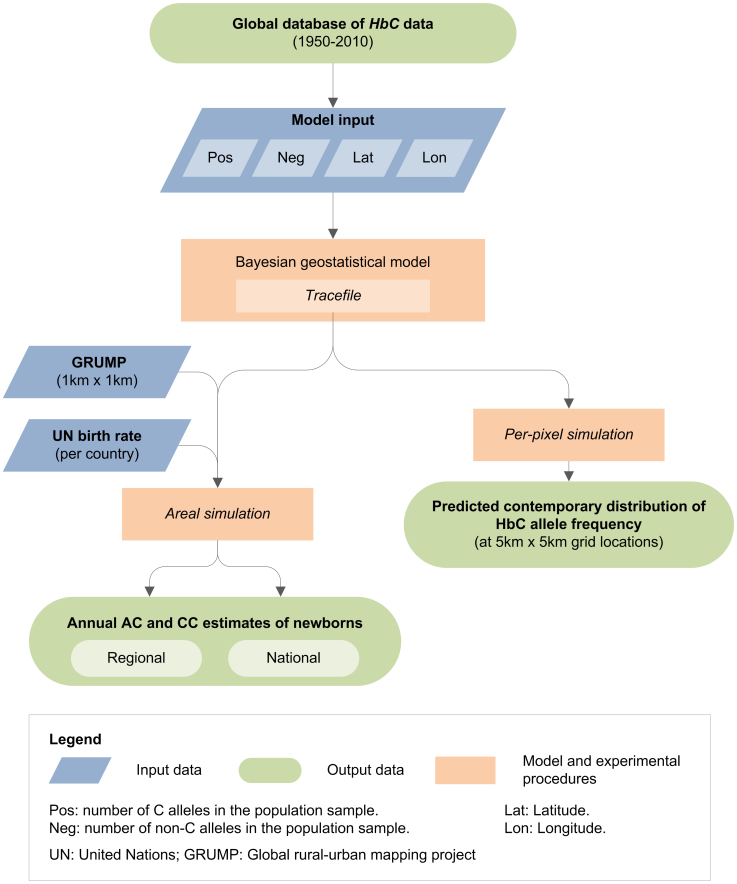
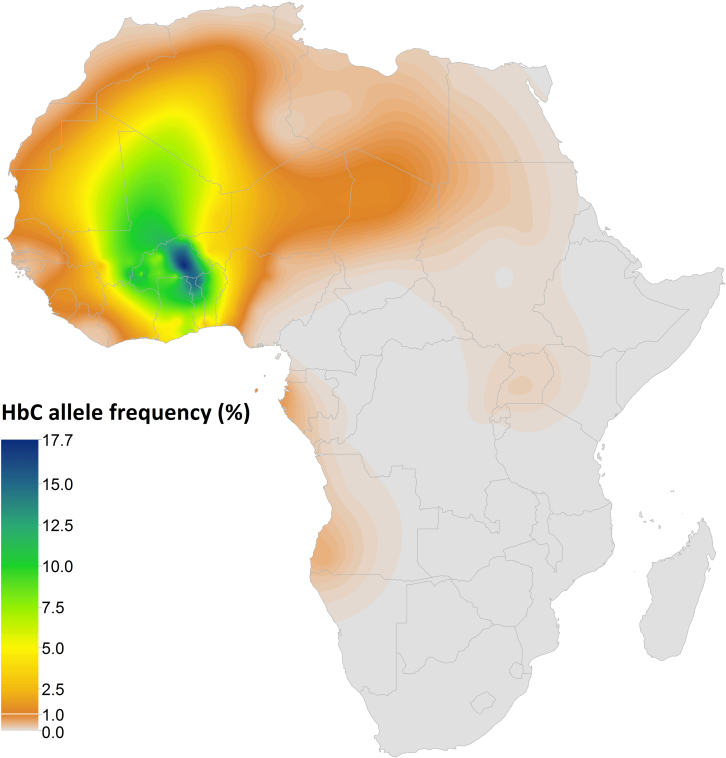
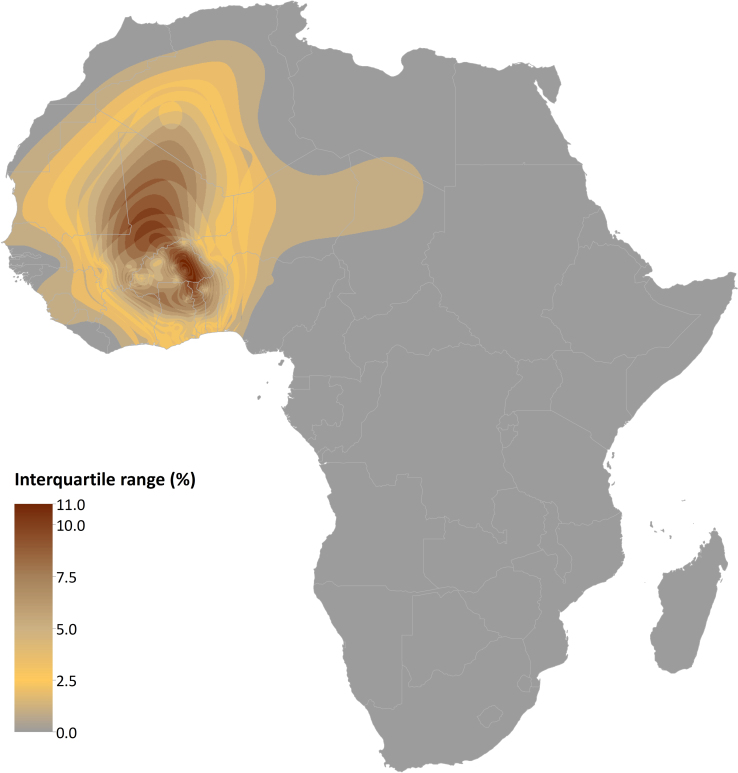
Haemoglobin C (HbC) is one of the commonest structural haemoglobin variants in human populations. Although HbC causes mild clinical complications, its diagnosis and genetic counselling are important to prevent inheritance with other haemoglobinopathies. Little is known about its contemporary distribution and the number of newborns affected. We assembled a global database of population surveys. We then used a Bayesian geostatistical model to create maps of HbC frequency across Africa and paired our predictions with high-resolution demographics to calculate heterozygous (AC) and homozygous (CC) newborn estimates and their associated uncertainty. Data were too sparse outside Africa for this methodology to be applied. The highest frequencies were found in West Africa but HbC was commonly found in other parts of the continent. The expected annual numbers of AC and CC newborns in Africa were 672,117 (interquartile range (IQR): 642,116-705,163) and 28,703 (IQR: 26,027-31,958), respectively. These numbers are about two times previous estimates.
血红蛋白 C(HbC)是人类中最常见的结构血红蛋白变体之一。尽管 HbC 会引起轻微的临床并发症,但对其进行诊断和遗传咨询对于预防与其他血红蛋白病的遗传具有重要意义。关于其现代分布和受影响的新生儿数量知之甚少。我们汇集了全球人群调查数据库。然后,我们使用贝叶斯地质统计模型来创建非洲各地 HbC 频率图,并将我们的预测与高分辨率人口统计数据进行配对,以计算杂合子(AC)和纯合子(CC)新生儿的估计值及其相关不确定性。由于该方法的数据在非洲以外地区过于稀疏,因此无法应用。在西非发现了最高的频率,但 HbC 在该大陆的其他地区也很常见。非洲每年预计有 672,117 名(四分位距(IQR):642,116-705,163)和 28,703 名(IQR:26,027-31,958)杂合子(AC)和纯合子(CC)的新生儿,分别。这些数字大约是之前估计值的两倍。