Gastroenterology Unit, IRCCS Casa Sollievo della Sofferenza, Hospital San Giovanni Rotondo, FG, San Giovanni, Italy.
PLoS One. 2013 Apr 8;8(4):e60527. doi: 10.1371/journal.pone.0060527. Print 2013.
Hepatitis C virus (HCV) infects approximately 3% of the world population and is the leading cause of liver disease, impacting hepatocyte metabolism, depending on virus genotype. Hepatic metabolic functions show rhythmic fluctuations with 24-h periodicity (circadian), driven by molecular clockworks ticking through translational-transcriptional feedback loops, operated by a set of genes, called clock genes, encoding circadian proteins. Disruption of biologic clocks is implicated in a variety of disorders including fatty liver disease, obesity and diabetes. The relation between HCV replication and the circadian clock is unknown.
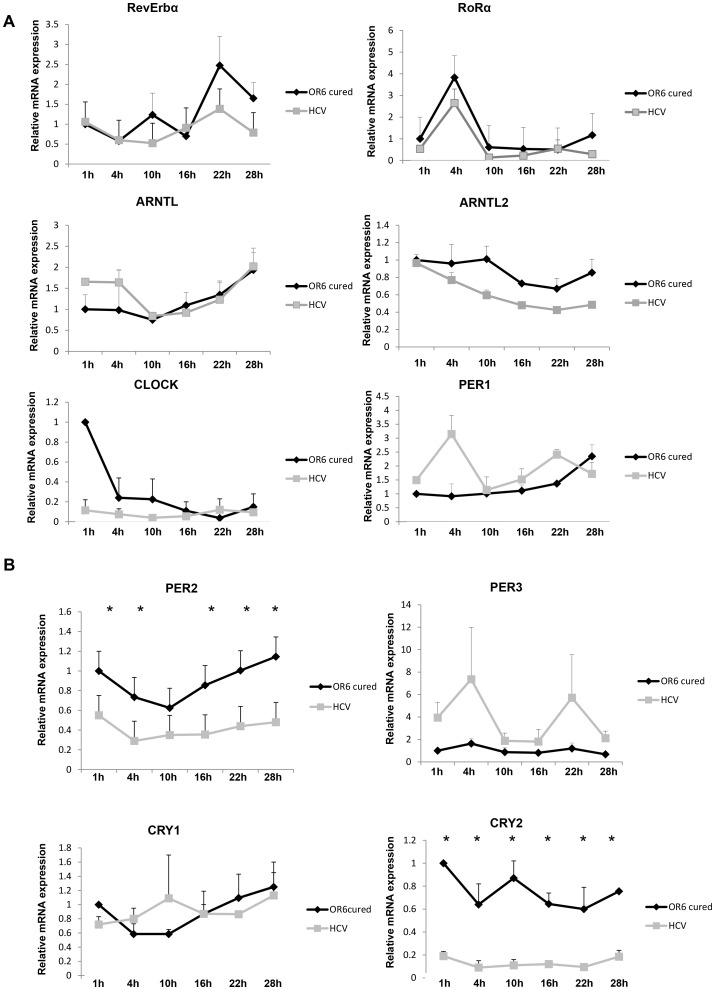
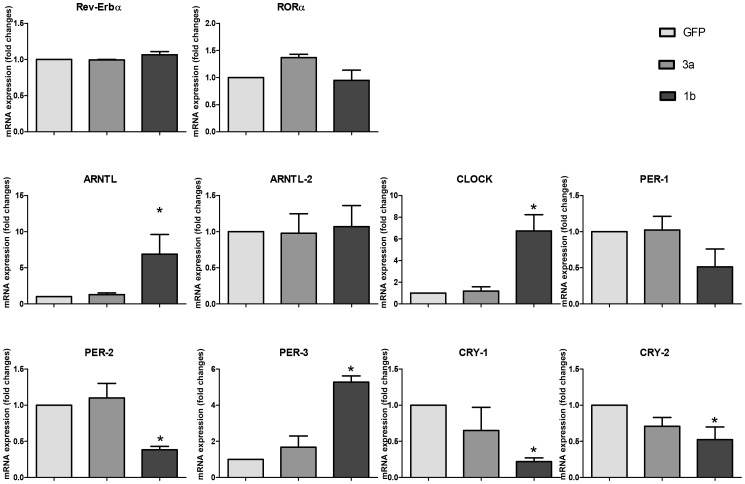
We investigated the relationship between HCV core infection and viral replication and the expression of clock genes (Rev-Erbα, Rorα, ARNTL, ARNTL2, CLOCK, PER1, PER2, PER3, CRY1 and CRY2) in two cellular models, the Huh-7 cells transiently expressing the HCV core protein genotypes 1b or 3a, and the OR6 cells stably harboring the full-length hepatitis C genotype 1b replicon, and in human liver biopsies, using qRT-PCR, immunoblotting, luciferase assays and immunohistochemistry.
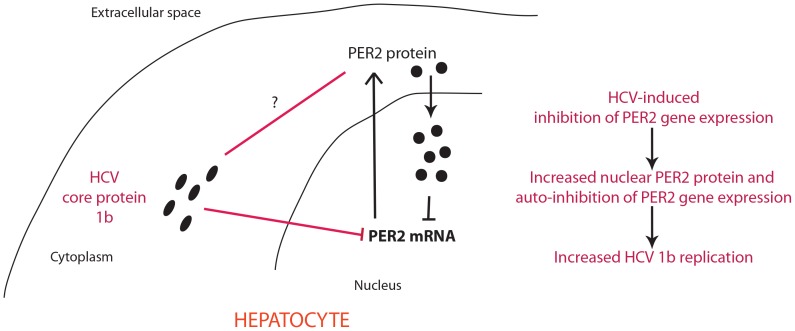
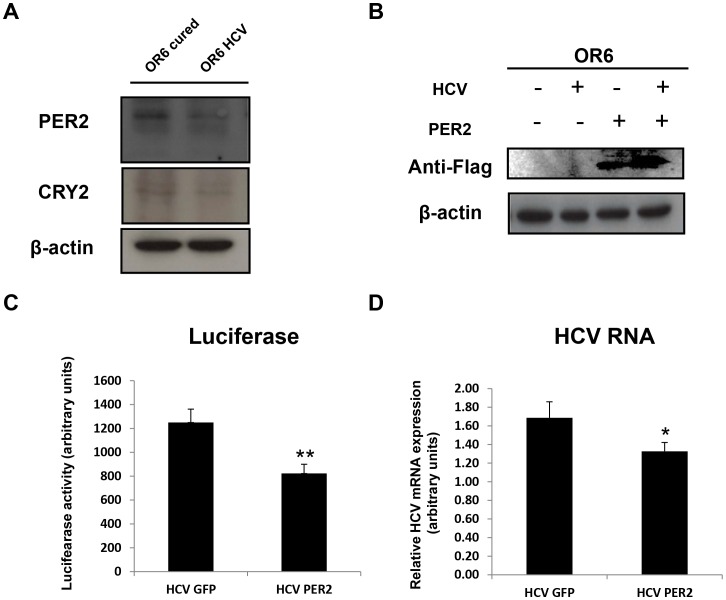
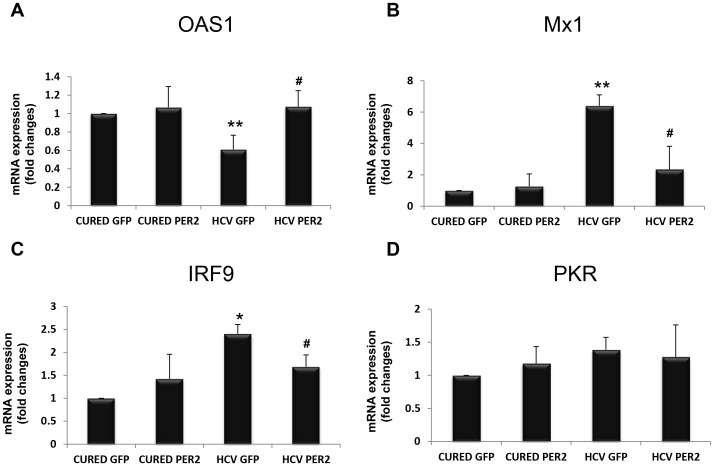
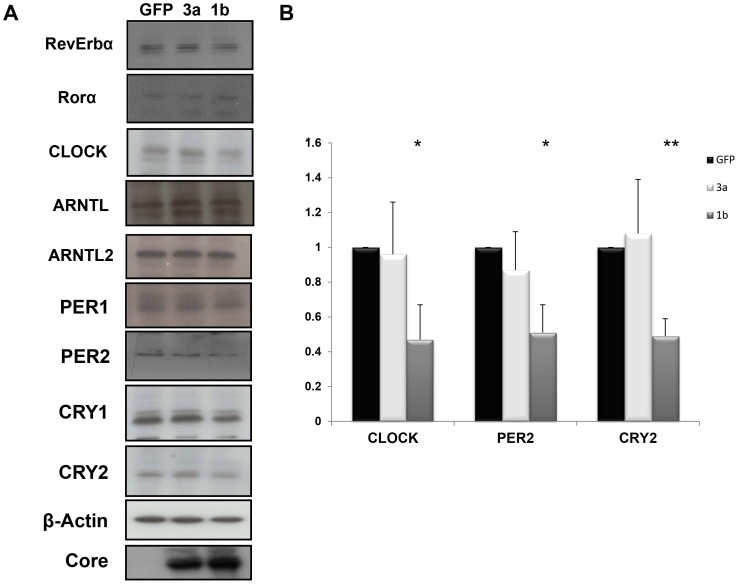
In Huh-7 cells expressing the HCV core protein genotype 1b, but not 3a, and in OR6 cells, transcript and protein levels of PER2 and CRY2 were downregulated. Overexpression of PER2 led to a consistent decrease in HCV RNA replicating levels and restoration of altered expression pattern of a subset of interferon stimulated genes (ISGs) in OR6 cells. Furthermore, in liver biopsies from HCV genotype 1b infected patients, PER2 was markedly localized to the nucleus, consistent with an auto-inhibitory transcriptional feedback loop.
HCV can modulate hepatic clock gene machinery, and the circadian protein PER2 counteracts viral replication. Further understanding of circadian regulation of HCV replication and rhythmic patterns of host-hosted relationship may improve the effectiveness of HCV antiviral therapy. This would extend to hepatic viral infections the current spectrum of chronotherapies, implemented to treat metabolic, immune related and neoplastic disease.
丙型肝炎病毒(HCV)感染了世界人口的约 3%,是导致肝脏疾病的主要原因,根据病毒基因型的不同,影响肝细胞的新陈代谢。肝脏的代谢功能具有 24 小时周期性的节律性波动(昼夜节律),由分子钟通过翻译-转录反馈环进行驱动,这些反馈环由一组称为时钟基因的基因操作,这些基因编码生物钟蛋白。生物钟的破坏与多种疾病有关,包括脂肪肝疾病、肥胖和糖尿病。HCV 复制与生物钟之间的关系尚不清楚。
我们研究了 HCV 核心感染和病毒复制与时钟基因(Rev-Erbα、Rorα、ARNTL、ARNTL2、CLOCK、PER1、PER2、PER3、CRY1 和 CRY2)在两种细胞模型中的表达之间的关系,这两种细胞模型是瞬时表达 HCV 核心蛋白基因型 1b 或 3a 的 Huh-7 细胞,以及稳定携带全长丙型肝炎基因型 1b 复制子的 OR6 细胞,并使用 qRT-PCR、免疫印迹、荧光素酶测定和免疫组织化学方法在人类肝活检组织中进行研究。
在表达 HCV 核心蛋白基因型 1b 的 Huh-7 细胞中,但不是 3a,以及在 OR6 细胞中,PER2 和 CRY2 的转录物和蛋白质水平均下调。PER2 的过表达导致 HCV RNA 复制水平持续下降,并恢复了 OR6 细胞中一组干扰素刺激基因(ISG)的改变表达模式。此外,在 HCV 基因型 1b 感染患者的肝活检组织中,PER2 明显定位于细胞核内,与自动抑制转录反馈环一致。
HCV 可以调节肝脏时钟基因机制,而生物钟蛋白 PER2 可抑制病毒复制。进一步了解 HCV 复制的昼夜节律调节和宿主-宿主关系的节律模式可能会提高 HCV 抗病毒治疗的效果。这将把目前用于治疗代谢、免疫相关和肿瘤疾病的时间治疗谱扩展到肝病毒感染。