BMC Cancer. 2013 Apr 17;13:196. doi: 10.1186/1471-2407-13-196.
The transition from normal epithelium to adenoma and, to invasive carcinoma in the human colon is associated with acquired molecular events taking 5-10 years for malignant transformation. We discovered CCAT1, a non-coding RNA over-expressed in colon cancer (CC), but not in normal tissues, thereby making it a potential disease-specific biomarker. We aimed to define and validate CCAT1 as a CC-specific biomarker, and to study CCAT1 expression across the adenoma-carcinoma sequence of CC tumorigenesis.
Tissue samples were obtained from patients undergoing resection for colonic adenoma(s) or carcinoma. Normal colonic tissue (n = 10), adenomatous polyps (n = 18), primary tumor tissue (n = 22), normal mucosa adjacent to primary tumor (n = 16), and lymph node(s) (n = 20), liver (n = 8), and peritoneal metastases (n = 19) were studied. RNA was extracted from all tissue samples, and CCAT1 expression was analyzed using quantitative real time-PCR (qRT-PCR) with confirmatory in-situ hybridization (ISH).
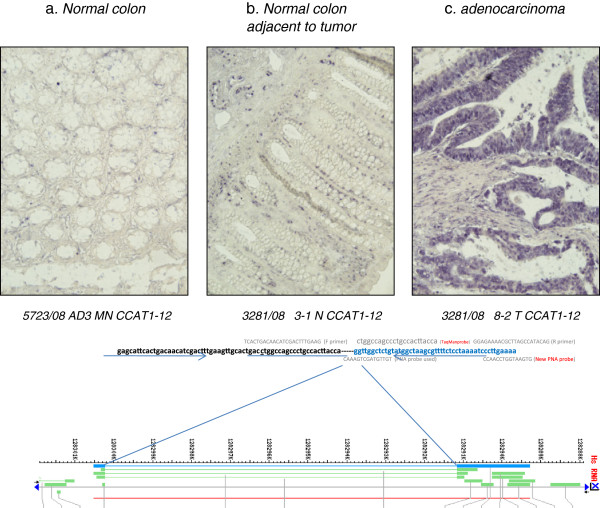
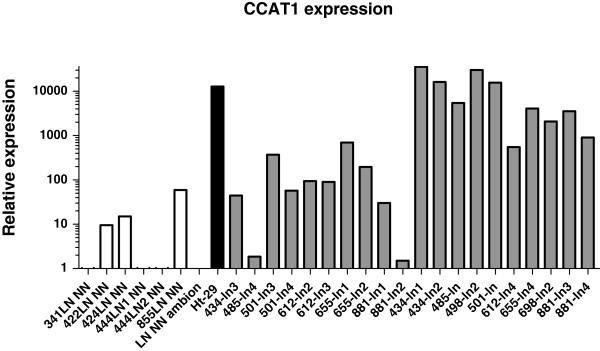
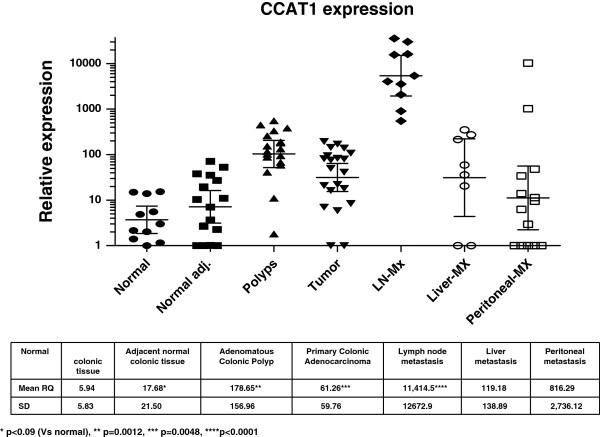
Borderline expression of CCAT1 was identified in normal tissue obtained from patients with benign conditions [mean Relative Quantity (RQ) = 5.9]. Significant relative CCAT1 up-regulation was observed in adenomatous polyps (RQ = 178.6 ± 157.0; p = 0.0012); primary tumor tissue (RQ = 64.9 ± 56.9; p = 0.0048); normal mucosa adjacent to primary tumor (RQ = 17.7 ± 21.5; p = 0.09); lymph node, liver and peritoneal metastases (RQ = 11,414.5 ± 12,672.9; 119.2 ± 138.9; 816.3 ± 2,736.1; p = 0.0001, respectively). qRT-PCR results were confirmed by ISH, demonstrating significant correlation between CCAT1 up-regulation measured using these two methods.
CCAT1 is up-regulated across the colon adenoma-carcinoma sequence. This up-regulation is evident in pre-malignant conditions and through all disease stages, including advanced metastatic disease suggesting a role in both tumorigenesis and the metastatic process.
人类结肠从正常上皮到腺瘤,再到浸润性癌的转变与获得性分子事件有关,这些事件需要 5-10 年才能发生恶性转化。我们发现 CCAT1 在结肠癌(CC)中过度表达,但在正常组织中不表达,因此它是一种潜在的疾病特异性生物标志物。我们旨在将 CCAT1 定义并确证为 CC 特异性生物标志物,并研究 CCAT1 在 CC 肿瘤发生的腺瘤-癌序列中的表达。
从接受结肠腺瘤(s)或癌切除术的患者中获得组织样本。研究了 10 例正常结肠组织、18 例腺瘤性息肉、22 例原发性肿瘤组织、16 例原发性肿瘤附近的正常粘膜和 20 例淋巴结、8 例肝和 19 例腹膜转移。从所有组织样本中提取 RNA,并使用定量实时 PCR(qRT-PCR)结合确认性原位杂交(ISH)分析 CCAT1 的表达。
在良性条件下获得的正常组织中发现 CCAT1 的边界表达[平均相对数量(RQ)= 5.9]。在腺瘤性息肉(RQ = 178.6 ± 157.0;p = 0.0012)、原发性肿瘤组织(RQ = 64.9 ± 56.9;p = 0.0048)、原发性肿瘤附近的正常粘膜(RQ = 17.7 ± 21.5;p = 0.09)中观察到 CCAT1 的相对显著上调;淋巴结、肝和腹膜转移(RQ = 11414.5 ± 12672.9;119.2 ± 138.9;816.3 ± 2736.1;p = 0.0001)。qRT-PCR 结果通过 ISH 得到证实,表明这两种方法测量的 CCAT1 上调之间存在显著相关性。
CCAT1 在结肠腺瘤-癌序列中上调。这种上调在癌前状态和所有疾病阶段都很明显,包括晚期转移性疾病,表明其在肿瘤发生和转移过程中都有作用。