Department of Cardiology, Copenhagen University Hospital Gentofte, Niels Andersens Vej 65, 2900 Hellerup, Denmark.
Heart. 2013 Jun;99(12):882-7. doi: 10.1136/heartjnl-2012-303375. Epub 2013 Apr 17.
To examine whether elevated resting heart rate (RHR) is an independent risk factor for mortality or a mere marker of physical fitness (VO2Max).
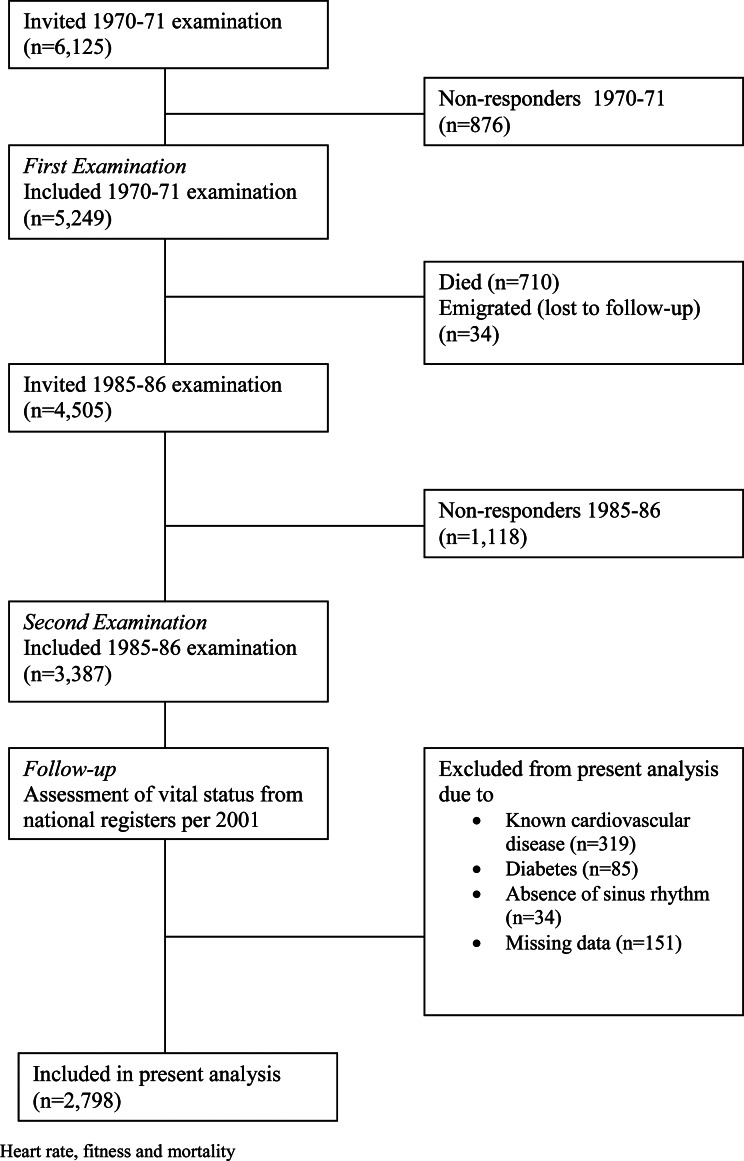
This was a prospective cohort study: the Copenhagen Male Study, a longitudinal study of healthy middle-aged employed men. Subjects with sinus rhythm and without known cardiovascular disease or diabetes were included. RHR was assessed from a resting ECG at study visit in 1985-1986. VO2Max was determined by the Åstrand bicycle ergometer test in 1970-1971. Subjects were classified into categories according to level of RHR. Associations with mortality were studied in multivariate Cox models adjusted for physical fitness, leisure-time physical activity and conventional cardiovascular risk factors.
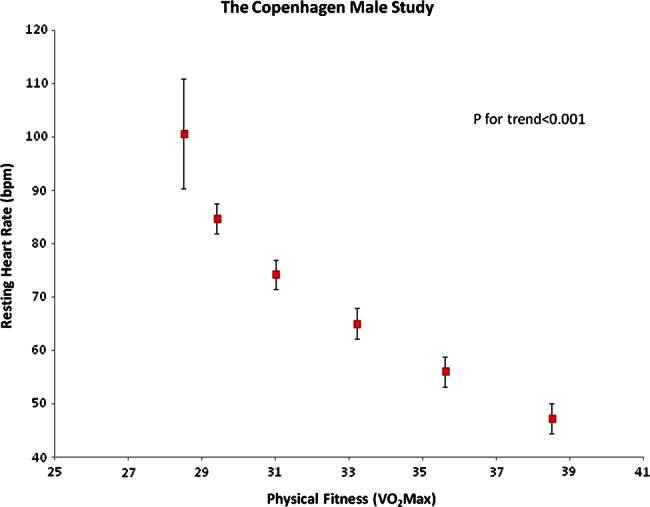
2798 subjects were followed for 16 years. 1082 deaths occurred. RHR was inversely related to physical fitness (p < 0.001). Overall, increasing RHR was highly associated with mortality in a graded manner after adjusting for physical fitness, leisure-time physical activity and other cardiovascular risk factors. Compared to men with RHR ≤ 50, those with RHR > 90 had an HR (95% CI) of 3.06 (1.97 to 4.75). With RHR as a continuous variable, risk of mortality increased with 16% (10-22) per 10 beats per minute (bpm). There was a borderline interaction with smoking (p = 0.07); risk per 10 bpm increase in RHR was 20% (12-27) in smokers, and 14% (4-24) in non-smokers.
Elevated RHR is a risk factor for mortality independent of physical fitness, leisure-time physical activity and other major cardiovascular risk factors.
探讨静息心率(RHR)升高是死亡的独立危险因素,还是仅仅是身体适应性(VO2Max)的标志物。
这是一项前瞻性队列研究:哥本哈根男性研究,一项对健康中年男性的纵向研究。研究对象为窦性心律且无已知心血管疾病或糖尿病者。RHR 是在 1985-1986 年研究访问时通过静息心电图评估的。VO2Max 是通过 1970-1971 年的Åstrand 自行车测功计测试确定的。根据 RHR 水平将受试者分为不同类别。使用多变量 Cox 模型,根据身体适应性、休闲时间体力活动和常规心血管危险因素调整后,研究与死亡率的相关性。
2798 名受试者随访 16 年。有 1082 人死亡。RHR 与身体适应性呈负相关(p < 0.001)。总体而言,在调整身体适应性、休闲时间体力活动和其他心血管危险因素后,RHR 逐渐升高与死亡率高度相关。与 RHR ≤ 50 的男性相比,RHR > 90 的男性的 HR(95%CI)为 3.06(1.97-4.75)。RHR 作为连续变量,死亡率风险增加 16%(10-22)/每分钟增加 10 次(bpm)。与吸烟存在边界交互作用(p = 0.07);RHR 每增加 10 bpm,吸烟者的风险增加 20%(12-27),非吸烟者的风险增加 14%(4-24)。
RHR 升高是死亡的危险因素,独立于身体适应性、休闲时间体力活动和其他主要心血管危险因素。