Department of Molecular Neurobiology, University of Groningen Groningen, Netherlands ; Department of Chronobiology, University of Groningen Groningen, Netherlands.
Front Mol Neurosci. 2013 Apr 11;6:8. doi: 10.3389/fnmol.2013.00008. eCollection 2013.
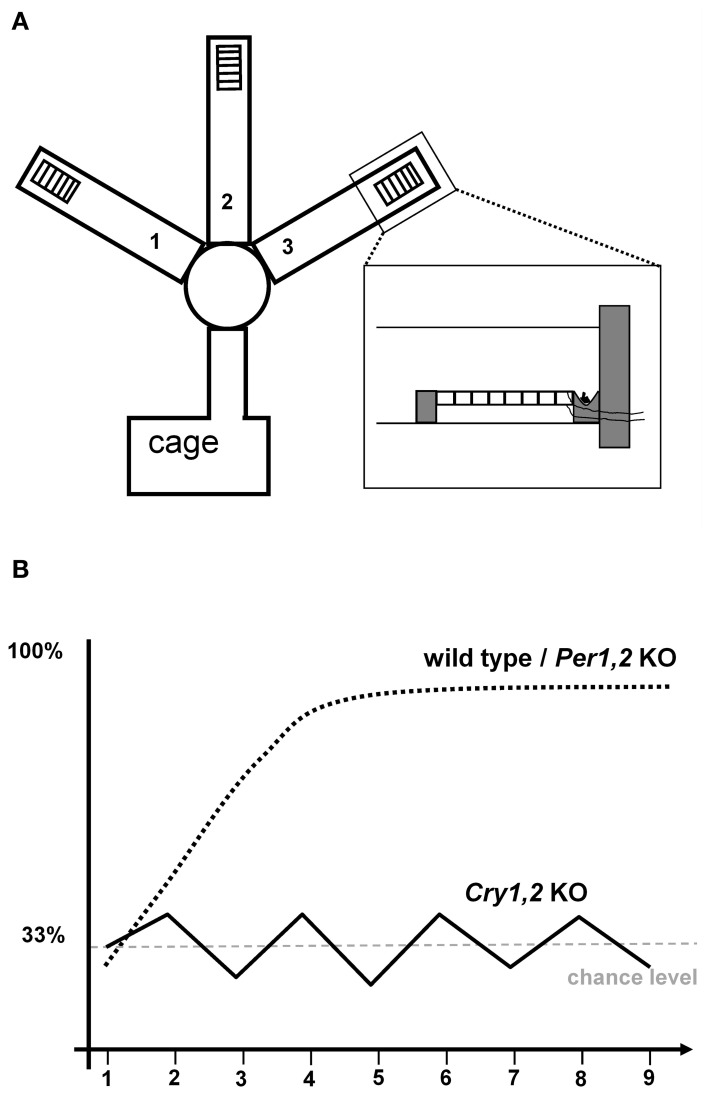
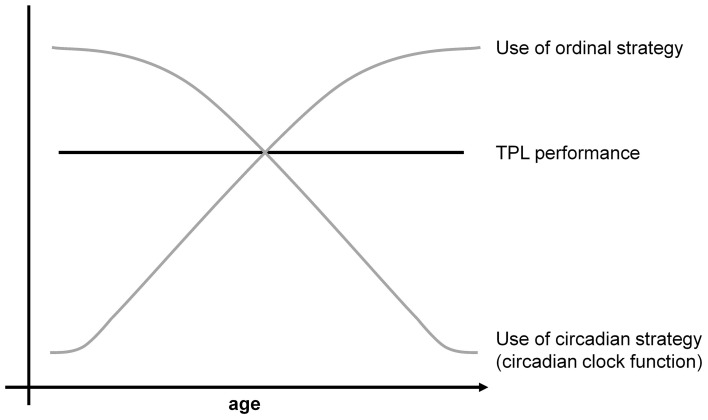
Time-Place learning (TPL) refers to the ability of animals to remember important events that vary in both time and place. This ability is thought to be functional to optimize resource localization and predator avoidance in a circadian changing environment. Various studies have indicated that animals use their circadian system for TPL. However, not much is known about this specific role of the circadian system in cognition. This review aims to put TPL in a broader context and to provide an overview of historical background, functional aspects, and future perspectives of TPL. Recent advances have increased our knowledge on establishing TPL in a laboratory setting, leading to the development of a behavioral paradigm demonstrating the circadian nature of TPL in mice. This has enabled the investigation of circadian clock components on a functional behavioral level. Circadian TPL (cTPL) was found to be Cry clock gene dependent, confirming the essential role of Cry genes in circadian rhythms. In contrast, preliminary results have shown that cTPL is independent of Per genes. Circadian system decline with aging predicts that cTPL is age sensitive, potentially qualifying TPL as a functional model for episodic memory and aging. The underlying neurobiological mechanism of TPL awaits further examination. Here we discuss some putative mechanisms.
时间-地点学习(TPL)是指动物记住时间和地点均发生变化的重要事件的能力。这种能力被认为对于在昼夜变化的环境中优化资源定位和避免捕食者是很有用的。许多研究表明,动物利用其生物钟系统进行 TPL。然而,对于生物钟系统在认知中的这种特定作用,我们知之甚少。本综述旨在将 TPL 置于更广泛的背景下,并概述 TPL 的历史背景、功能方面和未来展望。最近的进展增加了我们在实验室环境中建立 TPL 的知识,导致了一种行为范式的发展,该范式证明了小鼠 TPL 的昼夜节律性质。这使得能够在功能行为水平上研究生物钟成分。昼夜 TPL(cTPL)依赖于 Cry 时钟基因,证实了 Cry 基因在昼夜节律中的重要作用。相比之下,初步结果表明 cTPL 独立于 Per 基因。生物钟系统随年龄下降的预测表明 cTPL 对年龄敏感,这可能使 TPL 成为情景记忆和衰老的功能模型。TPL 的潜在神经生物学机制仍有待进一步研究。在这里,我们讨论了一些假设机制。