Li Junhua, Talaei-Khoei Amir, Seale Holly, Ray Pradeep, Macintyre C Raina
Asia-Pacific ubiquitous Healthcare research Centre (APuHC), The University of New South Wales, Sydney, Australia.
Interact J Med Res. 2013 Apr 16;2(1):e7. doi: 10.2196/ijmr.2468.
eHealth is an application of information and communication technologies across the whole range of functions that affect health. The benefits of eHealth (eg, improvement of health care operational efficiency and quality of patient care) have previously been documented in the literature. Health care providers (eg, medical doctors) are the key driving force in pushing eHealth initiatives. Without their acceptance and actual use, those eHealth benefits would be unlikely to be reaped.
To identify and synthesize influential factors to health care providers' acceptance of various eHealth systems.
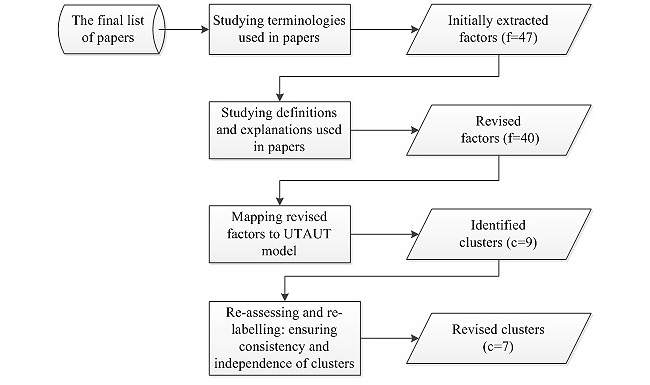
This systematic literature review was conducted in four steps. The first two steps facilitated the location and identification of relevant articles. The third step extracted key information from those articles including the studies' characteristics and results. In the last step, identified factors were analyzed and grouped in accordance with the Unified Theory of Acceptance and Use of Technology (UTAUT).
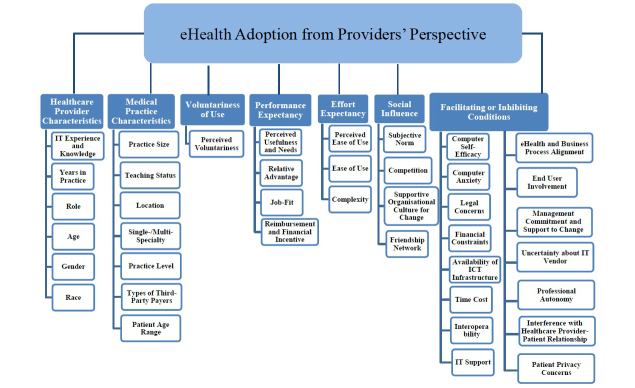
This study included 93 papers that have studied health care providers' acceptance of eHealth. From these papers, 40 factors were identified and grouped into 7 clusters: (1) health care provider characteristics, (2) medical practice characteristics, (3) voluntariness of use, (4) performance expectancy, (5) effort expectancy, (6) social influence, and (7) facilitating or inhibiting conditions.
The grouping results demonstrated that the UTAUT model is useful for organizing the literature but has its limitations. Due to the complex contextual dynamics of health care settings, our work suggested that there would be potential to extend theories on information technology adoption, which is of great benefit to readers interested in learning more on the topic. Practically, these findings may help health care decision makers proactively introduce interventions to encourage acceptance of eHealth and may also assist health policy makers refine relevant policies to promote the eHealth innovation.
电子健康是信息通信技术在影响健康的所有功能领域的应用。电子健康的益处(如提高医疗保健运营效率和患者护理质量)此前已在文献中得到记载。医疗保健提供者(如医生)是推动电子健康倡议的关键驱动力。没有他们的接受和实际使用,就不太可能收获这些电子健康的益处。
识别并综合影响医疗保健提供者接受各种电子健康系统的因素。
本系统文献综述分四个步骤进行。前两个步骤有助于查找和识别相关文章。第三步从这些文章中提取关键信息,包括研究的特征和结果。在最后一步,根据技术接受与使用统一理论(UTAUT)对识别出的因素进行分析和分组。
本研究纳入了93篇关于医疗保健提供者对电子健康接受情况的研究论文。从这些论文中,识别出40个因素,并将其分为7类:(1)医疗保健提供者特征;(2)医疗实践特征;(3)使用的自愿性;(4)绩效期望;(5)努力期望;(6)社会影响;(7)促进或抑制条件。
分组结果表明,UTAUT模型有助于整理文献,但也有其局限性。由于医疗保健环境中复杂的情境动态,我们的研究表明,有可能扩展信息技术采纳理论,这对有兴趣深入了解该主题的读者大有裨益。实际上,这些发现可能有助于医疗保健决策者积极引入干预措施,以鼓励对电子健康的接受,也可能有助于卫生政策制定者完善相关政策,以促进电子健康创新。