Department of Dermatology, School of Medicine and Public Health, University of Wisconsin, Madison, WI 53706, USA.
Exp Dermatol. 2013 May;22(5):342-8. doi: 10.1111/exd.12140.
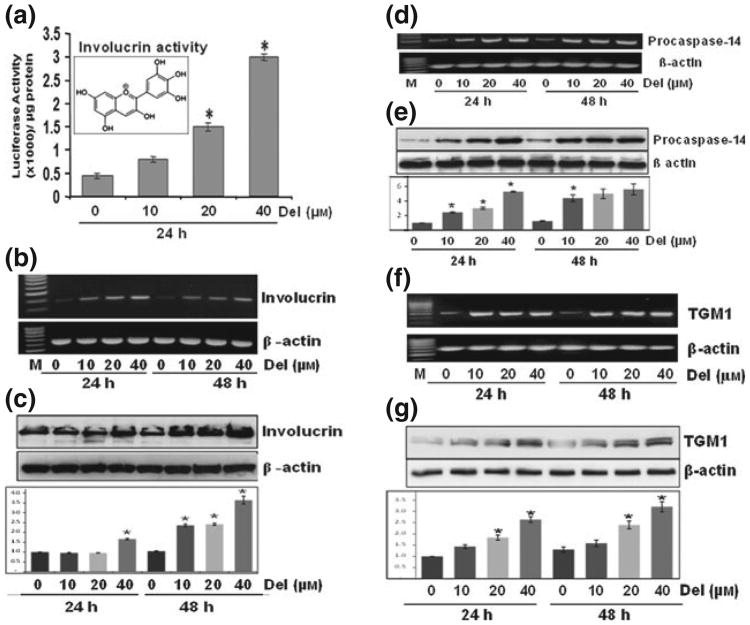
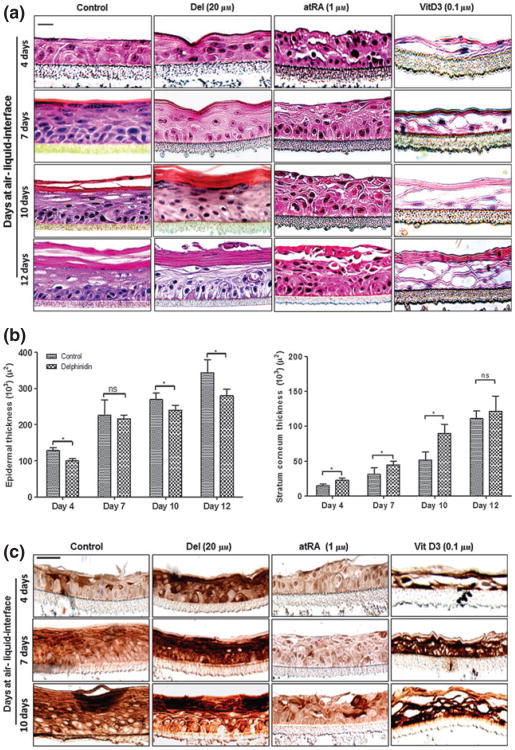
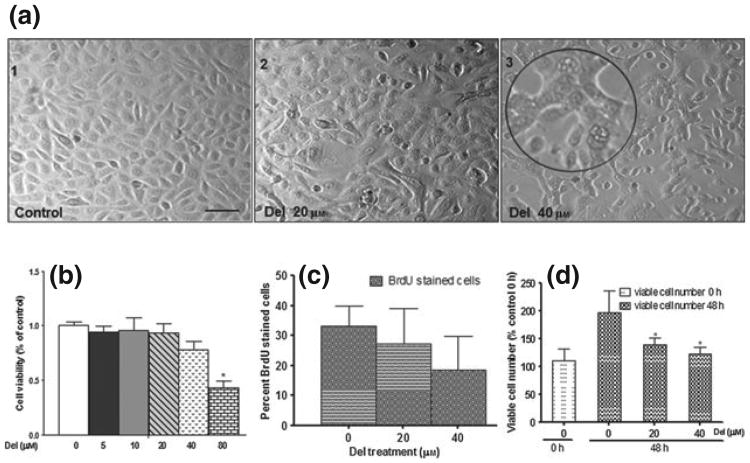
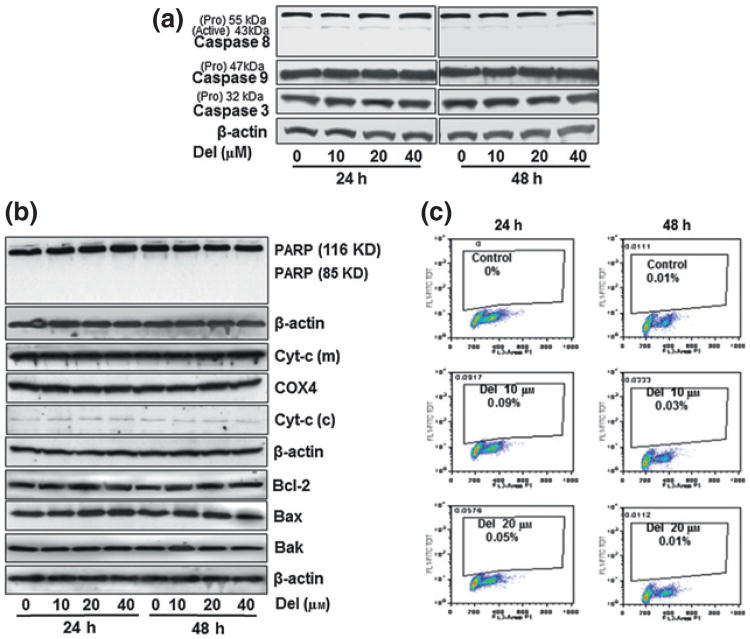
Delphinidin (Del), [3,5,7,3'-,4'-,5'-hexahydroxyflavylium], an anthocyanidin and a potent antioxidant abundantly found in pigmented fruits and vegetables exhibits proapoptotic effects in many cancer cells. Here, we determined the effect of Del on growth, apoptosis and differentiation of normal human epidermal keratinocytes (NHEKs) in vitro in submerged cultures and examined its effects in a three-dimensional (3D) epidermal equivalent (EE) model that permits complete differentiation reminiscent of in vivo skin. Treatment of NHEKs with Del (10-40 μm; 24-48 h) significantly enhanced keratinocyte differentiation. In Del-treated cells, there was marked increase in human involucrin (hINV) promoter activity with simultaneous increase in the mRNA and protein expressions of involucrin and other epidermal differentiation markers including procaspase-14 and transglutaminase-1 (TGM1), but without any effect on TGM2. Del treatment of NHEKs was associated with minimal decrease in cell viability, which was not associated with apoptosis as evident by lack of modulation of caspases, apoptosis-related proteins including Bcl-2 family of proteins and poly(ADP-ribose) polymerase cleavage. To establish the in vivo relevance of our observations in submerged cultures, we then validated these effects in a 3D EE model, where Del was found to significantly enhance cornification and increase the protein expression of cornification markers including caspase-14 and keratin 1. For the first time, we show that Del induces epidermal differentiation using an experimental system that closely mimics in vivo human skin. These observations suggest that Del could be a useful agent for dermatoses associated with epidermal barrier defects including aberrant keratinization, hyperproliferation or inflammation observed in skin diseases like psoriasis and ichthyoses.
飞燕草素(Del)[3,5,7,3'-,4'-,5'-六羟基黄酮]是一种花色苷和有效的抗氧化剂,大量存在于有色水果和蔬菜中,在许多癌细胞中表现出促凋亡作用。在这里,我们确定了 Del 对体外浸没培养的正常人类表皮角质形成细胞(NHEK)生长、凋亡和分化的影响,并在允许完全分化的三维(3D)表皮等效物(EE)模型中检查了其作用,这种模型使人联想到体内皮肤。用 Del(10-40 μm;24-48 h)处理 NHEK 可显著增强角质形成细胞分化。在 Del 处理的细胞中,人包裹蛋白(hINV)启动子活性明显增加,同时包裹蛋白和其他表皮分化标志物(包括前半胱天冬酶-14 和转谷氨酰胺酶-1(TGM1))的 mRNA 和蛋白表达增加,但对 TGM2 没有任何影响。Del 处理 NHEK 与细胞活力的最小下降相关,这与凋亡无关,如缺乏对半胱天冬酶的调节,凋亡相关蛋白,包括 Bcl-2 蛋白家族和多聚(ADP-核糖)聚合酶裂解。为了确定我们在浸没培养物中观察到的体内相关性,我们随后在 3D EE 模型中验证了这些效果,发现 Del 可显著增强角化作用并增加角蛋白 14 和角蛋白等角化标志物的蛋白表达。我们首次表明,Del 使用与体内人类皮肤非常相似的实验系统诱导表皮分化。这些观察结果表明,Del 可能是一种有用的药物,可用于治疗与表皮屏障缺陷相关的皮肤病,包括银屑病和鱼鳞癣等皮肤病中观察到的异常角化、过度增殖或炎症。