Department of Medicine, Stanford University, 300 Pasteur Drive, Stanford, CA 94305, USA.
QJM. 2013 Aug;106(8):721-9. doi: 10.1093/qjmed/hct093. Epub 2013 Apr 24.
Hyperuricemia is known to be a risk factor for incident type 2 diabetes mellitus, but the absolute magnitude of the association is not known. We aimed to evaluate the strength of association between hyperuricemia and the risk of developing diabetes among the US veterans with gout.
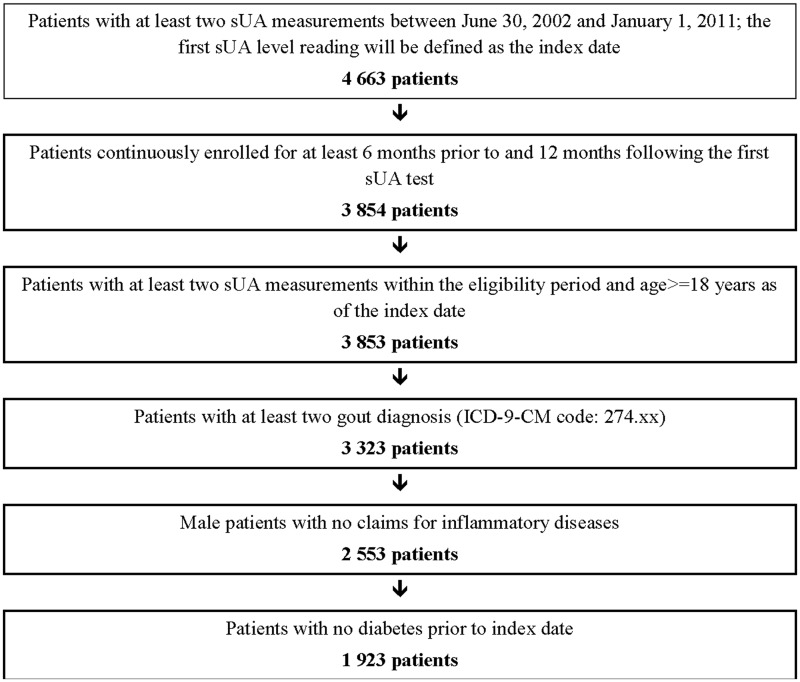
Patients (age ≥ 18 years) with ≥2 clinical encounters with gout diagnoses, no history of inflammatory diseases or diabetes and two serum urate (sUA) measurements between 1 January 2002 and 1 January 2011 were selected. Diabetes was identified using International Classification of Disease-9-Clinical Modification codes, use of anti-diabetic medications or HbA1c ≥6.5%. sUA levels were assessed at 6-month cycles (hyperuricemia: sUA >7 mg/dl). Accumulated hazard curves for time to first diabetes diagnosis were derived from Kaplan-Meier (KM) analysis. Risk of diabetes associated with hyperuricemia was estimated using a Cox proportional hazards model. Population attributable fraction (AF) of new-onset diabetes within 1 year was estimated using logistic regression.
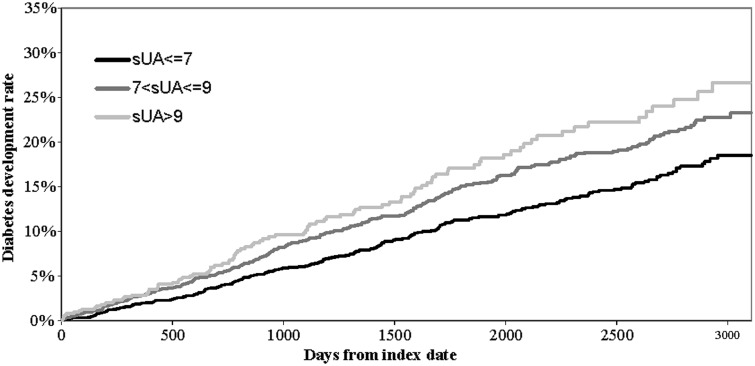
Among 1923 patients, average age was 62.9 years, body mass index was 30.6 kg/m(2), and follow-up time was 80 months. Diabetes rates from KM were 19% for sUA ≤ 7 mg/dl, 23% for 7 mg/dl < sUA ≤ 9 mg/dl and 27% for sUA > 9 mg/dl at the end of follow-up period (P < 0.001). Hyperuricemia was associated with a significantly higher risk of developing diabetes, after adjusting for confounding factors (hazard ratio: 1.19, 95% confidence interval: [1.01-1.41]). Approximately, 8.7% of all new cases of diabetes were statistically attributed to hyperuricemia.
Among veterans, hyperuricemia was associated with excess risk for developing diabetes. Approximately, 1 in 11 new cases of diabetes were statistically attributed to hyperuricemia.
高尿酸血症是 2 型糖尿病发病的一个危险因素,但具体关联的强度尚不清楚。我们旨在评估美国痛风患者高尿酸血症与发生糖尿病风险之间的关联强度。
选择年龄≥18 岁、至少有两次痛风临床诊断记录、无炎症性疾病或糖尿病病史且在 2002 年 1 月 1 日至 2011 年 1 月 1 日之间有两次血清尿酸(sUA)测量值的患者。糖尿病的诊断采用国际疾病分类-9-临床修正版(ICD-9-CM)代码、使用抗糖尿病药物或糖化血红蛋白(HbA1c)≥6.5%。sUA 水平在 6 个月周期内进行评估(高尿酸血症:sUA>7mg/dl)。通过 Kaplan-Meier(KM)分析得出首次糖尿病诊断的累积危险曲线。使用 Cox 比例风险模型估计高尿酸血症与糖尿病的相关性。使用逻辑回归估计 1 年内新发糖尿病的人群归因分数(AF)。
在 1923 例患者中,平均年龄为 62.9 岁,体重指数为 30.6kg/m2,随访时间为 80 个月。KM 结果显示,sUA≤7mg/dl、7mg/dl<sUA≤9mg/dl 和 sUA>9mg/dl 组的糖尿病发生率分别为 19%、23%和 27%,在随访期末差异有统计学意义(P<0.001)。在调整混杂因素后,高尿酸血症与发生糖尿病的风险显著相关(风险比:1.19,95%置信区间:1.01-1.41)。大约 8.7%的新发糖尿病病例归因于高尿酸血症。
在退伍军人中,高尿酸血症与发生糖尿病的风险增加相关。大约 11 例新发糖尿病病例中有 1 例归因于高尿酸血症。