Laboratory of Adjuvant and Antigen Research, U.S. Military HIV Research Program, Walter Reed Army Institute of Research, 503 Robert Grant Avenue, Silver Spring, MD 20910, USA.
Vaccine. 2013 Jun 10;31(26):2804-10. doi: 10.1016/j.vaccine.2013.04.027. Epub 2013 Apr 23.
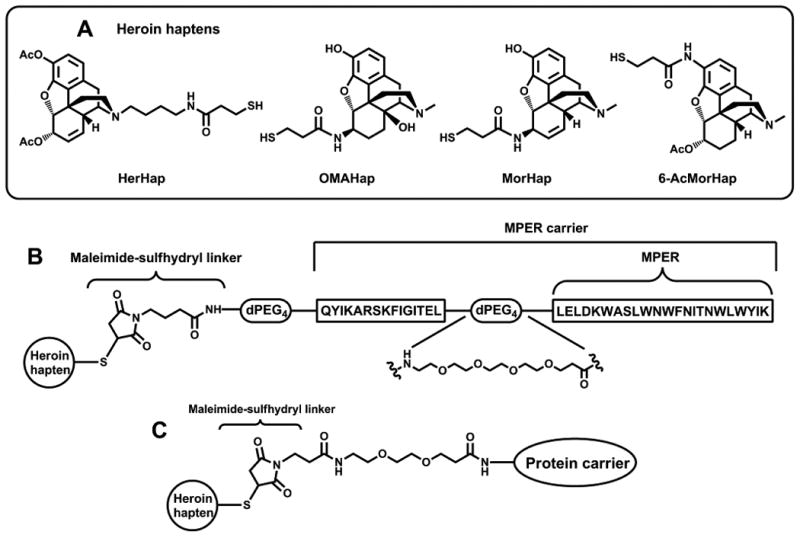
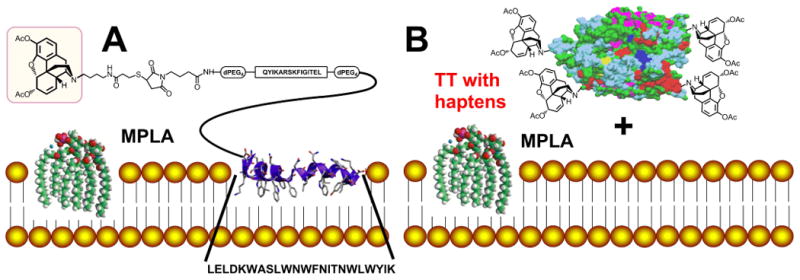
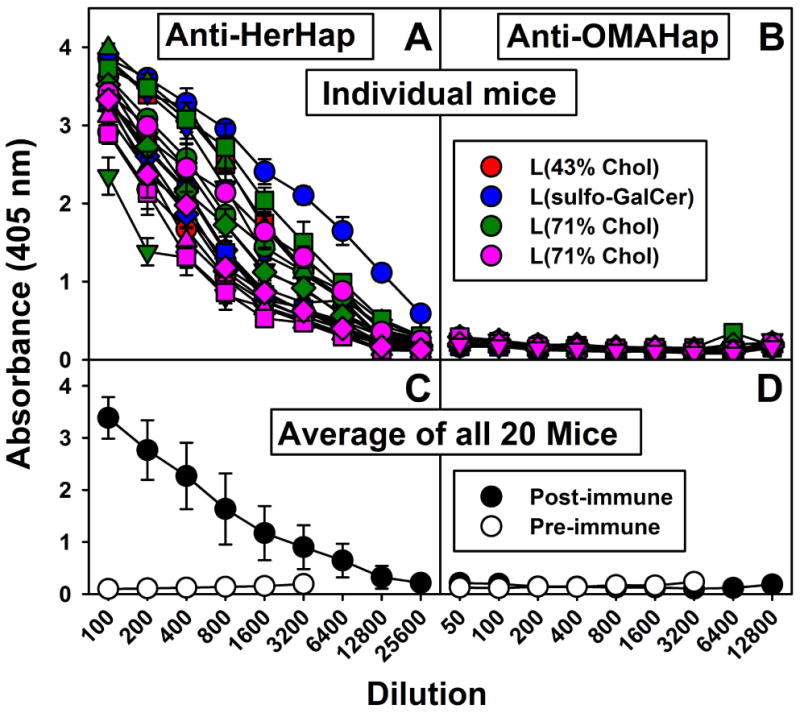
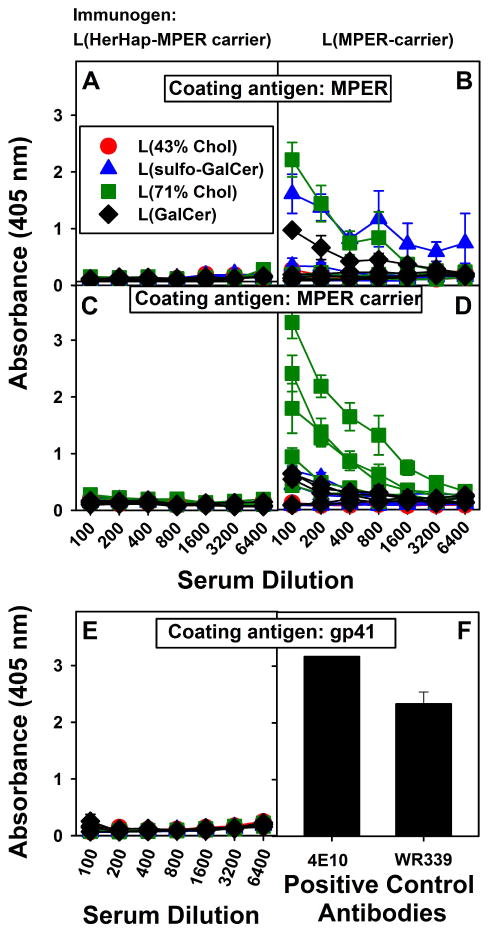
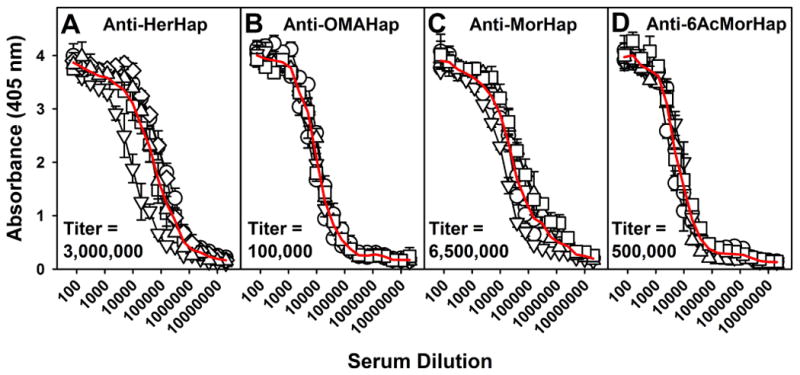
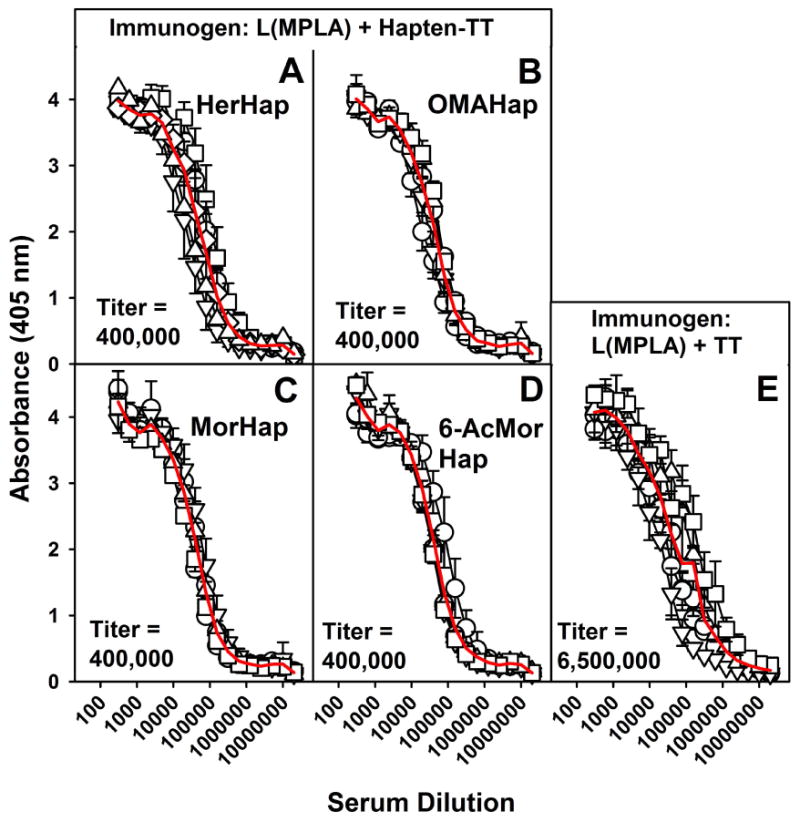
In order to create an effective immunization approach for a potential vaccine to heroin, liposomes containing monophosphoryl lipid A [L(MPLA)] were tested as an adjuvant system to induce antibodies to heroin hapten analogs. Four synthetic haptens and two immunization strategies were employed. In the first strategy, a hydrophobic 23 amino acid immunogenic peptide derived from the membrane proximal external region of gp41 from HIV-1 envelope protein was embedded as a carrier in the outer surface of L(MPLA), to which was conjugated a 15 amino acid universal T cell epitope and a terminal heroin hapten analog. In the second strategy, tetanus toxoid (TT) carrier protein was decorated with haptens by conjugation, and the hapten-conjugated protein was mixed with L(MPLA). After immunization of mice, each of the immunization strategies was effective for induction of IgG anti-hapten antibodies. The first immunization strategy induced a mean end-point IgG titer against one of two haptens tested of approximately 12,800; however, no detectable antibodies were induced against the liposome-associated HIV-1 carrier peptide. In the second immunization strategy, depending on the hapten used for decorating the TT, end-point IgG titers ranged from 100,000 to 6,500,000. In this strategy, in which hapten was conjugated to the TT, end-point IgG titers of 400,000 to the TT carrier were observed with each conjugate. However, upon mixing unconjugated TT with L(MPLA), anti-TT titers of 6,500,000 were observed. We conclude that L(MPLA) serves as a potent adjuvant for inducing antibodies to candidate heroin haptens. However, antibodies to the carrier peptide or protein were partly or completed inhibited by the presence of conjugated hapten.
为了开发针对潜在海洛因疫苗的有效免疫方法,研究人员测试了含有单磷酰脂质 A [L(MPLA)]的脂质体作为佐剂系统,以诱导针对海洛因半抗原类似物的抗体。研究采用了四种合成半抗原和两种免疫策略。在第一种策略中,将 HIV-1 包膜蛋白 gp41 膜近端外部区域的 23 个氨基酸免疫原性肽作为载体嵌入 L(MPLA)的外表面,该载体与一个 15 个氨基酸的通用 T 细胞表位和末端海洛因半抗原类似物连接。在第二种策略中,破伤风类毒素 (TT) 载体蛋白通过缀合来修饰半抗原,然后将缀合的半抗原蛋白与 L(MPLA)混合。在对小鼠进行免疫接种后,两种免疫策略都能有效地诱导 IgG 抗半抗原抗体。第一种免疫策略诱导针对两种测试半抗原之一的 IgG 效价约为 12800;然而,没有检测到针对与脂质体相关的 HIV-1 载体肽的抗体。在第二种免疫策略中,根据用于修饰 TT 的半抗原,效价 IgG 范围从 100000 到 6500000。在这种策略中,当半抗原与 TT 缀合时,观察到每个缀合物的 IgG 效价为 400000 至 TT 载体。然而,当将未缀合的 TT 与 L(MPLA)混合时,观察到抗 TT 的效价为 6500000。我们得出结论,L(MPLA)是诱导针对候选海洛因半抗原抗体的有效佐剂。然而,载体肽或蛋白的抗体被结合的半抗原部分或完全抑制。