Medical Research Council Centre for Outbreak Analysis and Modelling, Department of Infectious Disease Epidemiology, Imperial College London, London, United Kingdom.
PLoS One. 2013 Apr 22;8(4):e61588. doi: 10.1371/journal.pone.0061588. Print 2013.
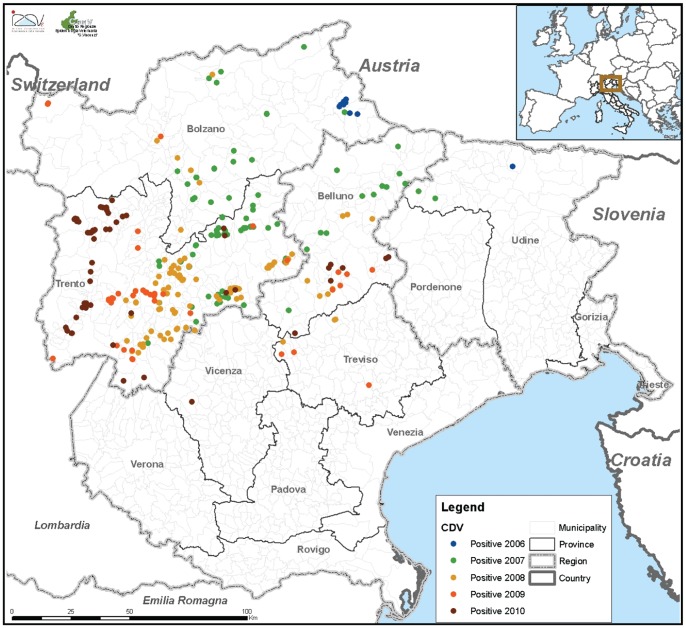
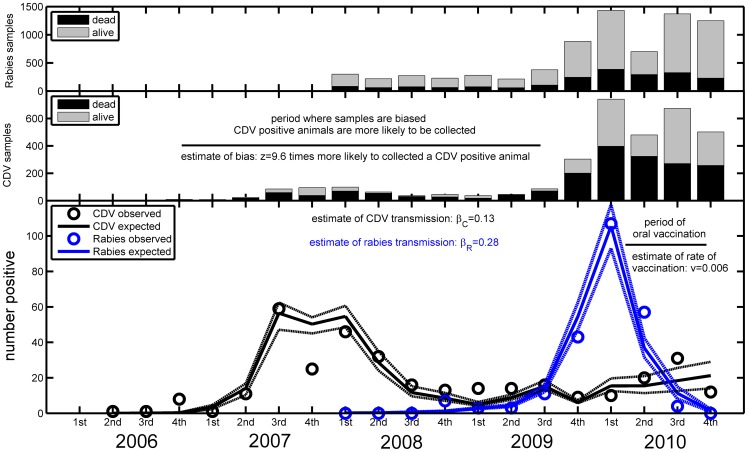
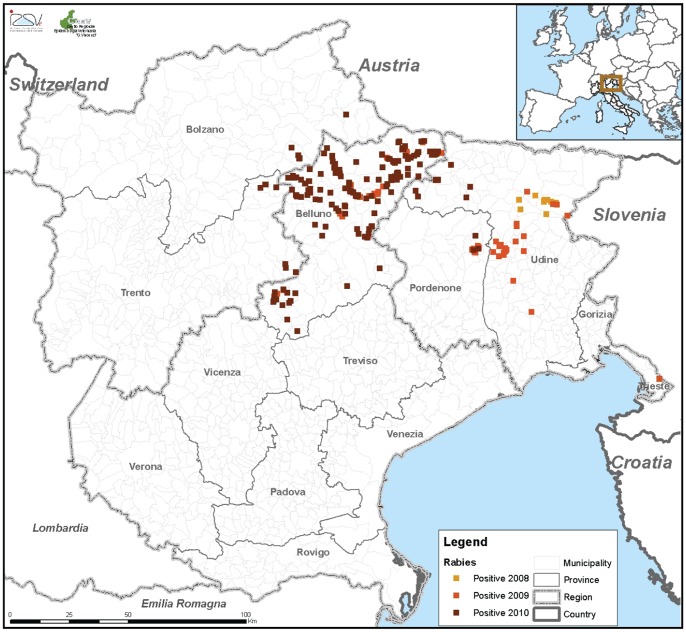
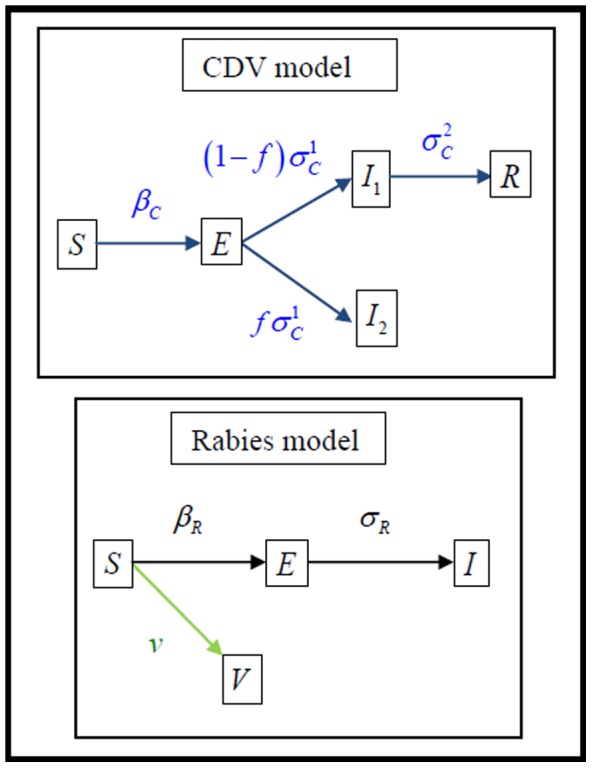
Since 2006 the red fox (Vulpes vulpes) population in north-eastern Italy has experienced an epidemic of canine distemper virus (CDV). Additionally, in 2008, after a thirteen-year absence from Italy, fox rabies was re-introduced in the Udine province at the national border with Slovenia. Disease intervention strategies are being developed and implemented to control rabies in this area and minimise risk to human health. Here we present empirical data and the epidemiological picture relating to these epidemics in the period 2006-2010. Of important significance for epidemiological studies of wild animals, basic mathematical models are developed to exploit information collected from the surveillance program on dead and/or living animals in order to assess the incidence of infection. These models are also used to estimate the rate of transmission of both diseases and the rate of vaccination, while correcting for a bias in early collection of CDV samples. We found that the rate of rabies transmission was roughly twice that of CDV, with an estimated effective contact between infected and susceptible fox leading to a new infection occurring once every 3 days for rabies, and once a week for CDV. We also inferred that during the early stage of the CDV epidemic, a bias in the monitoring protocol resulted in a positive sample being almost 10 times more likely to be collected than a negative sample. We estimated the rate of intake of oral vaccine at 0.006 per day, allowing us to estimate that roughly 68% of the foxes would be immunised. This was confirmed by field observations. Finally we discuss the implications for the eco-epidemiological dynamics of both epidemics in relation to control measures.
自 2006 年以来,意大利东北部的红狐(Vulpes vulpes)种群经历了犬瘟热病毒(CDV)的流行。此外,2008 年,在意大利十三年未出现狐狸狂犬病后,这种疾病在与斯洛文尼亚接壤的乌迪内省重新出现。目前正在制定和实施疾病干预策略,以控制该地区的狂犬病并将对人类健康的风险降至最低。在这里,我们展示了 2006 年至 2010 年期间与这些流行病相关的经验数据和流行病学图片。对于野生动物的流行病学研究来说,基本的数学模型非常重要,这些模型用于利用从对死亡和/或存活动物的监测计划中收集到的信息,以评估感染的发生率。这些模型还用于估计两种疾病的传播率和疫苗接种率,同时纠正 CDV 样本早期收集的偏差。我们发现,狂犬病的传播速度大约是 CDV 的两倍,估计感染和易感狐狸之间的有效接触导致新的感染每三天发生一次,而 CDV 则每周发生一次。我们还推断,在 CDV 流行的早期阶段,监测方案中的偏差导致阳性样本的采集率几乎是阴性样本的 10 倍。我们估计口服疫苗的摄取率为每天 0.006,这使我们能够估计大约 68%的狐狸将被免疫。这一点得到了实地观察的证实。最后,我们讨论了这两种流行病的生态流行病学动态对控制措施的影响。