Faculty of Physical Education and Recreation, University of Alberta, Edmonton, Alberta, Canada.
PLoS One. 2013 Apr 22;8(4):e61894. doi: 10.1371/journal.pone.0061894. Print 2013.
To examine the effects of reading exercise-related magazine articles (health, appearance, or control) and the moderating effects of exercise self-identity on reasons for exercise and perceptions of attractiveness, among women in first year university. An additional purpose was to use a thought listing technique, the results of which were examined for evidence of internalization of the exercise-related messages.
Female students in their first year of studies between September 2010 and April 2011 (N = 173; mean age = 19.31 years, mean body mass index = 22.01).
Participants read a health, appearance, or control article, listed thoughts, and completed questionnaires measuring reasons for exercising, physical self-perception, and exercise self-identity.
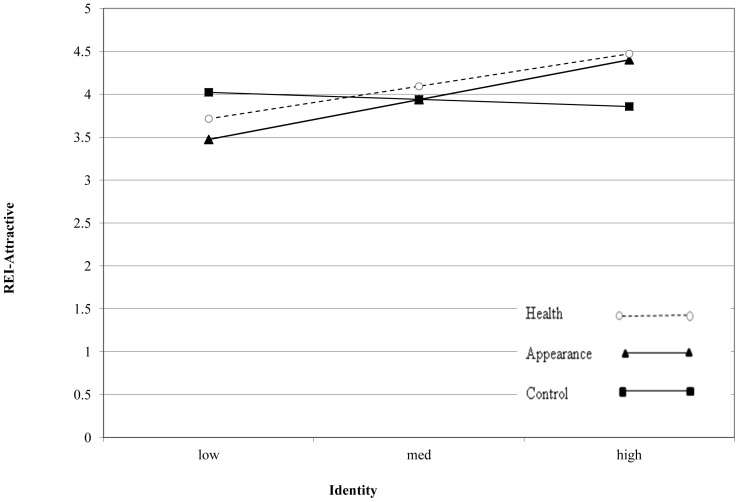
Participants in the health condition rated exercise for health significantly higher than control condition participants. Participants with high exercise self-identity rated attractiveness as a reason for exercising significantly higher than low exercise self-identity participants in both the health and appearance conditions. Participants with higher internalization scores (i.e., accepted societal norms of appearance) reported exercising for attractiveness reasons more so than participants with lower internalization scores.
The good news is that health messages may be influential and result in wanting to exercise for health purposes. However, exercising for attractiveness was rated highly by participants with high exercise identity who read either the health or appearance articles. Health and appearance are not necessarily distinct concepts for female undergraduate students and the media may influence cited reasons for exercise.
研究阅读与运动相关的杂志文章(健康、外貌或控制)对女性大一学生运动原因和吸引力感知的影响,以及运动自我认同的调节作用。另一个目的是使用思维列表技术,检查其结果是否有运动相关信息内化的证据。
2010 年 9 月至 2011 年 4 月期间的大一女学生(N=173;平均年龄 19.31 岁,平均体重指数 22.01)。
参与者阅读健康、外貌或控制文章,列出想法,并完成测量运动原因、身体自我感知和运动自我认同的问卷。
健康条件下的参与者将运动归因于健康的比例显著高于控制条件下的参与者。在健康和外貌条件下,具有高运动自我认同的参与者将吸引力作为运动的原因的评分显著高于低运动自我认同的参与者。内化得分较高(即接受社会外貌规范)的参与者比内化得分较低的参与者更倾向于因吸引力原因而锻炼。
好消息是,健康信息可能具有影响力,并促使人们出于健康目的进行锻炼。然而,具有高运动身份认同的参与者无论阅读健康或外貌文章,都将为了吸引力而运动评为重要原因。健康和外貌对于女性本科生来说并非截然不同的概念,媒体可能会影响锻炼的原因。