Laboratory for Applied Cancer Research, Tel Aviv Sourasky Medical Center, Sackler Faculty of Medicine, Tel Aviv University,Tel Aviv, Israel.
Cancer Med. 2013 Apr;2(2):155-63. doi: 10.1002/cam4.45. Epub 2013 Mar 11.
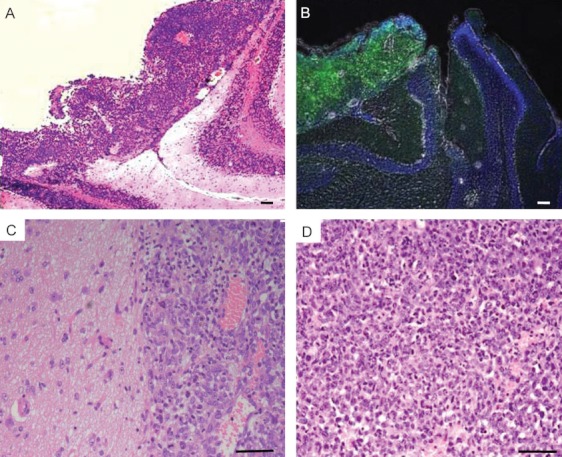
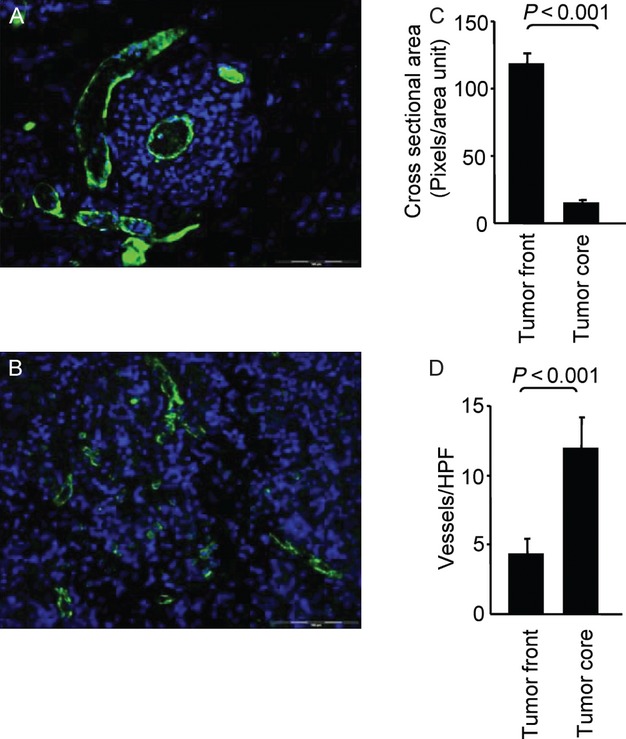
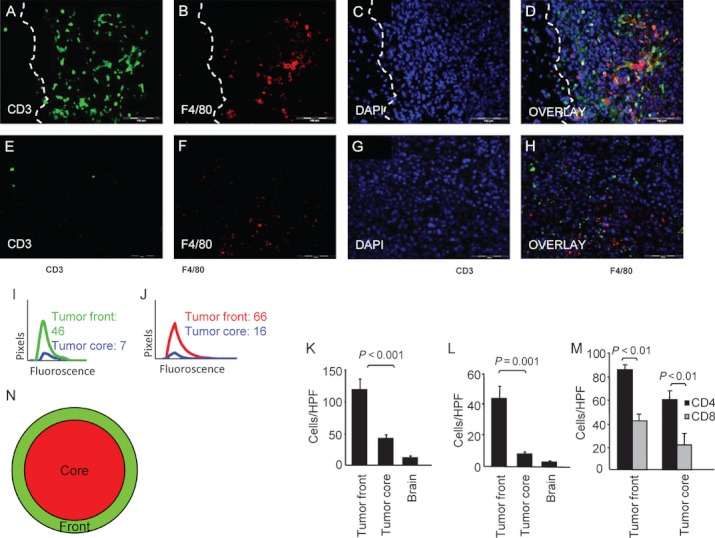
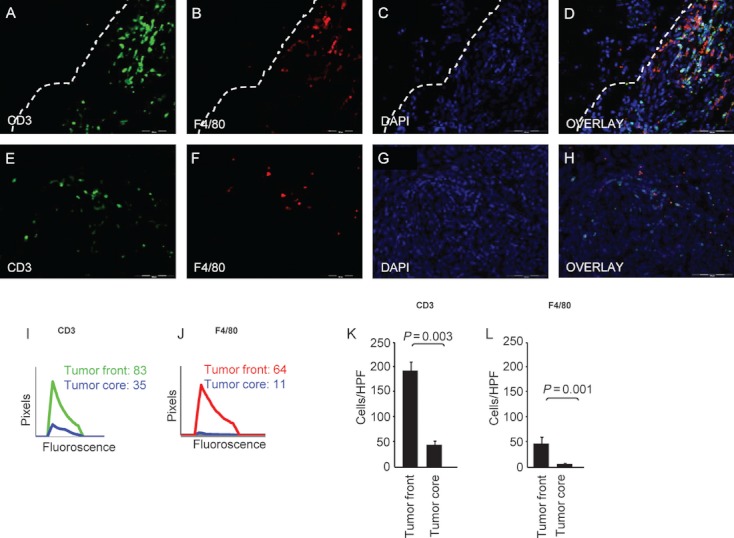
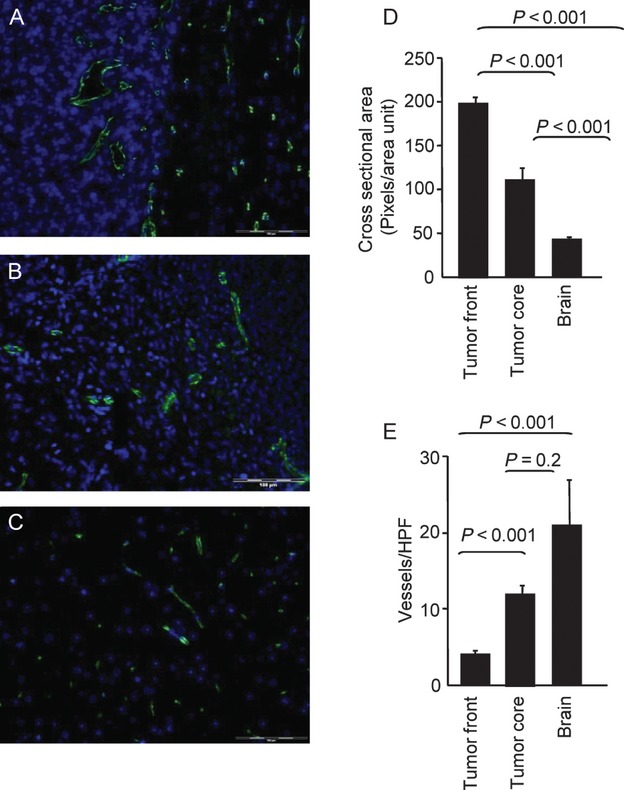
Brain metastases occur in 15% of patients with melanoma and are associated with a dismal prognosis. Here, we investigate the architectural phenotype and stromal reaction of melanoma brain metastasis in mice and humans. A syngeneic, green fluorescence protein (GFP)-expressing murine B16-F1 melanoma clone was introduced via intracardiac injection, and was examined in vivo in comparison with human specimens. Immunofluorescence analyses of the brain metastases revealed that F4/80(+) macrophages/microglia were most abundant at the tumor front, but rare in its core, where they were found only around blood vessels (P = 0.01). Similar pattern of infiltration was found in CD3(+) T cells (P < 0.01). Infiltrating T cells were prominently CD4(+) compared with CD8(+) T cells (P < 0.001). Blood vessels (CD31(+)) were less abundant at the tumor front than in its center (12 ± 1 vs. 4 ± 0.6 vessels per high-power field [HPF], P < 0.001). In contrast, there were few vessels at the tumor front, but their diameter was significantly larger at the front (8236 μm(2) vs. 4617 μm(2) average cross-sectional area, P < 0.005). This is the first comparative analysis of melanoma brain metastases showing similar stromal reaction in murine models and human specimens. Our results validate the utility of this murine model of melanoma brain metastases for investigating the mechanism of the human disease.
脑转移发生于 15%的黑色素瘤患者中,与预后不良有关。在此,我们研究了小鼠和人类黑色素瘤脑转移的结构表型和基质反应。通过心内注射,引入了同源 GFP 表达的 B16-F1 黑色素瘤克隆,并与人类标本进行了体内比较。对脑转移瘤的免疫荧光分析表明,F4/80(+)巨噬细胞/小胶质细胞在肿瘤前缘最为丰富,但在其核心中却很少见,仅在血管周围发现(P=0.01)。在 CD3(+)T 细胞中也发现了类似的浸润模式(P<0.01)。浸润的 T 细胞明显以 CD4(+)为主,而不是 CD8(+)T 细胞(P<0.001)。肿瘤前缘的血管(CD31(+))比中心(12±1 比 4±0.6 个血管/高倍视野 [HPF],P<0.001)少。相比之下,肿瘤前缘的血管较少,但它们的直径在前缘明显较大(8236μm(2)比 4617μm(2)平均截面积,P<0.005)。这是首次对黑色素瘤脑转移进行比较分析,显示在小鼠模型和人类标本中存在相似的基质反应。我们的结果验证了这种黑色素瘤脑转移的小鼠模型用于研究人类疾病机制的效用。