Department of Ophthalmology, Faculty of Medicine, University Duisburg-Essen Essen, Germany.
Cancer Med. 2013 Apr;2(2):208-15. doi: 10.1002/cam4.61. Epub 2013 Feb 14.
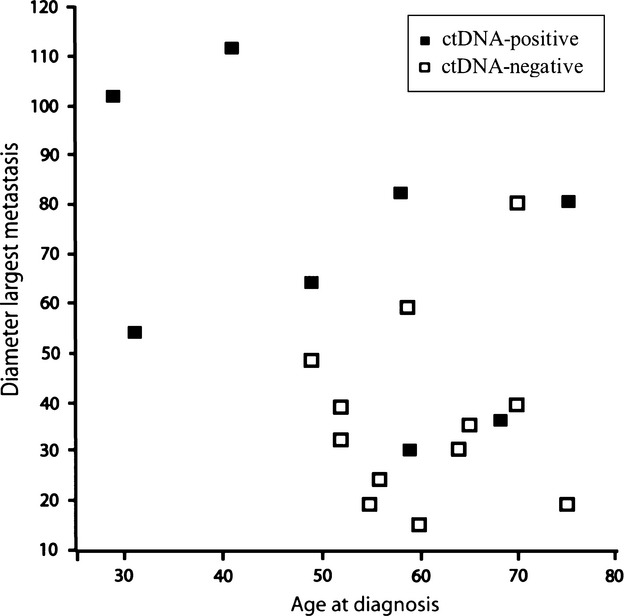
Elevated levels of cell-free DNA (cfDNA) are frequently observed in tumor patients. Activating mutations in exon 4 (R183) and exon 5 (Q209) of GNAQ and GNA 11 are almost exclusively found in uveal melanoma, thus providing a highly specific marker for the presence of circulating tumor DNA (ctDNA). To establish a reliable, noninvasive assay that might allow early detection and monitoring of metastatic disease, we determined the proportion of GNAQ or GNA 11 mutant reads in cfDNA of uveal melanoma patients by ultradeep sequencing. Cell-free DNA from 28 uveal melanoma patients with metastases or extraocular growth was isolated and quantified by real-time polymerase chain reaction (PCR) (7-1550 ng DNA/mL plasma). GNAQ and GNA 11 regions of interest were amplified in 22 of 28 patients and ultradeep sequencing of amplicons was performed to detect even low proportions of mutant reads. We detected Q209 mutations (2-38% mutant reads) in either GNAQ or GNA 11 in the plasma of 9 of 22 metastasized patients. No correlation between the proportion of mutant reads and the concentration of cfDNA could be detected. Among the nine ctDNA-positive patients, four had metastases in bone, whereas no metastases were detected in the 13 ctDNA-negative patients at this location (P = 0.025). Furthermore, ctDNA-positive patients tended to be younger at initial diagnosis and show larger metastases. The results show that ultradeep amplicon sequencing can be used to detect tumor DNA in plasma of metastasized uveal melanoma patients. It remains to be shown if this approach can be used for early detection of disseminated tumor disease.
肿瘤患者的循环游离 DNA(cfDNA)水平常常升高。GNAQ 和 GNA 11 的外显子 4(R183)和外显子 5(Q209)的激活突变几乎仅存在于葡萄膜黑素瘤中,因此为循环肿瘤 DNA(ctDNA)的存在提供了高度特异性的标志物。为了建立一种可靠的、非侵入性的检测方法,以实现转移性疾病的早期检测和监测,我们通过超深度测序来确定 cfDNA 中 GNAQ 或 GNA 11 突变体读数的比例。通过实时聚合酶链反应(PCR)(7-1550ngDNA/mL 血浆)从 28 例有转移或眼外生长的葡萄膜黑素瘤患者中分离和定量细胞游离 DNA。在 28 例患者中的 22 例中扩增了 GNAQ 和 GNA 11 感兴趣区域,并对扩增子进行了超深度测序,以检测甚至低比例的突变体读数。我们在 9 例转移性患者的血浆中检测到 GNAQ 或 GNA 11 的 Q209 突变(2-38%的突变体读数)。未检测到突变体读数比例与 cfDNA 浓度之间的相关性。在 9 例 ctDNA 阳性患者中,有 4 例在骨中有转移,而在 13 例 ctDNA 阴性患者中未在此部位检测到转移(P=0.025)。此外,ctDNA 阳性患者在初始诊断时往往更年轻,并且表现出更大的转移。结果表明,超深度扩增子测序可用于检测转移性葡萄膜黑素瘤患者血浆中的肿瘤 DNA。尚需进一步研究该方法是否可用于早期检测播散性肿瘤疾病。