López-Rocha Estela, Juárez-Álvarez Julio, Riego-Ruiz Lina, Enciso-Moreno Leonor, Ortega-Aguilar Francisco, Hernández-Nieto Julián, Enciso-Moreno José A, López-Revilla Rubén
División de Biología Molecular, Instituto Potosino de Investigación Científica y Tecnológica, Camino a la Presa San José 2055, 78216 San Luis Potosí, SLP, Mexico.
BMC Res Notes. 2013 May 1;6:172. doi: 10.1186/1756-0500-6-172.
Although epidemiologic and socioeconomic criteria and biomedical risk factors indicate high-priority for tuberculosis (TB) control in Mexico, molecular epidemiology studies of the disease in the country are scarce.
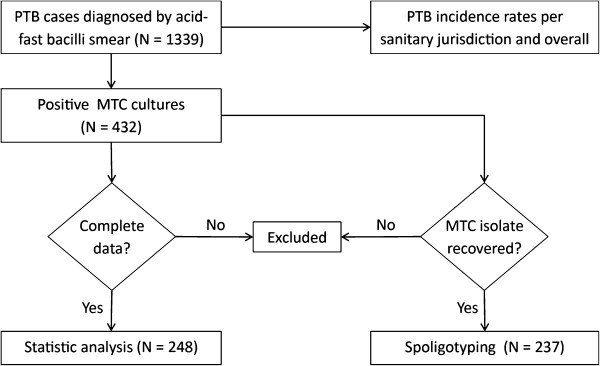
Complete sociodemographic and clinical data were obtained from 248 of the 432 pulmonary TB (PTB) cases confirmed from 2006 to 2010 on the population under epidemiological surveillance in the state of San Luis Potosí, México. From most PTB cases with complete data Mycobacterium tuberculosis complex (MTC) isolates were recovered and their spoligotypes, lineages and families, geographic distribution and drug resistance determined.
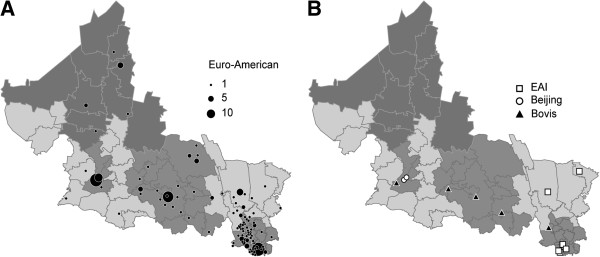
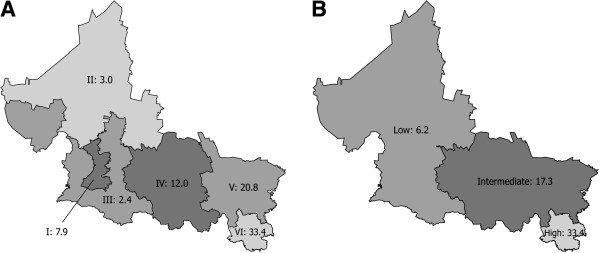
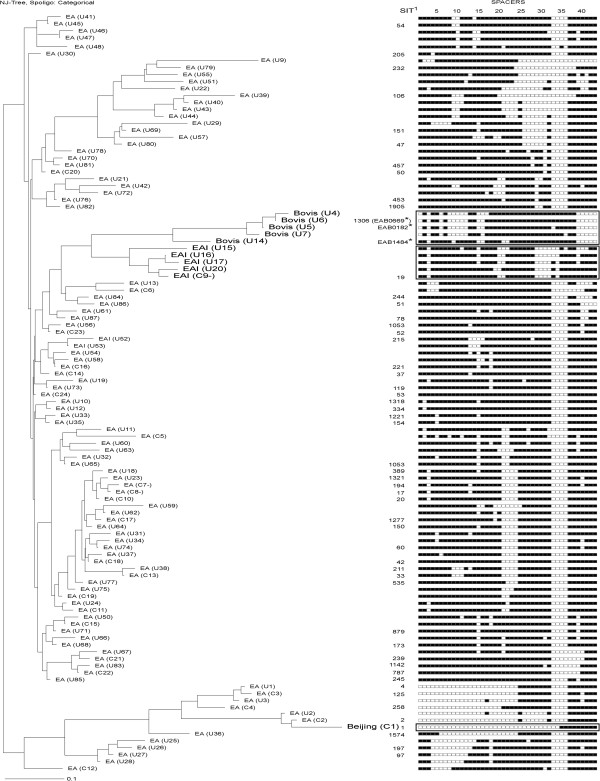
Pulmonary tuberculosis incidence ranged from 2.4 to 33.4 (cases per 100,000 inhabitants) in the six state sanitary jurisdictions that were grouped in regions of low (jurisdictions I-II-III), intermediate (jurisdictions IV-V) and high incidence (jurisdiction VI) with 6.2, 17.3 and 33.4 rates, respectively. Most patients were poor, 50-years-median-age males and housewives. Among the 237 MTC spoligotyped isolates, 232 corresponded to M. tuberculosis (104 spoligotypes in 24 clusters) and five to M. bovis. The predominant Euro-American lineage was distributed all over the state, the East-Asian lineage (Beijing family) in the capital city, the Indo-Oceanic (Manila family) in eastern localities, and M. bovis in rural localities.
In San Luis Potosí TB affects mainly poor male adults and is caused by M. tuberculosis and to a minor extent by M. bovis. There is great genotypic diversity among M. tuberculosis strains, the Euro-American lineage being much more prevalent than the Indo-Oceanic and East-Asian lineages. The frequency of resistant strains is relatively low and not associated to any particular lineage.
尽管流行病学和社会经济标准以及生物医学风险因素表明墨西哥的结核病(TB)控制具有高度优先性,但该国关于该疾病的分子流行病学研究却很匮乏。
从2006年至2010年在墨西哥圣路易斯波托西州接受流行病学监测的人群中确诊的432例肺结核(PTB)病例中,选取248例获取了完整的社会人口统计学和临床数据。从大多数具有完整数据的PTB病例中分离出结核分枝杆菌复合群(MTC)菌株,并确定其 spoligotypes、谱系和家族、地理分布以及耐药性。
在分为低发病率(辖区I - II - III)、中等发病率(辖区IV - V)和高发病率(辖区VI)三个区域的六个州卫生辖区中,肺结核发病率在2.4至33.4(每10万居民中的病例数)之间,发病率分别为6.2、17.3和33.4。大多数患者为贫困人群,中位年龄为50岁的男性和家庭主妇。在237株进行spoligotyping分型的MTC菌株中,232株对应结核分枝杆菌(24个簇中有104种spoligotypes),5株对应牛分枝杆菌。主要的欧美谱系分布于全州,东亚谱系(北京家族)分布在首府城市,印度洋谱系(马尼拉家族)分布在东部地区,牛分枝杆菌分布在农村地区。
在圣路易斯波托西州,结核病主要影响贫困成年男性,由结核分枝杆菌引起,牛分枝杆菌引起的比例较小。结核分枝杆菌菌株之间存在很大的基因型多样性,欧美谱系比印度洋和东亚谱系更为普遍。耐药菌株的频率相对较低,且与任何特定谱系无关。