Trimbos Institute, Netherlands Institute of Mental Health and Addiction, Utrecht ; Tranzo Department, Tilburg University, Tilburg.
Neuropsychiatr Dis Treat. 2013;9:529-37. doi: 10.2147/NDT.S43969. Epub 2013 Apr 22.
Common mental disorders (CMD) have a major impact on both society and individual workers, so return to work (RTW) is an important issue. In The Netherlands, the occupational physician plays a central role in the guidance of sick-listed workers with respect to RTW. Evidence-based guidelines are available, but seem not to be effective in improving RTW in people with CMD. An intervention supporting the occupational physician in guidance of sick-listed workers combined with specific guidance regarding RTW is needed. A blended E-health module embedded in collaborative occupational health care is now available, and comprises a decision aid supporting the occupational physician and an E-health module, Return@Work, to support sick-listed workers in the RTW process. The cost-effectiveness of this intervention will be evaluated in this study and compared with that of care as usual.
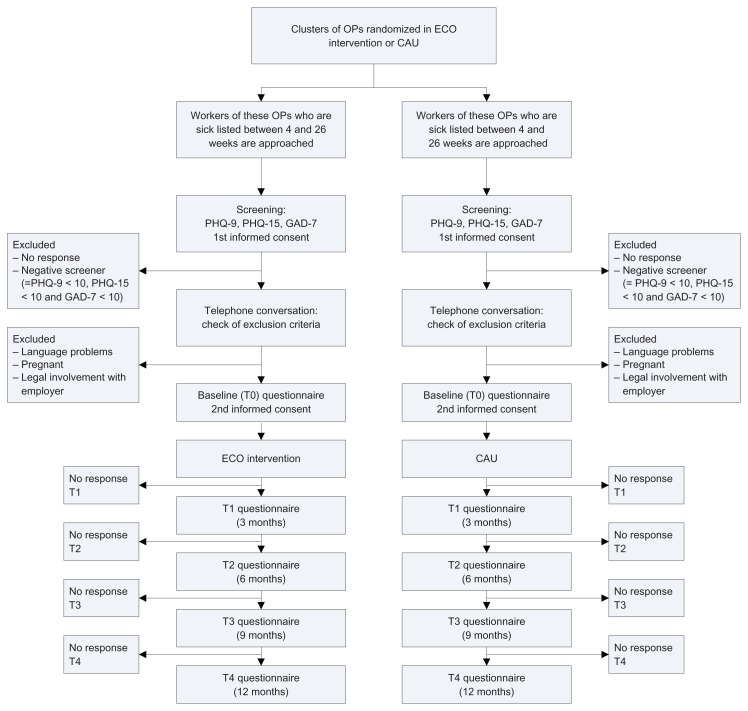
This study is a two-armed cluster randomized controlled trial, with randomization done at the level of occupational physicians. Two hundred workers with CMD on sickness absence for 4-26 weeks will be included in the study. Workers whose occupational physician is allocated to the intervention group will receive the collaborative occupational health care intervention. Occupational physicians allocated to the care as usual group will give conventional sickness guidance. Follow-up assessments will be done at 3, 6, 9, and 12 months after baseline. The primary outcome is duration until RTW. The secondary outcome is severity of symptoms of CMD. An economic evaluation will be performed as part of this trial.
It is hypothesized that collaborative occupational health care intervention will be more (cost)-effective than care as usual. This intervention is innovative in its combination of a decision aid by email sent to the occupational physician and an E-health module aimed at RTW for the sick-listed worker.
常见精神障碍(CMD)对社会和个体劳动者都有重大影响,因此重返工作岗位(RTW)是一个重要问题。在荷兰,职业医生在指导因 CMD 而请病假的劳动者重返工作岗位方面发挥着核心作用。现已有循证指南,但似乎并未有效提高 CMD 患者的 RTW 率。需要一种干预措施来支持职业医生指导请病假的劳动者,并提供有关 RTW 的具体指导。一种嵌入协作式职业健康护理的混合电子健康模块现已推出,其中包括支持职业医生的决策辅助工具和一个电子健康模块“Return@Work”,以支持请病假的劳动者进行 RTW 过程。本研究将评估该干预措施的成本效益,并将其与常规护理进行比较。
这是一项两臂集群随机对照试验,在职业医生层面进行随机分组。将纳入 200 名因 CMD 而缺勤 4-26 周的劳动者。被分配到干预组的职业医生将接受协作式职业健康护理干预。被分配到常规护理组的职业医生将提供常规病假指导。基线后 3、6、9 和 12 个月将进行随访评估。主要结局是 RTW 前的时间。次要结局是 CMD 症状的严重程度。作为本试验的一部分,将进行经济评估。
假设协作式职业健康护理干预将比常规护理更具(成本)效益。这种干预措施的创新性在于,它将电子邮件发送给职业医生的决策辅助工具与旨在帮助请病假的劳动者重返工作岗位的电子健康模块相结合。