The First Clinical College of Nanjing Medical University, Nanjing, China.
PLoS One. 2013 Apr 24;8(4):e62181. doi: 10.1371/journal.pone.0062181. Print 2013.
Genetic variation in glutathione S-transferases (GSTs) may contribute to lung cancer risk. Many studies have investigated the correlation between the Glutathione S-transferase T1 (GSTT1) null genotype and lung cancer risk in Asian population but yielded inconclusive results.
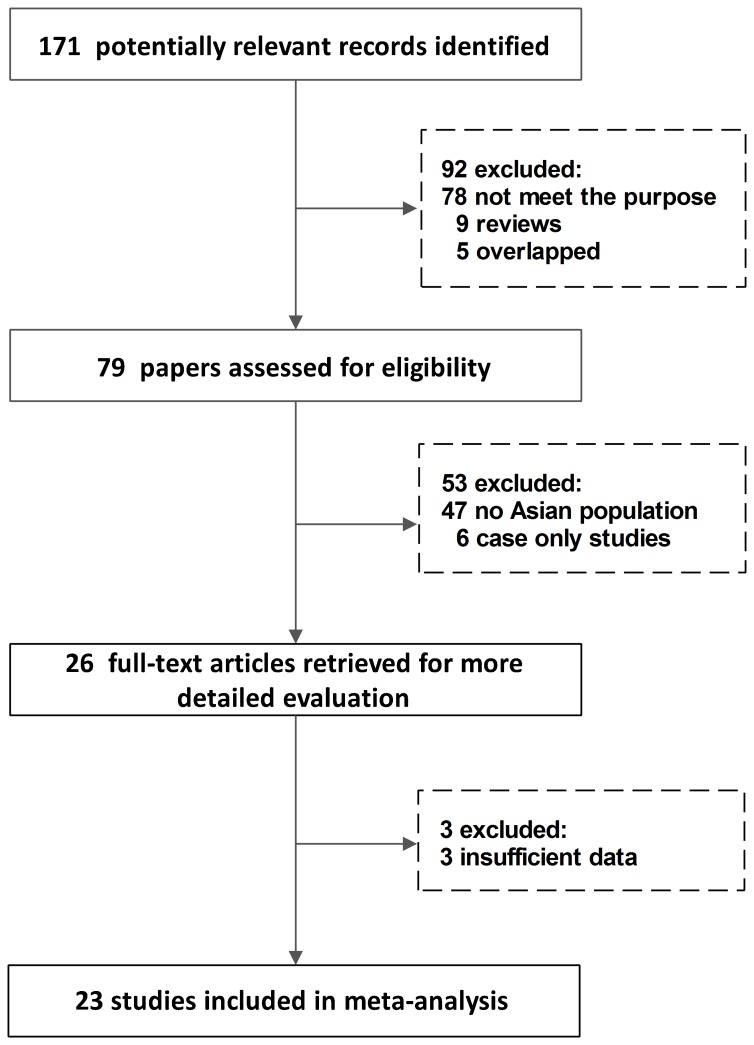
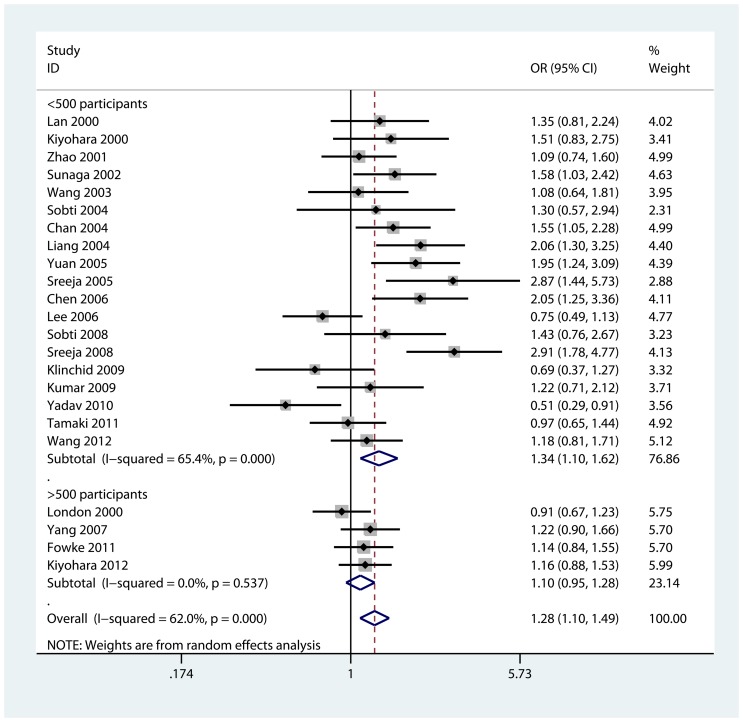
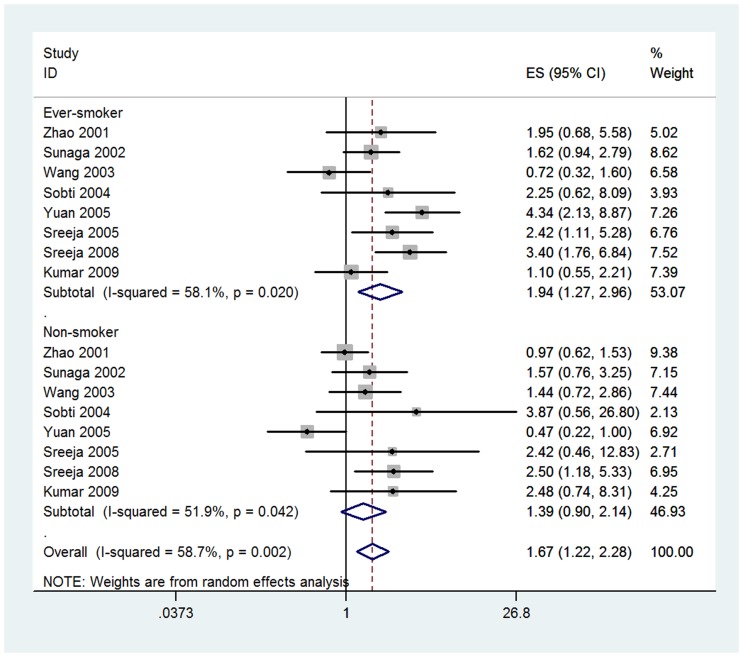
METHODOLOGY/PRINCIPAL FINDINGS: We performed a meta-analysis of 23 studies including 4065 cases and 5390 controls. We assessed the strength of the association of GSTT1 with lung cancer risk and performed sub-group analyses by source of controls, smoking status, histological types, and sample size. A statistically significant correlation between GSTT1 null genotype and lung cancer in Asian population was observed (OR = 1.28, 95% CI = 1.10, 1.49; Pheterogeneity<0.001 and I(2) = 62.0%). Sub-group analysis revealed there was a statistically increased lung cancer risk in ever-smokers who carried the GSTT1 null genotype (OR = 1.94, 95% CI = 1.27, 2.96; P heterogeneity = 0.02 and I(2) = 58.1%). It was also indicated that GSTT1 null genotype could increase lung cancer risk among population-based studies (OR = 1.25, 95% CI = 1.04, 1.50; Pheterogeneity = 0.003 and I(2) = 56.8%). The positive association was also found in studies of sample size (≤500 participants) (OR = 1.34, 95% CI = 1.10, 1.62; Pheterogeneity<0.001 and I(2) = 65.4%).
These meta-analysis results suggest that GSTT1 null genotype is associated with a significantly increased risk of lung cancer in Asian population.
谷胱甘肽 S-转移酶(GSTs)的遗传变异可能导致肺癌风险增加。许多研究已经调查了谷胱甘肽 S-转移酶 T1(GSTT1)无效基因型与亚洲人群肺癌风险之间的相关性,但结果尚无定论。
方法/主要发现:我们对包括 4065 例病例和 5390 例对照的 23 项研究进行了荟萃分析。我们评估了 GSTT1 与肺癌风险的关联强度,并按对照来源、吸烟状况、组织学类型和样本量进行了亚组分析。在亚洲人群中,观察到 GSTT1 无效基因型与肺癌之间存在统计学显著相关性(OR=1.28,95%CI=1.10,1.49;P 异质性<0.001,I(2)=62.0%)。亚组分析显示,携带 GSTT1 无效基因型的既往吸烟者肺癌发病风险呈统计学增加(OR=1.94,95%CI=1.27,2.96;P 异质性=0.02,I(2)=58.1%)。还表明,GSTT1 无效基因型可能会增加基于人群的研究中的肺癌风险(OR=1.25,95%CI=1.04,1.50;P 异质性=0.003,I(2)=56.8%)。在样本量(≤500 名参与者)的研究中也发现了阳性关联(OR=1.34,95%CI=1.10,1.62;P 异质性<0.001,I(2)=65.4%)。
这些荟萃分析结果表明,GSTT1 无效基因型与亚洲人群肺癌风险显著增加相关。