Center for Limnology, University of Wisconsin, Madison, Wisconsin, United States of America.
PLoS One. 2013 Apr 26;8(4):e62279. doi: 10.1371/journal.pone.0062279. Print 2013.
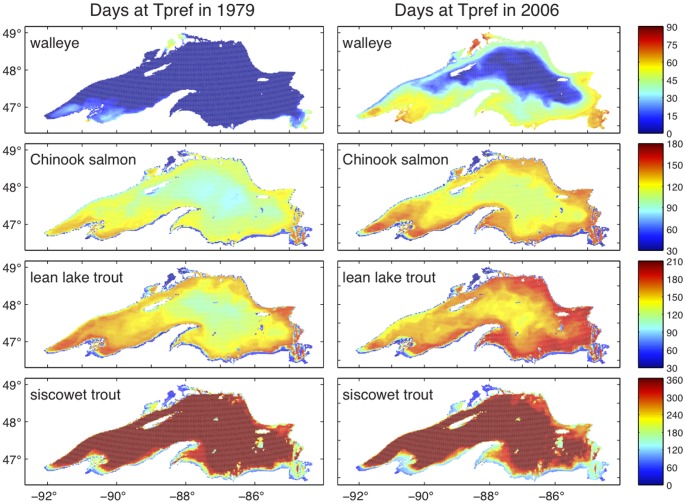
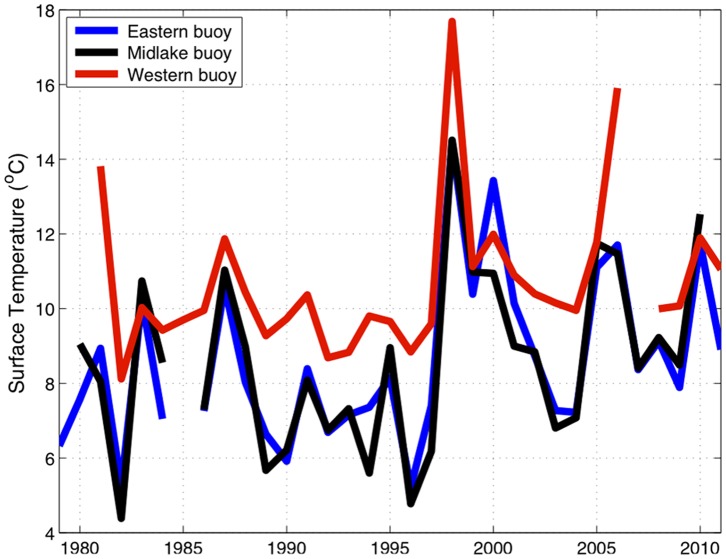
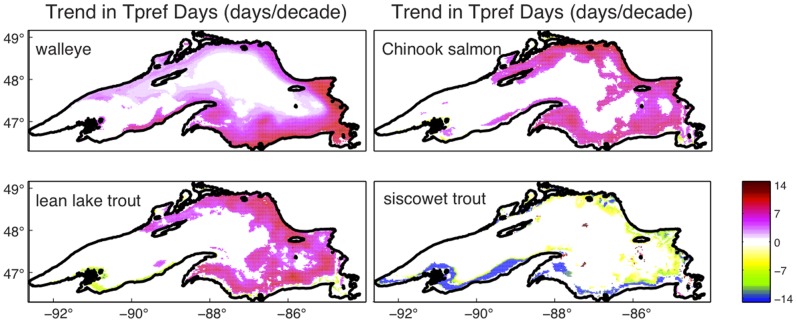
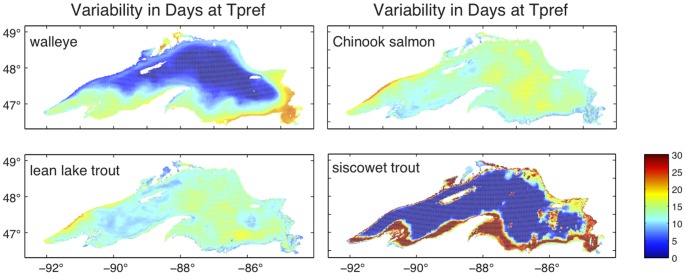
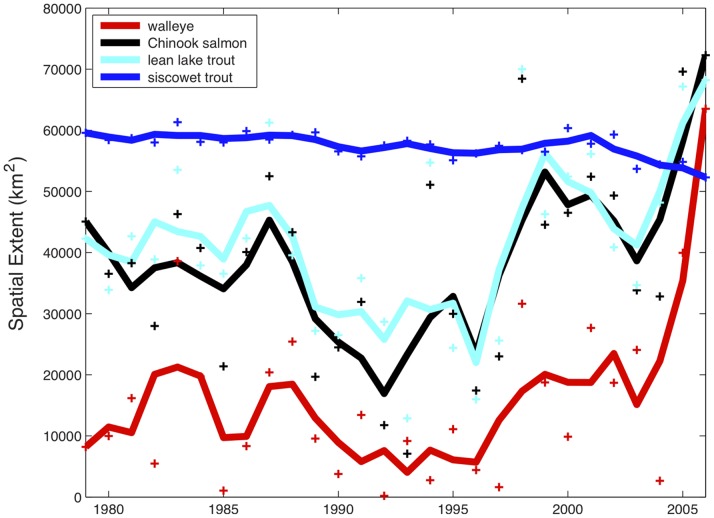
Climate change is expected to alter species distributions and habitat suitability across the globe. Understanding these shifting distributions is critical for adaptive resource management. The role of temperature in fish habitat and energetics is well established and can be used to evaluate climate change effects on habitat distributions and food web interactions. Lake Superior water temperatures are rising rapidly in response to climate change and this is likely influencing species distributions and interactions. We use a three-dimensional hydrodynamic model that captures temperature changes in Lake Superior over the last 3 decades to investigate shifts in habitat size and duration of preferred temperatures for four different fishes. We evaluated habitat changes in two native lake trout (Salvelinus namaycush) ecotypes, siscowet and lean lake trout, Chinook salmon (Oncorhynchus tshawytscha), and walleye (Sander vitreus). Between 1979 and 2006, days with available preferred thermal habitat increased at a mean rate of 6, 7, and 5 days per decade for lean lake trout, Chinook salmon, and walleye, respectively. Siscowet lake trout lost 3 days per decade. Consequently, preferred habitat spatial extents increased at a rate of 579, 495 and 419 km(2) per year for the lean lake trout, Chinook salmon, and walleye while siscowet lost 161 km(2) per year during the modeled period. Habitat increases could lead to increased growth and production for three of the four fishes. Consequently, greater habitat overlap may intensify interguild competition and food web interactions. Loss of cold-water habitat for siscowet, having the coldest thermal preference, could forecast potential changes from continued warming. Additionally, continued warming may render more suitable conditions for some invasive species.
气候变化预计将改变全球各地的物种分布和栖息地适宜性。了解这些分布的变化对于适应性资源管理至关重要。温度在鱼类栖息地和能量学中的作用已经得到充分证实,可以用来评估气候变化对栖息地分布和食物网相互作用的影响。苏必利尔湖的水温因气候变化而迅速上升,这可能正在影响物种分布和相互作用。我们使用三维水动力模型来捕捉苏必利尔湖过去 30 年来的温度变化,以研究四种不同鱼类的栖息地大小和适宜温度持续时间的变化。我们评估了两种本地湖鳟(Salvelinus namaycush)生态型、siscowet 和 lean 湖鳟、奇努克鲑(Oncorhynchus tshawytscha)和大眼鲷(Sander vitreus)的栖息地变化。在 1979 年至 2006 年期间,lean 湖鳟、奇努克鲑和大眼鲷分别有适宜热栖息地的天数以每年 6、7 和 5 天的平均速度增加。siscowet 湖鳟每年减少 3 天。因此,在模拟期间,lean 湖鳟、奇努克鲑和大眼鲷的适宜栖息地空间范围每年分别以 579、495 和 419 平方公里的速度增加,而 siscowet 每年减少 161 平方公里。栖息地的增加可能导致四种鱼类中的三种生长和产量增加。因此,更大的栖息地重叠可能会加剧 guild 间的竞争和食物网相互作用。siscowet 失去了冷水栖息地,其对温度的偏好最低,这可能预示着持续变暖带来的潜在变化。此外,持续变暖可能为一些入侵物种提供更适宜的条件。