School of Psychological Sciences, Tel Aviv University, Tel Aviv, Israel.
PLoS One. 2013 Apr 30;8(4):e62501. doi: 10.1371/journal.pone.0062501. Print 2013.
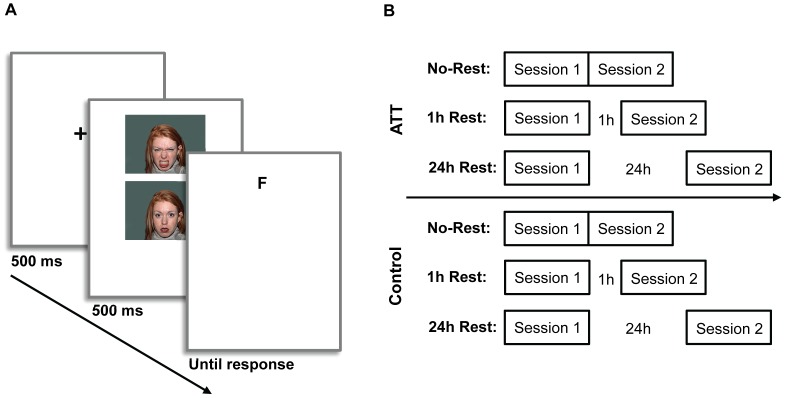
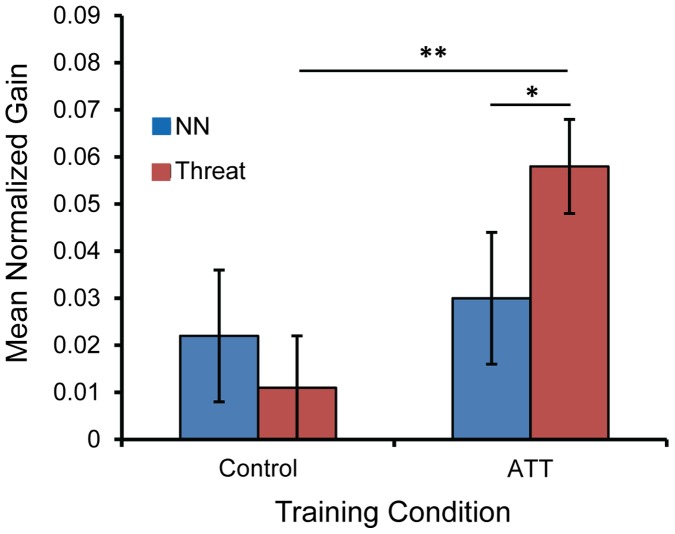
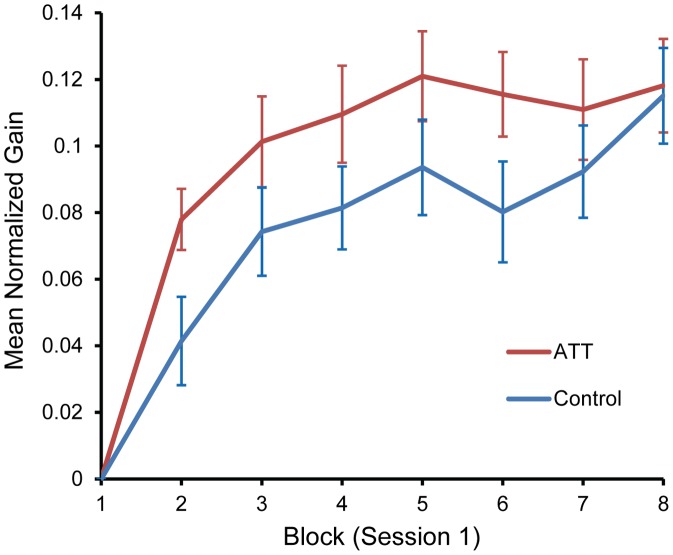
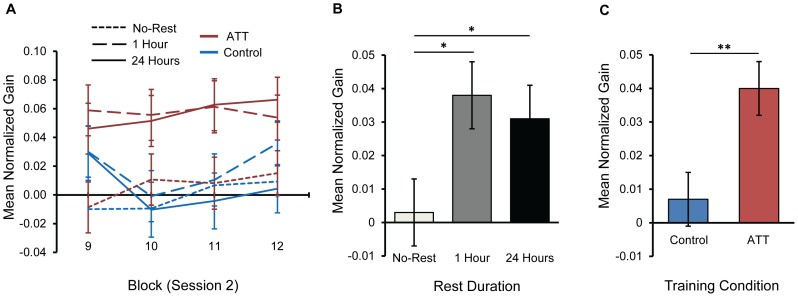
Practice on a procedural task involves within-session learning and between-session consolidation of learning, with the latter requiring a minimum of about four hours to evolve due to involvement of slower cellular processes. Learning to attend to threats is vital for survival and thus may involve faster memory consolidation than simple procedural learning. Here, we tested whether attention to threat modulates the time-course and magnitude of learning and memory consolidation effects associated with skill practice. All participants (N = 90) practiced in two sessions on a dot-probe task featuring pairs of neutral and angry faces followed by target probes which were to be discriminated as rapidly as possible. In the attend-threat training condition, targets always appeared at the angry face location, forming an association between threat and target location; target location was unrelated to valence in a control training condition. Within each attention training condition, duration of the between-session rest interval was varied to establish the time-course for emergence of consolidation effects. During the first practice session, we observed robust improvement in task performance (online, within-session gains), followed by saturation of learning. Both training conditions exhibited similar overall learning capacities, but performance in the attend-threat condition was characterized by a faster learning rate relative to control. Consistent with the memory consolidation hypothesis, between-session performance gains (delayed gains) were observed only following a rest interval. However, rest intervals of 1 and 24 hours yielded similar delayed gains, suggesting accelerated consolidation processes. Moreover, attend-threat training resulted in greater delayed gains compared to the control condition. Auxiliary analyses revealed that enhanced performance was retained over several months, and that training to attend to neutral faces resulted in effects similar to control. These results provide a novel demonstration of how attention to threat can accelerate and enhance memory consolidation effects associated with skill acquisition.
在程序性任务上进行练习涉及到会话内学习和会话间巩固学习,后者由于涉及到较慢的细胞过程,因此需要至少大约四个小时才能发展。学习注意威胁对于生存至关重要,因此可能涉及比简单程序性学习更快的记忆巩固。在这里,我们测试了注意力对威胁是否调节了与技能练习相关的学习和记忆巩固效果的时间进程和幅度。所有参与者(N=90)在两次会话中练习了一个点探测任务,该任务包括中性和愤怒面孔的对,然后是目标探针,要求尽可能快地进行区分。在关注威胁的训练条件下,目标总是出现在愤怒的面孔位置,在威胁和目标位置之间形成了关联;在对照训练条件下,目标位置与效价无关。在每个注意训练条件下,改变会话间休息间隔的持续时间,以确定巩固效果出现的时间进程。在第一次练习会话中,我们观察到任务表现(在线,会话内增益)有了显著的提高,随后学习达到饱和。两种训练条件都表现出相似的整体学习能力,但关注威胁条件的表现特征是相对于对照组具有更快的学习速度。与记忆巩固假说一致,只有在休息间隔之后才观察到会话间表现增益(延迟增益)。然而,1 小时和 24 小时的休息间隔产生了相似的延迟增益,表明巩固过程加速。此外,与对照组相比,关注威胁训练导致了更大的延迟增益。辅助分析表明,增强的表现可以保留几个月,并且针对中性面孔的训练导致了与对照组相似的效果。这些结果提供了一个新的证明,即注意威胁如何加速和增强与技能获取相关的记忆巩固效果。