Department of Microbiology, Immunology and Pathology, Colorado State University, Fort Collins, Colorado, United States of America.
PLoS Negl Trop Dis. 2013 Apr 18;7(4):e2175. doi: 10.1371/journal.pntd.0002175. Print 2013.
Aedes aegypti is the primary global vector to humans of yellow fever and dengue flaviviruses. Over the past 50 years, many population genetic studies have documented large genetic differences among global populations of this species. These studies initially used morphological polymorphisms, followed later by allozymes, and most recently various molecular genetic markers including microsatellites and mitochondrial markers. In particular, since 2000, fourteen publications and four unpublished datasets have used sequence data from the NADH dehydrogenase subunit 4 mitochondrial gene to compare Ae. aegypti collections and collectively 95 unique mtDNA haplotypes have been found. Phylogenetic analyses in these many studies consistently resolved two clades but no comprehensive study of mtDNA haplotypes have been made in Africa, the continent in which the species originated.
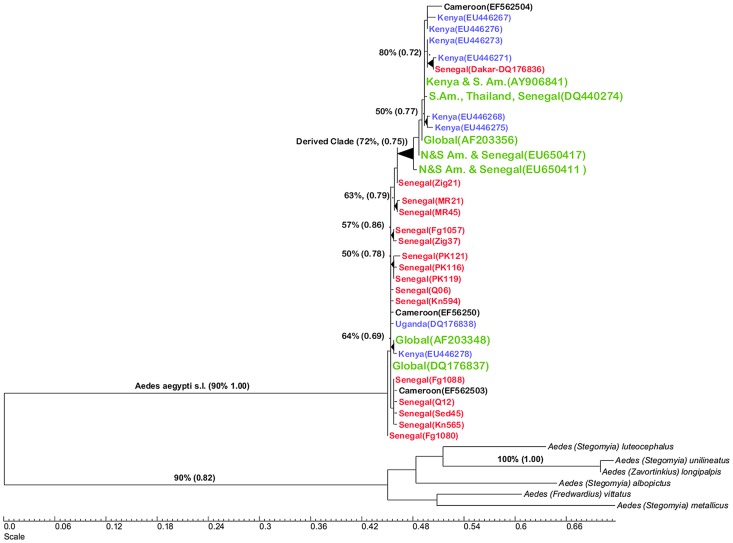
ND4 haplotypes were sequenced in 426 Ae. aegypti s.l. from Senegal, West Africa and Kenya, East Africa. In Senegal 15 and in Kenya 7 new haplotypes were discovered. When added to the 95 published haplotypes and including 6 African Aedes species as outgroups, phylogenetic analyses showed that all but one Senegal haplotype occurred in a basal clade while most East African haplotypes occurred in a second clade arising from the basal clade. Globally distributed haplotypes occurred in both clades demonstrating that populations outside Africa consist of mixtures of mosquitoes from both clades.
Populations of Ae. aegypti outside Africa consist of mosquitoes arising from one of two ancestral clades. One clade is basal and primarily associated with West Africa while the second arises from the first and contains primarily mosquitoes from East Africa.
埃及伊蚊是黄热病和登革热黄病毒向人类传播的主要全球媒介。在过去的 50 年中,许多种群遗传学研究记录了该物种在全球种群中的巨大遗传差异。这些研究最初使用形态多态性,随后是同工酶,最近则使用各种分子遗传标记,包括微卫星和线粒体标记。特别是自 2000 年以来,已有十四篇出版物和四份未发表的数据集使用来自 NADH 脱氢酶亚单位 4 线粒体基因的序列数据来比较埃及伊蚊种群,共发现了 95 个独特的 mtDNA 单倍型。在这些许多研究中,系统发育分析一致地解决了两个分支,但在该物种起源的非洲大陆上,尚未对 mtDNA 单倍型进行全面研究。
对来自塞内加尔(西非)和肯尼亚(东非)的 426 只埃及伊蚊 s.l.进行了 ND4 单倍型测序。在塞内加尔发现了 15 个新单倍型,在肯尼亚发现了 7 个新单倍型。当将这 95 个已发表的单倍型以及包括 6 种非洲伊蚊物种作为外群加入时,系统发育分析表明,除了一个塞内加尔单倍型外,所有单倍型都出现在一个基础分支中,而大多数东非单倍型则出现在一个从基础分支产生的第二个分支中。全球分布的单倍型出现在两个分支中,表明非洲以外的种群由来自两个分支的蚊子混合而成。
非洲以外的埃及伊蚊种群由来自两个祖先分支之一的蚊子组成。一个分支是基础的,主要与西非有关,而第二个分支则从第一个分支产生,主要包含来自东非的蚊子。