Division of Medical Information Sciences, University Hospitals of Geneva and University of Geneva, Geneva, Switzerland.
PLoS One. 2013 Apr 30;8(4):e62874. doi: 10.1371/journal.pone.0062874. Print 2013.
Improving antibiotic prescribing practices is an important public-health priority given the widespread antimicrobial resistance. Establishing clinical practice guidelines is crucial to this effort, but their development is a complex task and their quality is directly related to the methodology and source of knowledge used.
We present the design and the evaluation of a tool (KART) that aims to facilitate the creation and maintenance of clinical practice guidelines based on information retrieval techniques.
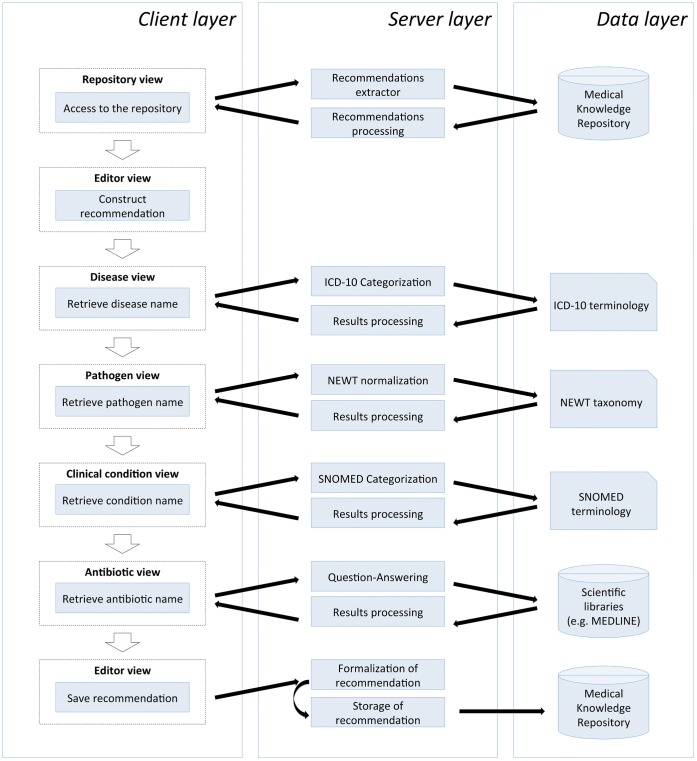
KART consists of three main modules 1) a literature-based medical knowledge extraction module, which is built upon a specialized question-answering engine; 2) a module to normalize clinical recommendations based on automatic text categorizers; and 3) a module to manage clinical knowledge, which formalizes and stores clinical recommendations for further use. The evaluation of the usability and utility of KART followed the methodology of the cognitive walkthrough.
KART was designed and implemented as a standalone web application. The quantitative evaluation of the medical knowledge extraction module showed that 53% of the clinical recommendations generated by KART are consistent with existing clinical guidelines. The user-based evaluation confirmed this result by showing that KART was able to find a relevant antibiotic for half of the clinical scenarios tested. The automatic normalization of the recommendation produced mixed results among end-users.
We have developed an innovative approach for the process of clinical guidelines development and maintenance in a context where available knowledge is increasing at a rate that cannot be sustained by humans. In contrast to existing knowledge authoring tools, KART not only provides assistance to normalize, formalize and store clinical recommendations, but also aims to facilitate knowledge building.
鉴于抗菌药物耐药性广泛存在,改善抗生素处方实践是一项重要的公共卫生重点。制定临床实践指南对于实现这一目标至关重要,但指南的制定是一项复杂的任务,其质量直接关系到所使用的方法和知识来源。
我们介绍了一种工具(KART)的设计和评估,该工具旨在通过信息检索技术来促进临床实践指南的创建和维护。
KART 由三个主要模块组成:1)基于文献的医学知识提取模块,它建立在专门的问答引擎之上;2)基于自动文本分类器对临床推荐进行规范化的模块;3)用于管理临床知识的模块,它将临床推荐形式化并存储以供进一步使用。KART 的可用性和实用性评估遵循认知走查方法。
KART 被设计并实现为一个独立的网络应用程序。对医学知识提取模块的定量评估表明,KART 生成的临床推荐中有 53%与现有的临床指南一致。基于用户的评估通过显示 KART 能够在测试的一半临床场景中找到相关的抗生素,证实了这一结果。推荐的自动规范化在最终用户中产生了混合的结果。
我们开发了一种创新的方法,用于在知识不断增加的情况下,进行临床指南的开发和维护。与现有的知识创作工具不同,KART 不仅提供了协助规范化、形式化和存储临床推荐的功能,还旨在促进知识构建。