Graduate Program in School of Rehabilitation Sciences, Faculty of Medicine, University of British Columbia Vancouver, BC, Canada.
Front Hum Neurosci. 2013 May 6;7:169. doi: 10.3389/fnhum.2013.00169. eCollection 2013.
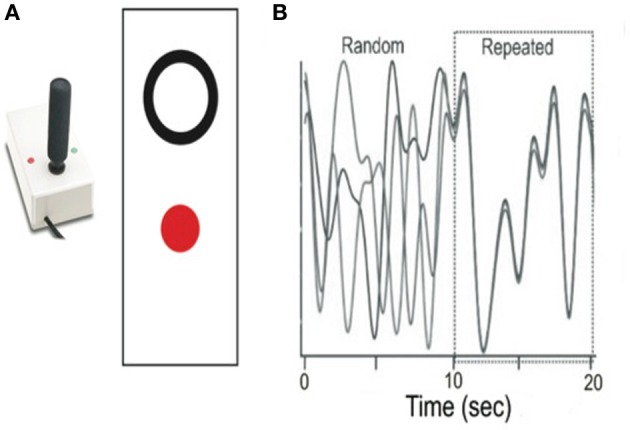
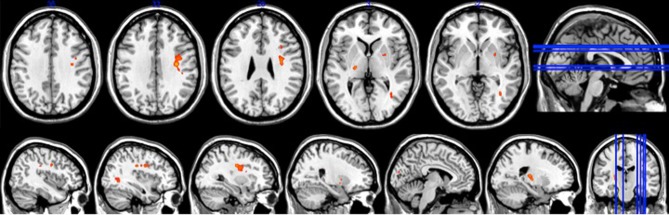
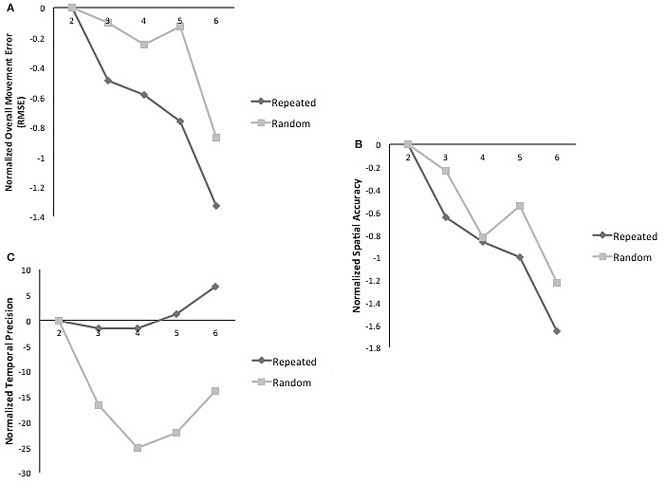
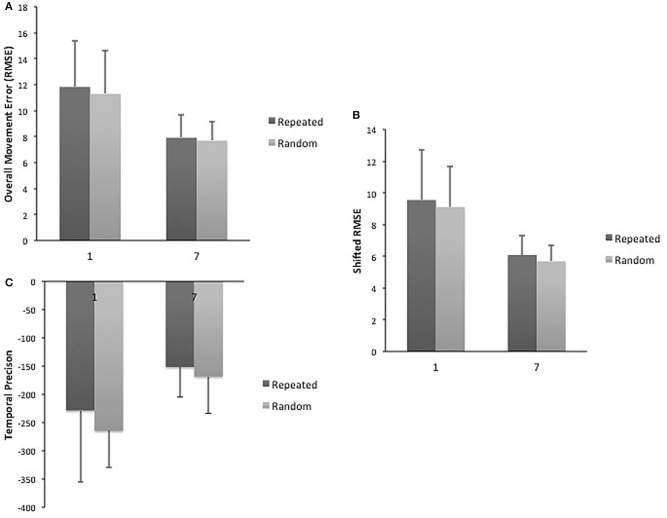
Implicit learning may be shown by improvements in motor performance, which occur unconsciously with practice and are typically restricted to the task that was practiced. The purpose of this study was to examine behaviorally relevant brain activation associated with change in motor behavior during sequence-specific motor learning of a perceptuomotor continuous tracking (CT) task in middle-aged adults. To gain further insight into the neural structures associated with change in motor behavior, overall improvement in tracking (root mean square error; RMSE) was decomposed into two components-temporal precision and spatial accuracy. We hypothesized that individual differences in CT task performance would be evident in unique networks of brain activation that supported overall tracking behavior as well-temporal and spatial tracking accuracy. A group of middle-aged healthy individuals performed the CT task, which contains repeated and random segments for seven days. Functional magnetic resonance imaging (fMRI) data was collected on the first and seventh day while the participants performed the task. Subjects did not gain explicit awareness of the sequence. To assess behaviorally-relevant changes in the blood oxygenation level-dependent (BOLD) response associated with individual sequence-specific tracking performance, separate statistical images were created for each participant and weighted by the difference score between repeated and random performance for days 1 and 7. Given the similarity of performance for random and repeated sequences during early practice, there were no unique networks evident at day 1. On Day 7 the resultant group statistical fMRI image demonstrated a positive correlation between RMSE difference score and bilateral cerebellar activation (lobule VI). In addition, individuals who showed greater sequence-specific temporal precision demonstrated increased activation in the precentral gyrus, middle occipital gyrus, and putamen of the right hemisphere and the thalamus, cuneus, and cerebellum of the left hemisphere. Activation of this neural network further confirms its involvement in timing of movements as it has been previously associated with task performance when individuals are instructed to emphasize speed over accuracy. In the present study, behavioral performance was associated with neural correlates of individual variation in motor learning that characterized the ability to implicitly learn a sequence-specific CT task.
内隐学习可以通过运动表现的提高来体现,这种提高是在练习过程中无意识地发生的,通常仅限于所练习的任务。本研究的目的是检查与中年成年人感知运动连续跟踪 (CT) 任务的序列特异性运动学习过程中运动行为变化相关的行为相关脑激活。为了更深入地了解与运动行为变化相关的神经结构,将跟踪的整体改善(均方根误差;RMSE)分解为两个分量-时间精度和空间准确性。我们假设 CT 任务表现的个体差异将体现在支持整体跟踪行为以及时间和空间跟踪准确性的独特大脑激活网络中。一组中年健康个体执行了 CT 任务,该任务包含重复和随机段,共进行七天。在参与者执行任务的第一天和第七天收集了功能磁共振成像 (fMRI) 数据。受试者没有获得序列的明确意识。为了评估与个体序列特异性跟踪性能相关的血氧水平依赖 (BOLD) 反应的行为相关变化,为每位参与者创建了单独的统计图像,并根据第 1 天和第 7 天重复和随机性能之间的差值对其进行加权。鉴于在早期练习中随机和重复序列的性能相似,因此在第 1 天没有明显的网络。在第 7 天,群组统计 fMRI 图像显示 RMSE 差值评分与双侧小脑激活(VI 叶)之间存在正相关。此外,表现出更大的序列特异性时间精度的个体在右半球的中央前回、中枕叶和壳核以及左半球的丘脑、楔叶和小脑显示出更高的激活。该神经网络的激活进一步证实了它在运动定时中的参与,因为它以前与个体被指示强调速度而不是准确性时的任务表现有关。在本研究中,行为表现与运动学习个体差异的神经相关物相关联,这些差异特征是隐含地学习序列特异性 CT 任务的能力。