Center for Genome Sciences and Systems Biology, Washington University, St. Louis, MO 63108, USA.
Sci Transl Med. 2013 May 8;5(184):184ra60. doi: 10.1126/scitranslmed.3005497.
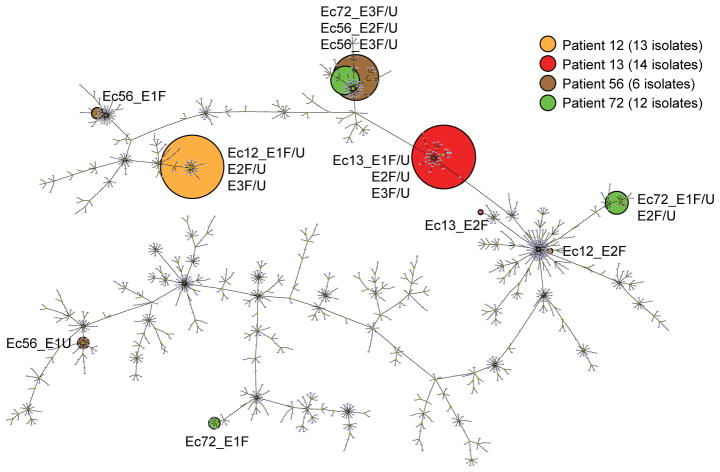
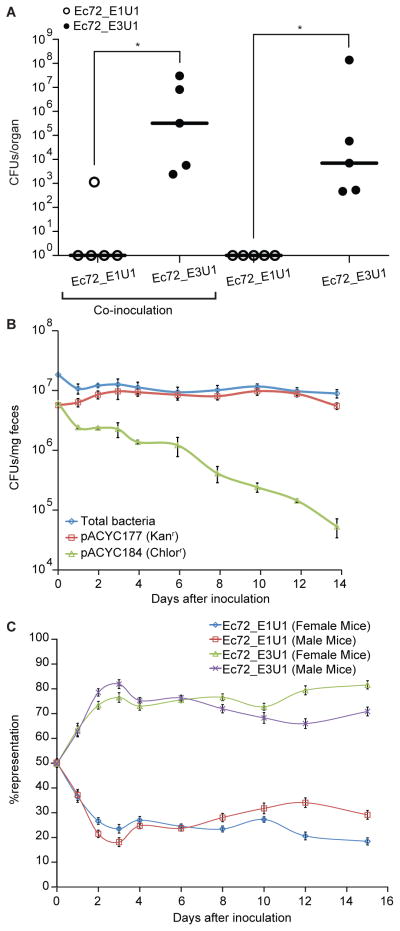
Urinary tract infections (UTIs) are common in women, and recurrence is a major clinical problem. Most UTIs are caused by uropathogenic Escherichia coli (UPEC). UPEC are generally thought to migrate from the gut to the bladder to cause UTI. UPEC form specialized intracellular bacterial communities in the bladder urothelium as part of a pathogenic mechanism to establish a foothold during acute stages of infection. Evolutionarily, such a specific adaptation to the bladder environment would be predicted to result in decreased fitness in other habitats, such as the gut. To examine this prediction, we characterized 45 E. coli strains isolated from the feces and urine of four otherwise healthy women with recurrent UTI. Multilocus sequence typing and whole genome sequencing revealed that two patients maintained a clonal population in both these body habitats throughout their recurrent UTIs, whereas the other two exhibited a wholesale shift in the dominant UPEC strain colonizing both sites. In vivo competition studies in mouse models, using isolates taken from one of the patients with a wholesale population shift, revealed that the strain that dominated her last UTI episode had increased fitness in both the gut and the bladder relative to the strain that dominated in preceding episodes. Increased fitness correlated with differences in the strains' gene repertoires and carbohydrate and amino acid utilization profiles. Thus, UPEC appear capable of persisting in both the gut and urinary tract without a fitness trade-off, emphasizing the need to widen our consideration of potential reservoirs for strains causing recurrent UTI.
尿路感染(UTI)在女性中很常见,复发是一个主要的临床问题。大多数 UTI 是由尿路致病性大肠杆菌(UPEC)引起的。一般认为 UPEC 从肠道迁移到膀胱引起 UTI。UPEC 在膀胱尿路上皮中形成专门的细胞内细菌群落,作为其在感染急性阶段建立立足点的致病机制的一部分。从进化的角度来看,这种对膀胱环境的特殊适应预计会导致其在其他栖息地(如肠道)中的适应性降低。为了检验这一预测,我们对 45 株从 4 位复发性 UTI 健康女性的粪便和尿液中分离出来的大肠杆菌菌株进行了特征描述。多位点序列分型和全基因组测序显示,在这两个身体栖息地中,两位患者的复发性 UTI 都保持着克隆种群,而另外两位患者的优势 UPEC 菌株在这两个部位的定植则发生了全面转变。使用来自一位患者中具有全种群转变的分离株进行的体内竞争研究表明,在她最后一次 UTI 发作中占主导地位的菌株在肠道和膀胱中的适应性均高于在之前发作中占主导地位的菌株。适应性增强与菌株基因库和碳水化合物及氨基酸利用谱的差异有关。因此,UPEC 似乎能够在肠道和泌尿道中持续存在而不会产生适应性权衡,这强调了需要扩大对引起复发性 UTI 的菌株的潜在储库的考虑。