Dugasani Sreekantha Reddy, Lee Namhoon, Lee Junwye, Kim Byeonghoon, Hwang Si Un, Lee Keun Woo, Kang Won Nam, Park Sung Ha
Department of Physics, Sungkyunkwan University, Suwon 440-746, Korea.
Sci Rep. 2013;3:1819. doi: 10.1038/srep01819.
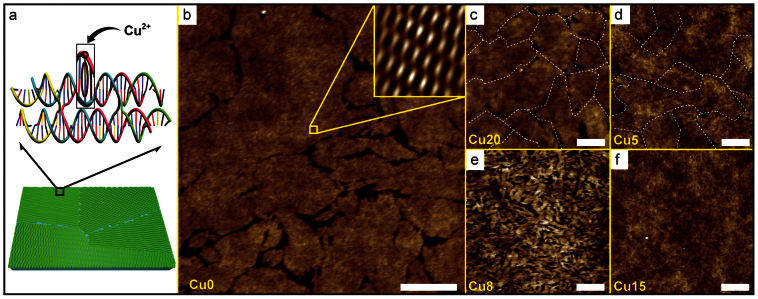
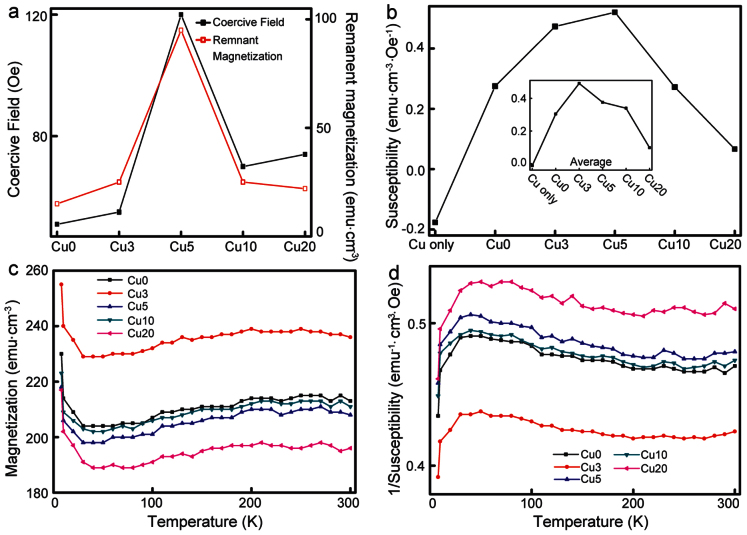
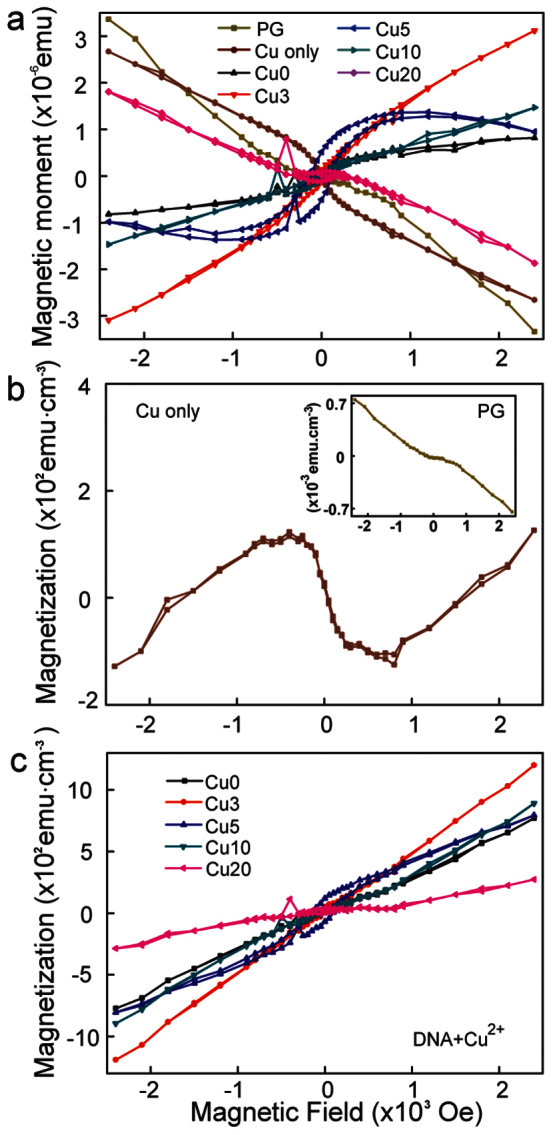
We developed a new method of fabricating a divalent copper ion (Cu(2+)) modified DNA thin film on a glass substrate and studied its magnetic properties. We evaluated the coercive field (Hc), remanent magnetization (Mr), susceptibility (χ), and thermal variation of magnetization with varying Cu(2+) concentrations [Cu(2+)] resulting in DNA thin films. Although thickness of the two dimensional DNA thin film with Cu(2+) in dry state was extremely thin (0.6 nm), significant ferromagnetic signals were observed at room temperature. The DNA thin films with a [Cu(2+)] near 5 mM showed the distinct S-shape hysteresis with appreciable high Hc, Mr and χ at low field (≤600 Oe). These were primarily caused by the presence of small magnetic dipoles of Cu(2+) coordination on the DNA molecule, through unpaired d electrons interacting with their nearest neighbors and the inter-exchange energy in the magnetic dipoles making other neighboring dipoles oriented in the same direction.
我们开发了一种在玻璃基板上制备二价铜离子(Cu(2+))修饰DNA薄膜的新方法,并研究了其磁性能。我们评估了不同Cu(2+)浓度[Cu(2+)]导致的DNA薄膜的矫顽场(Hc)、剩余磁化强度(Mr)、磁化率(χ)以及磁化强度的热变化。尽管干燥状态下含Cu(2+)的二维DNA薄膜厚度极薄(0.6 nm),但在室温下仍观察到显著的铁磁信号。[Cu(2+)]接近5 mM的DNA薄膜在低场(≤600 Oe)下呈现出明显的S形磁滞回线,具有相当高的Hc、Mr和χ。这些主要是由于DNA分子上Cu(2+)配位的小磁偶极子的存在,通过未成对的d电子与其最近邻相互作用以及磁偶极子中的交换能使其他相邻偶极子沿相同方向取向。