Esquinas Rodriguez Antonio M, Papadakos Peter J, Carron Michele, Cosentini Roberto, Chiumello Davide
Crit Care. 2013 Apr 25;17(2):223. doi: 10.1186/cc11875.
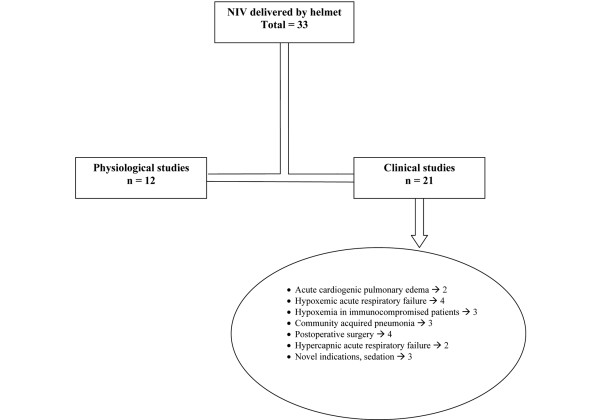
Non-invasive mechanical ventilation (NIV) has proved to be an excellent technique in selected critically ill patients with different forms of acute respiratory failure. However, NIV can fail on account of the severity of the disease and technical problems, particularly at the interface. The helmet could be an alternative interface compared to face mask to improve NIV success. We performed a clinical review to investigate the main physiological and clinical studies assessing the efficacy and related issues of NIV delivered with a helmet. A computerized search strategy of MEDLINE/PubMed (January 2000 to May 2012) and EMBASE (January 2000 to May 2012) was conducted limiting the search to retrospective, prospective, nonrandomized and randomized trials. We analyzed 152 studies from which 33 were selected, 12 physiological and 21 clinical (879 patients). The physiological studies showed that NIV with helmet could predispose to CO₂ rebreathing and increase the patients' ventilator asynchrony. The main indications for NIV were acute cardiogenic pulmonary edema, hypoxemic acute respiratory failure (community-acquired pneumonia, postoperative and immunocompromised patients) and hypercapnic acute respiratory failure. In 9 of the 21 studies the helmet was compared to a face mask during either continous positive airway pressure or pressure support ventilation. In eight studies oxygenation was similar in the two groups, while the intubation rate was similar in four and lower in three studies for the helmet group compared to face mask group. The outcome was similar in six studies. The tolerance was better with the helmet in six of the studies. Although these data are limited, NIV delivered by helmet could be a safe alternative to the face mask in patients with acute respiratory failure.
无创机械通气(NIV)已被证明是治疗某些患有不同形式急性呼吸衰竭的危重症患者的一种出色技术。然而,由于疾病的严重程度和技术问题,尤其是在接口处,NIV可能会失败。与面罩相比,头盔可能是一种可提高NIV成功率的替代接口。我们进行了一项临床综述,以调查评估头盔式NIV疗效及相关问题的主要生理学和临床研究。对MEDLINE/PubMed(2000年1月至2012年5月)和EMBASE(2000年1月至2012年5月)进行了计算机化检索,检索仅限于回顾性、前瞻性、非随机和随机试验。我们分析了152项研究,从中筛选出33项,其中12项生理学研究和21项临床研究(879例患者)。生理学研究表明,头盔式NIV可能会导致二氧化碳重复吸入,并增加患者的呼吸机不同步性。NIV的主要适应证为急性心源性肺水肿、低氧性急性呼吸衰竭(社区获得性肺炎、术后及免疫功能低下患者)和高碳酸血症性急性呼吸衰竭。在21项研究中的9项中,在持续气道正压通气或压力支持通气期间,将头盔与面罩进行了比较。在8项研究中,两组的氧合情况相似,而在4项研究中,两组的插管率相似,在3项研究中,头盔组的插管率低于面罩组。在6项研究中,结果相似。在6项研究中,头盔的耐受性更好。尽管这些数据有限,但对于急性呼吸衰竭患者,头盔式NIV可能是面罩的一种安全替代方法。