Departament de Genètica i de Microbiologia, Universitat Autònoma de Barcelona, Bellaterra, Barcelona, Spain.
Genome Biol Evol. 2013;5(6):1127-41. doi: 10.1093/gbe/evt076.
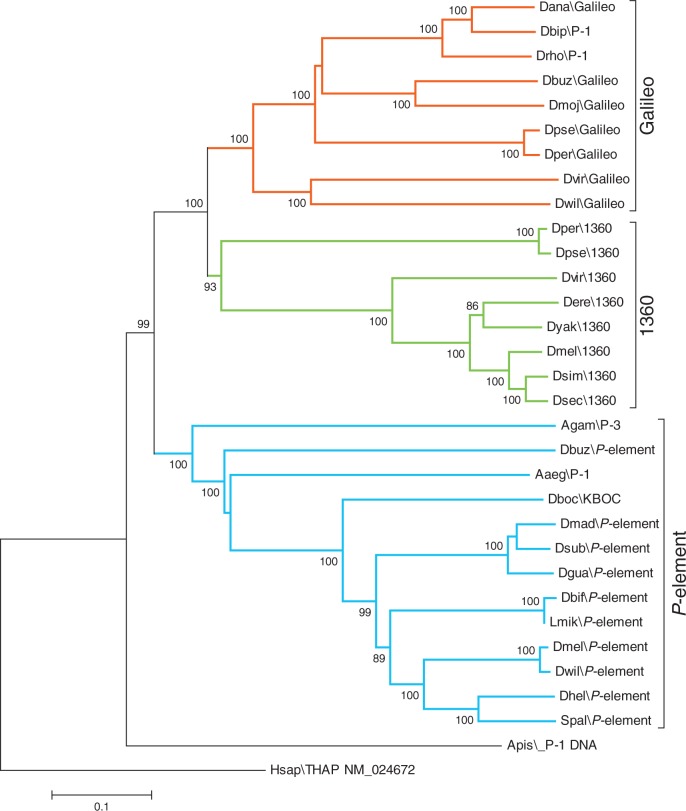
The transposon BuT5 caused two chromosomal inversions fixed in two Drosophila species of the repleta group, D. mojavensis and D. uniseta. BuT5 copies are approximately 1-kb long, lack any coding capacity, and do not resemble any other transposable element (TE). Because of its elusive features, BuT5 has remained unclassified to date. To fully characterize BuT5, we carried out bioinformatic similarity searches in available sequenced genomes, including 21 Drosophila species. Significant hits were only recovered for D. mojavensis genome, where 48 copies were retrieved, 22 of them approximately 1-kb long. Polymerase chain reaction (PCR) and dot blot analyses on 54 Drosophila species showed that BuT5 is homogeneous in size and has a widespread distribution within the repleta group. Thus, BuT5 can be considered as a miniature inverted-repeat TE. A detailed analysis of the BuT5 hits in D. mojavensis revealed three partial copies of a transposon with ends very similar to BuT5 and a P-element-like transposase-encoding region in between. A putatively autonomous copy of this P element was isolated by PCR from D. buzzatii. This copy is 3,386-bp long and possesses a seven-exon gene coding for an 822-aa transposase. Exon-intron boundaries were confirmed by reverse transcriptase-PCR experiments. A phylogenetic tree built with insect P superfamily transposases showed that the D. buzzatii P element belongs to an early diverging lineage within the P-element family. This divergent P element is likely the master transposon mobilizing BuT5. The BuT5/P element partnership probably dates back approximately 16 Ma and is the ultimate responsible for the generation of the two chromosomal inversions in the Drosophila repleta species group.
转座子 BuT5 导致了两个染色体倒位,这两个倒位在 repleta 组的两个果蝇物种中固定下来,即 D. mojavensis 和 D. uniseta。BuT5 拷贝大约长 1kb,缺乏任何编码能力,也不像任何其他转座元件(TE)。由于其难以捉摸的特征,BuT5 至今仍未分类。为了充分描述 BuT5,我们在现有的已测序基因组中进行了生物信息学相似性搜索,包括 21 个果蝇物种。仅在 D. mojavensis 基因组中回收了显著的命中,其中回收了 48 个拷贝,其中 22 个大约 1kb 长。对 54 个果蝇物种的聚合酶链反应(PCR)和点印迹分析表明,BuT5 在大小上是同质的,并且在 repleta 组内广泛分布。因此,BuT5 可以被认为是一种微型倒置重复 TE。对 D. mojavensis 中 BuT5 命中的详细分析显示,有三个转座子的部分拷贝,它们的末端非常类似于 BuT5,中间有一个类似于 P 元素的转座酶编码区。通过 PCR 从 D. buzzatii 中分离出这个 P 元素的一个假定自主拷贝。这个拷贝长 3386bp,具有一个编码 822 个氨基酸的转座酶的七个外显子基因。通过逆转录酶-PCR 实验证实了外显子-内含子边界。用昆虫 P 超家族转座酶构建的系统发育树表明,D. buzzatii P 元素属于 P 元素家族中一个早期分化的谱系。这个发散的 P 元素可能是驱动 BuT5 的主要转座子。BuT5/P 元素的伙伴关系可能可以追溯到大约 1600 万年前,是导致 Drosophila repleta 物种组中两个染色体倒位的最终原因。