Department of Comparative Biomedical Sciences, The Royal Veterinary College, London, UK.
Vascul Pharmacol. 2013 Jul-Aug;59(1-2):19-26. doi: 10.1016/j.vph.2013.05.002. Epub 2013 May 16.
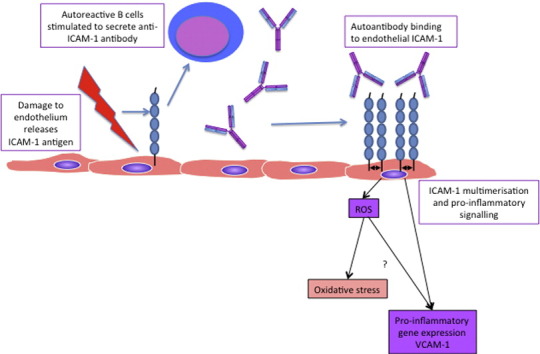
Scleroderma (SSc) is a complex autoimmune disorder that can be characterised by the presence 2of circulating autoantibodies to nuclear, cytoplasmic and cell surface antigens. In particular antibodies directed against endothelial cell antigens (anti-endothelial cell antibodies; AECA) have been detected. ICAM-1 is an adhesion molecule expressed on the surface of human endothelial cells. We have previously shown that cross-linking ICAM-1 with monoclonal antibodies leads to pro-inflammatory activation of human endothelial and vascular smooth muscle cells and that cardiac transplant recipients with transplant associated vasculopathy make antibodies directed against ICAM-1.
To determine whether SSc patients make antibodies directed against ICAM-1 and whether these antibodies induce pro-inflammatory activation of human endothelial cells in vitro.
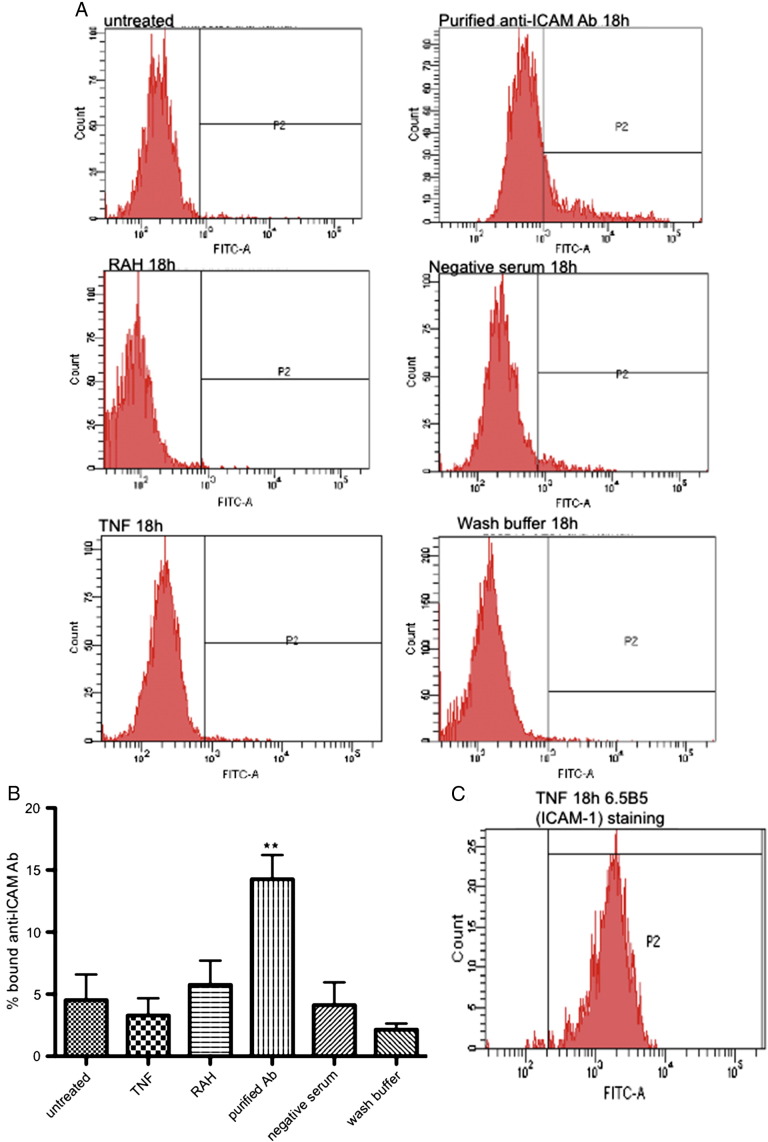
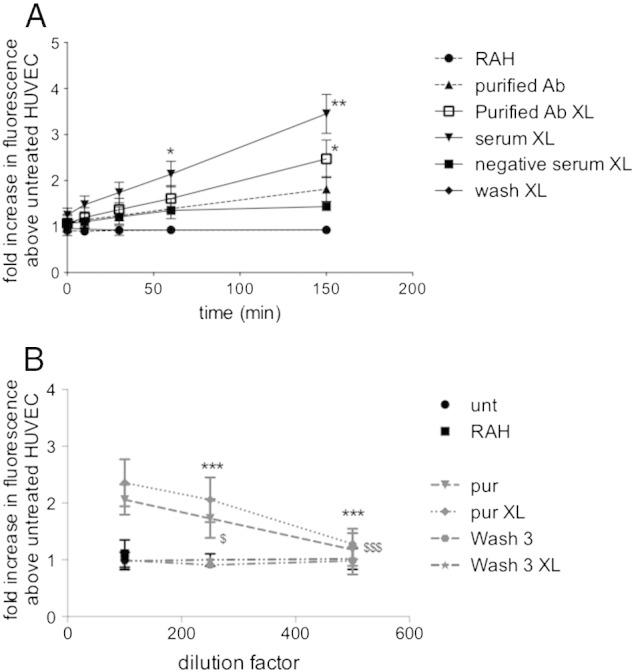
Using recombinant ICAM-1 as capture antigen, an ELISA was developed to measure ICAM-1 antibodies in sera from SSc patients. Antibodies were purified using ICAM-1 micro-affinity columns. HUVEC were incubated with purified anti-ICAM-1 antibodies and generation of reactive oxygen species, and expression of VCAM-1 was measured.
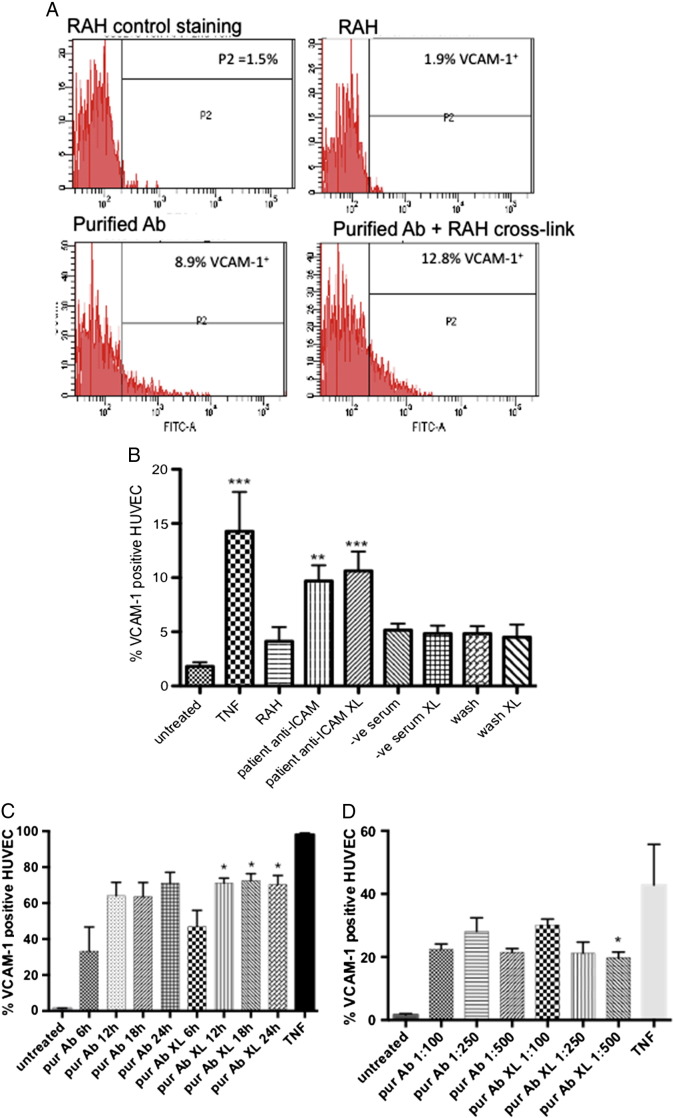
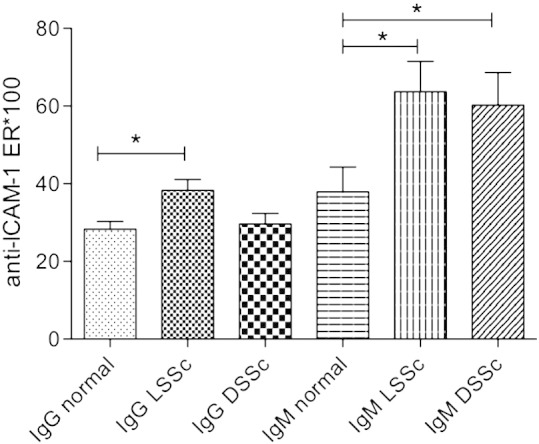
Significantly elevated levels of anti-ICAM-1 antibodies were detected in patients with diffuse (dSSc; 10/31 32%) or limited (lSSc; 14/36 39%) scleroderma. Cross-linking of HUVEC with purified anti-ICAM-1 antibodies caused a significant increase in ROS production (2.471±0.408 fold increase above untreated after 150 min p<0.001), and significant increase in VCAM-1 expression (10.6±1.77% vs 4.12±1.33%, p<0.01).
AECA from SSc patients target specific endothelial antigens including ICAM-1, and cause pro-inflammatory activation of human endothelial cells, suggesting that they are not only a marker of disease but that they contribute to its progression.
硬皮病(SSc)是一种复杂的自身免疫性疾病,其特征可表现为存在针对核、细胞质和细胞表面抗原的循环自身抗体。特别是已经检测到针对内皮细胞抗原的抗体(抗内皮细胞抗体;AECA)。ICAM-1 是一种在人内皮细胞表面表达的粘附分子。我们之前已经表明,用单克隆抗体交联 ICAM-1 可导致人内皮细胞和血管平滑肌细胞的促炎激活,并且患有移植相关血管病的心脏移植受者会产生针对 ICAM-1 的抗体。
确定 SSc 患者是否产生针对 ICAM-1 的抗体,以及这些抗体是否在体外诱导人内皮细胞的促炎激活。
使用重组 ICAM-1 作为捕获抗原,开发了一种 ELISA 来测量 SSc 患者血清中的 ICAM-1 抗体。使用 ICAM-1 微亲和柱纯化抗体。将纯化的抗 ICAM-1 抗体与 HUVEC 孵育,测量活性氧的产生和 VCAM-1 的表达。
在弥漫性(dSSc;31 例中有 10 例,32%)或局限性(lSSc;36 例中有 14 例,39%)硬皮病患者中检测到明显升高的抗 ICAM-1 抗体水平。用纯化的抗 ICAM-1 抗体交联 HUVEC 可导致 ROS 产生显著增加(与未经处理的相比,150 分钟后增加 2.471±0.408 倍,p<0.001),并导致 VCAM-1 表达显著增加(10.6±1.77%对 4.12±1.33%,p<0.01)。
来自 SSc 患者的 AECA 靶向特定的内皮抗原,包括 ICAM-1,并导致人内皮细胞的促炎激活,这表明它们不仅是疾病的标志物,而且还促进疾病的进展。