Yasaka Koichiro, Katsura Masaki, Akahane Masaaki, Sato Jiro, Matsuda Izuru, Ohtomo Kuni
Department of Radiology, Graduate School of Medicine, The University of Tokyo, Tokyo, Japan.
Springerplus. 2013 May 7;2(1):209. doi: 10.1186/2193-1801-2-209. Print 2013 Dec.
To evaluate dose reduction and image quality of abdominopelvic computed tomography (CT) reconstructed with model-based iterative reconstruction (MBIR) compared to adaptive statistical iterative reconstruction (ASIR).
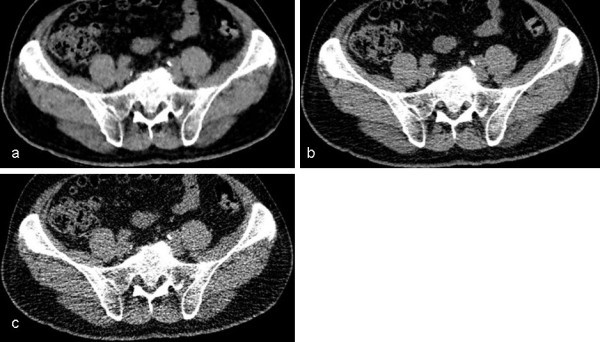
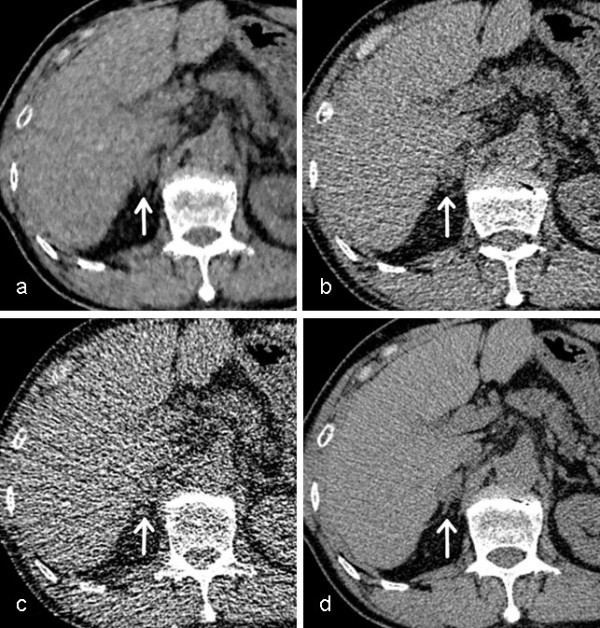
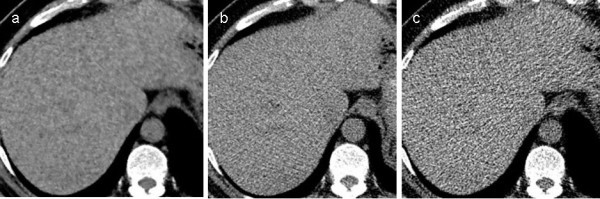
In this prospective study, 85 patients underwent referential-, low-, and ultralow-dose unenhanced abdominopelvic CT. Images were reconstructed with ASIR for low-dose (L-ASIR) and ultralow-dose CT (UL-ASIR), and with MBIR for ultralow-dose CT (UL-MBIR). Image noise was measured in the abdominal aorta and iliopsoas muscle. Subjective image analyses and a lesion detection study (adrenal nodules) were conducted by two blinded radiologists. A reference standard was established by a consensus panel of two different radiologists using referential-dose CT reconstructed with filtered back projection.
Compared to low-dose CT, there was a 63% decrease in dose-length product with ultralow-dose CT. UL-MBIR had significantly lower image noise than L-ASIR and UL-ASIR (all p<0.01). UL-MBIR was significantly better for subjective image noise and streak artifacts than L-ASIR and UL-ASIR (all p<0.01). There were no significant differences between UL-MBIR and L-ASIR in diagnostic acceptability (p>0.65), or diagnostic performance for adrenal nodules (p>0.87).
MBIR significantly improves image noise and streak artifacts compared to ASIR, and can achieve radiation dose reduction without severely compromising image quality.
评估与自适应统计迭代重建(ASIR)相比,基于模型的迭代重建(MBIR)重建的腹盆腔计算机断层扫描(CT)的剂量降低情况和图像质量。
在这项前瞻性研究中,85例患者接受了参考剂量、低剂量和超低剂量的未增强腹盆腔CT检查。低剂量CT(L-ASIR)和超低剂量CT(UL-ASIR)图像采用ASIR重建,超低剂量CT(UL-MBIR)图像采用MBIR重建。在腹主动脉和髂腰肌中测量图像噪声。由两名盲法放射科医生进行主观图像分析和病变检测研究(肾上腺结节)。由两名不同的放射科医生组成的共识小组使用滤波反投影重建的参考剂量CT建立参考标准。
与低剂量CT相比,超低剂量CT的剂量长度乘积降低了63%。UL-MBIR的图像噪声明显低于L-ASIR和UL-ASIR(所有p<0.01)。在主观图像噪声和条纹伪影方面,UL-MBIR明显优于L-ASIR和UL-ASIR(所有p<0.01)。UL-MBIR和L-ASIR在诊断可接受性(p>0.65)或肾上腺结节的诊断性能(p>0.87)方面无显著差异。
与ASIR相比,MBIR显著改善了图像噪声和条纹伪影,并且可以在不严重影响图像质量的情况下实现辐射剂量降低。