China Animal Healthy and Epidemic Center, Qingdao 266032, China.
Virol J. 2013 May 20;10:155. doi: 10.1186/1743-422X-10-155.
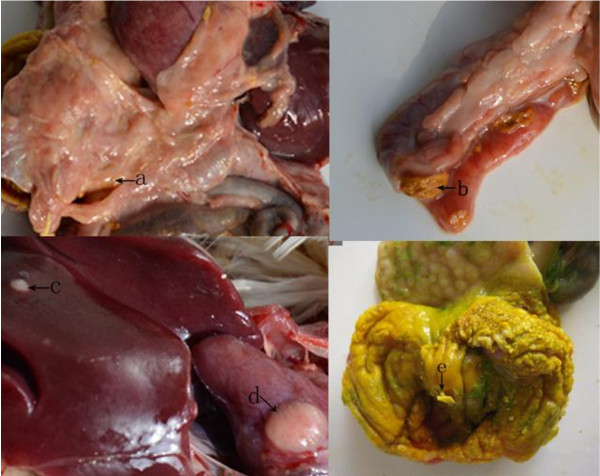
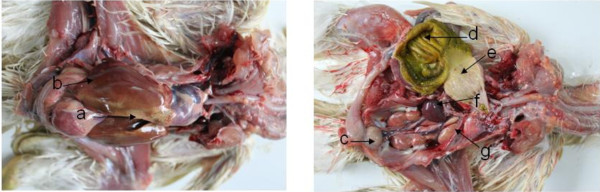
A severe MD was broken out at a farm in Shandong, China, despite FC126 vaccination of the chickens at 1-day-old. The mortality of the flocks reached up to 38.3%. The infected chickens were found to have MD pathological changes, including enlargement of spleens, livers and kidneys, and tumors occured on organs later. Samples were collected from the chickens for diagnosis.
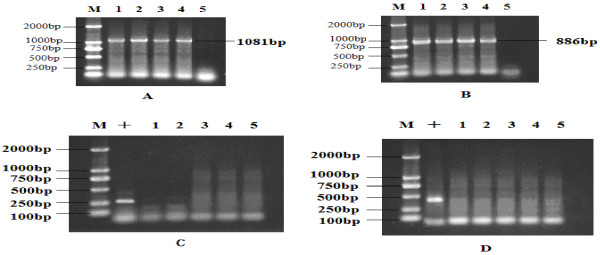
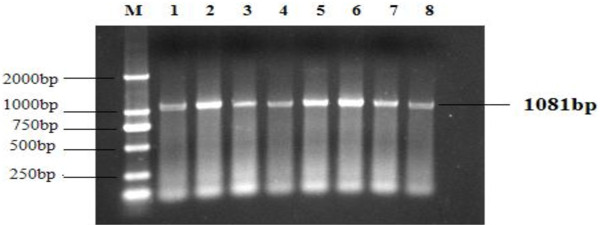
The collected samples were inoculated into primary duck embryo fibroblast (DEF) cells, and the MDV strain named SD2012-1 was isolated. In order to identify the isolate, amplification by PCR and sequencing of oncogenic Meq and vIL-8 gene were processed, the obtained sequences were compared with the sequences of reference strains, and SD2012-1 was used to challenge immunized SPF chickens.
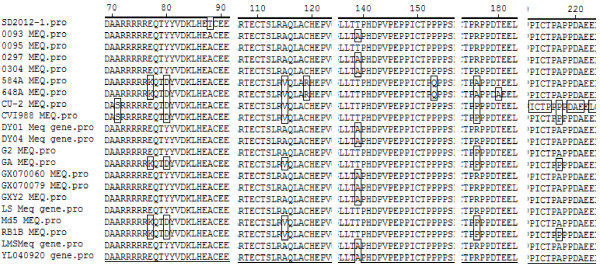
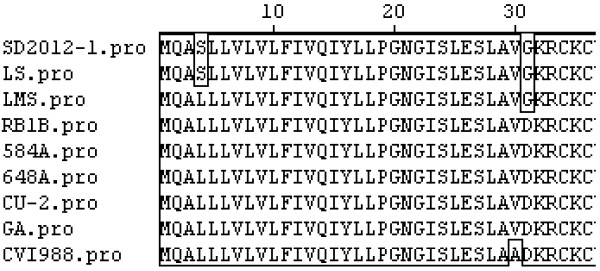
A very virulent MDV isolate strain, SD2012-1, was isolated from a chicken flock in Shandong Province, China, the isolate had the characteristics of very virulent MDV-1, nucleotide and deduced amino acid sequence comparisons of Meq and vIL-8 gene of SD2012-1 with those of reference strains showed SD2012-1 had high homology with MDV strains isolated from China, SD2012-1 could break through the protection provided by HVT vaccine and HVT + SB-1 vaccine immunization and caused the mortality of SPF chickens over 60%. The immune failure occured at the farm could be due to the improper selection of vaccines. SD2012-1 produced death later and the gross postmortem lesions of chickens died early and later were different.
MDV strain SD2012-1 isolated from Shandong Province, China was found to have the characteristics of very virulent MDV-1, which could break through the protection provided by HVT vaccine and HVT + SB-1 vaccine, the virus seemed to have a long latent period, and cause different gross postmortem lesions of chickens between chickens died early and later. A better immunization way should be chosen to prevent infection of this MDV strain in field.
尽管在 1 日龄时对鸡进行了 FC126 疫苗接种,但中国山东的一个农场仍爆发了严重的马立克氏病(MD)。鸡群的死亡率高达 38.3%。受感染的鸡出现 MD 病理变化,包括脾脏、肝脏和肾脏肿大,以及后期器官上的肿瘤。采集鸡的样本进行诊断。
采集的样本接种到原代鸭胚成纤维细胞(DEF)细胞中,分离出 MDV 株,命名为 SD2012-1。为了鉴定分离株,对致癌基因 Meq 和 vIL-8 基因进行了 PCR 扩增和测序,将获得的序列与参考株序列进行比较,并用 SD2012-1 对免疫 SPF 鸡进行攻毒。
从中国山东省的一个鸡群中分离到一株非常毒力的 MDV 分离株 SD2012-1,该分离株具有 MDV-1 非常毒力的特征。SD2012-1 的 Meq 和 vIL-8 基因核苷酸和推导氨基酸序列与参考株的比较表明,SD2012-1 与中国分离的 MDV 株具有高度同源性。SD2012-1 可以突破 HVT 疫苗和 HVT+SB-1 疫苗免疫提供的保护,导致 SPF 鸡的死亡率超过 60%。农场发生免疫失败可能是由于疫苗选择不当。SD2012-1 产生死亡的时间较晚,早期和晚期死亡的鸡的大体剖检病变不同。
从中国山东省分离到的 MDV 株 SD2012-1 具有非常毒力 MDV-1 的特征,可突破 HVT 疫苗和 HVT+SB-1 疫苗的保护作用,该病毒潜伏期似乎较长,可引起早期和晚期死亡鸡的不同大体剖检病变。应选择更好的免疫方法来防止该 MDV 株在田间感染。