University of Dundee, Dundee, UK.
Diabetologia. 2013 Aug;56(8):1716-25. doi: 10.1007/s00125-013-2928-7. Epub 2013 May 21.
AIMS/HYPOTHESIS: The aim of our study was to identify subgroups of patients attending the Scottish Diabetic Retinopathy Screening (DRS) programme who might safely move from annual to two yearly retinopathy screening.
This was a retrospective cohort study of screening data from the DRS programme collected between 2005 and 2011 for people aged ≥12 years with type 1 or type 2 diabetes in Scotland. We used hidden Markov models to calculate the probabilities of transitions to referable diabetic retinopathy (referable background or proliferative retinopathy) or referable maculopathy.
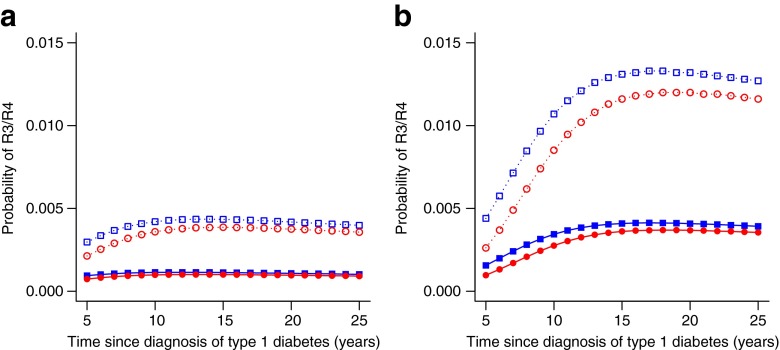
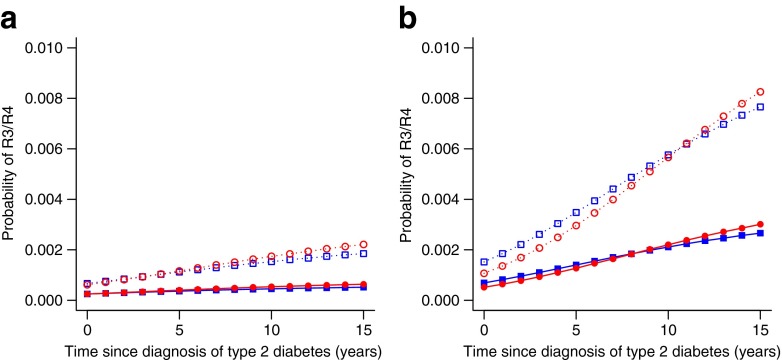
The study included 155,114 individuals with no referable diabetic retinopathy or maculopathy at their first DRS examination and with one or more further DRS examinations. There were 11,275 incident cases of referable diabetic eye disease (9,204 referable maculopathy, 2,071 referable background or proliferative retinopathy). The observed transitions to referable background or proliferative retinopathy were lower for people with no visible retinopathy vs mild background retinopathy at their prior examination (respectively, 1.2% vs 8.1% for type 1 diabetes and 0.6% vs 5.1% for type 2 diabetes). The lowest probability for transitioning to referable background or proliferative retinopathy was among people with two consecutive screens showing no visible retinopathy, where the probability was <0.3% for type 1 and <0.2% for type 2 diabetes at 2 years.
CONCLUSIONS/INTERPRETATION: Transition rates to referable diabetic eye disease were lowest among people with type 2 diabetes and two consecutive screens showing no visible retinopathy. If such people had been offered two yearly screening the DRS service would have needed to screen 40% fewer people in 2009.
目的/假设:本研究的目的是确定参加苏格兰糖尿病视网膜病变筛查(DRS)计划的患者亚组,这些患者可以安全地从每年筛查改为每两年筛查一次。
这是一项回顾性队列研究,对 2005 年至 2011 年苏格兰参加 DRS 计划的年龄≥12 岁的 1 型或 2 型糖尿病患者的筛查数据进行了分析。我们使用隐马尔可夫模型计算了向可转诊的糖尿病视网膜病变(可转诊背景或增殖性视网膜病变)或可转诊的黄斑病变过渡的概率。
该研究包括 155114 名首次 DRS 检查时无可转诊的糖尿病视网膜病变或黄斑病变且有一次或多次进一步 DRS 检查的患者。共有 11275 例新发可转诊的糖尿病眼病(9204 例可转诊的黄斑病变,2071 例可转诊的背景或增殖性视网膜病变)。与前一次检查时无可见性视网膜病变相比,轻度背景性视网膜病变的患者向可转诊的背景或增殖性视网膜病变的观察性转变率较低(分别为 1 型糖尿病患者的 1.2%和 8.1%,2 型糖尿病患者的 0.6%和 5.1%)。向可转诊的背景或增殖性视网膜病变转变的最低概率是在前两次检查均无可见性视网膜病变的人群中,1 型和 2 型糖尿病患者在 2 年内的概率均低于 0.3%。
结论/解释:向可转诊的糖尿病眼病的转变率在连续两次检查均无可见性视网膜病变的 2 型糖尿病患者中最低。如果这些人接受了每两年筛查一次的建议,那么在 2009 年,DRS 服务将需要减少 40%的筛查人数。