Instituto de Biología Molecular y Celular de Plantas (IBMCP), Ingeniero Fausto Elio s/n, Valencia 46022, Spain.
BMC Genomics. 2013 May 23;14:343. doi: 10.1186/1471-2164-14-343.
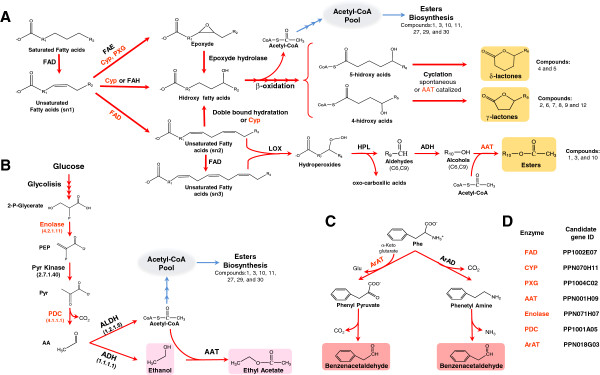
Ever since the recent completion of the peach genome, the focus of genetic research in this area has turned to the identification of genes related to important traits, such as fruit aroma volatiles. Of the over 100 volatile compounds described in peach, lactones most likely have the strongest effect on fruit aroma, while esters, terpenoids, and aldehydes have minor, yet significant effects. The identification of key genes underlying the production of aroma compounds is of interest for any fruit-quality improvement strategy.
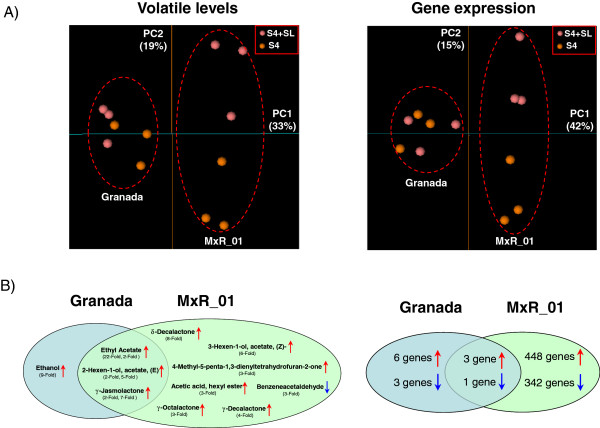
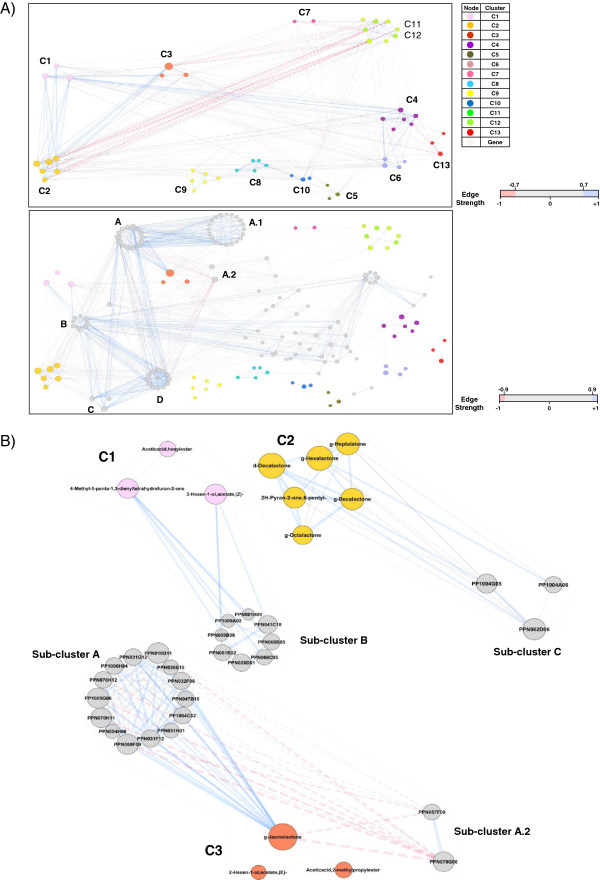
Volatile (52 compounds) and gene expression (4348 genes) levels were profiled in peach fruit from a maturity time-course series belonging to two peach genotypes that showed considerable differences in maturation characteristics and postharvest ripening. This data set was analyzed by complementary correlation-based approaches to discover the genes related to the main aroma-contributing compounds: lactones, esters, and phenolic volatiles, among others. As a case study, one of the candidate genes was cloned and expressed in yeast to show specificity as an ω-6 Oleate desaturase, which may be involved in the production of a precursor of lactones/esters.
Our approach revealed a set of genes (an alcohol acyl transferase, fatty acid desaturases, transcription factors, protein kinases, cytochromes, etc.) that are highly associated with peach fruit volatiles, and which could prove useful in breeding or for biotechnological purposes.
自从最近完成了桃基因组之后,该领域的遗传研究焦点转向了鉴定与重要性状相关的基因,例如果实香气挥发物。在桃的 100 多种挥发性化合物中,内酯类化合物最有可能对果实香气产生最强的影响,而酯类、萜类和醛类则有较小但显著的影响。鉴定产生香气化合物的关键基因对于任何改善果实品质的策略都很有意义。
在两个桃基因型的成熟时间序列中,对桃果实的挥发性(52 种化合物)和基因表达(4348 种基因)水平进行了分析,这两个基因型在成熟特征和采后成熟方面存在显著差异。通过互补的基于相关性的方法对该数据集进行了分析,以发现与主要香气贡献化合物(内酯、酯类和酚类挥发物等)相关的基因。作为一个案例研究,克隆并在酵母中表达了一个候选基因,以显示其作为ω-6 油酸去饱和酶的特异性,这可能与内酯/酯的前体产生有关。
我们的方法揭示了一组与桃果实挥发物高度相关的基因(醇酰基转移酶、脂肪酸去饱和酶、转录因子、蛋白激酶、细胞色素等),这些基因可能在育种或生物技术方面具有应用价值。