Immune Regulation and Tolerance Research Group, Programa Disciplinario de Inmunología, ICBM, Facultad de Medicina, Universidad de Chile, Santiago, Chile.
J Transl Med. 2013 May 24;11:128. doi: 10.1186/1479-5876-11-128.
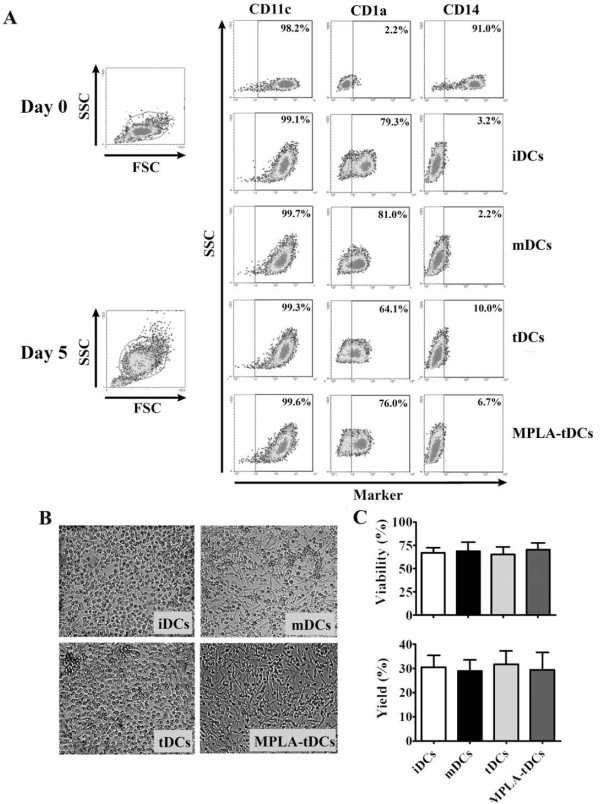
Generation of tolerogenic dendritic cells (TolDCs) for therapy is challenging due to its implications for the design of protocols suitable for clinical applications, which means not only using safe products, but also working at defining specific biomarkers for TolDCs identification, developing shorter DCs differentiation methods and obtaining TolDCs with a stable phenotype. We describe here, a short-term protocol for TolDCs generation, which are characterized in terms of phenotypic markers, cytokines secretion profile, CD4+ T cell-stimulatory ability and migratory capacity.
TolDCs from healthy donors were generated by modulation with dexamethasone plus monophosphoryl lipid A (MPLA-tDCs). We performed an analysis of MPLA-tDCs in terms of yield, viability, morphology, phenotypic markers, cytokines secretion profile, stability, allogeneic and antigen-specific CD4+ T-cell stimulatory ability and migration capacity.
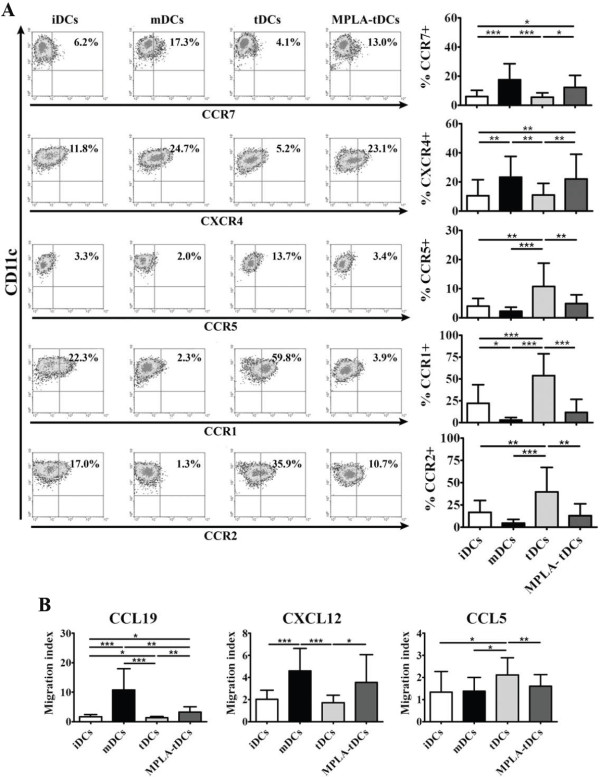
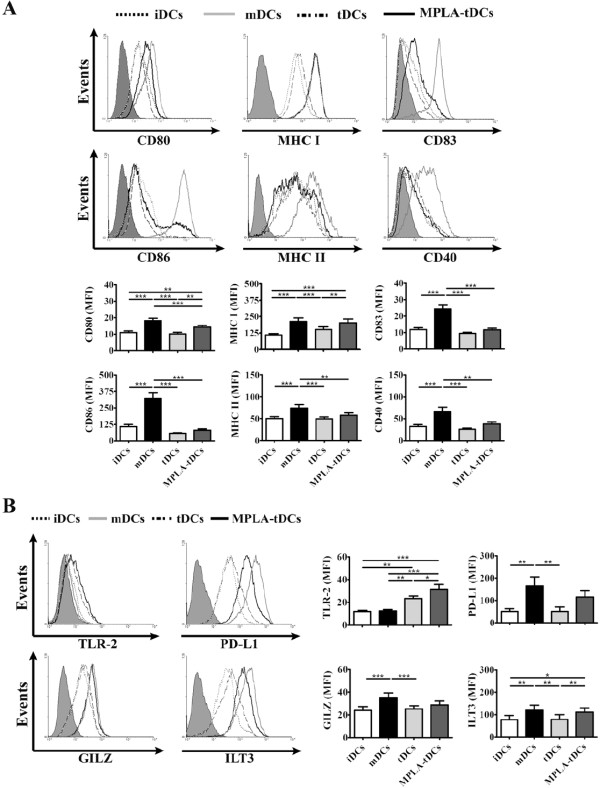
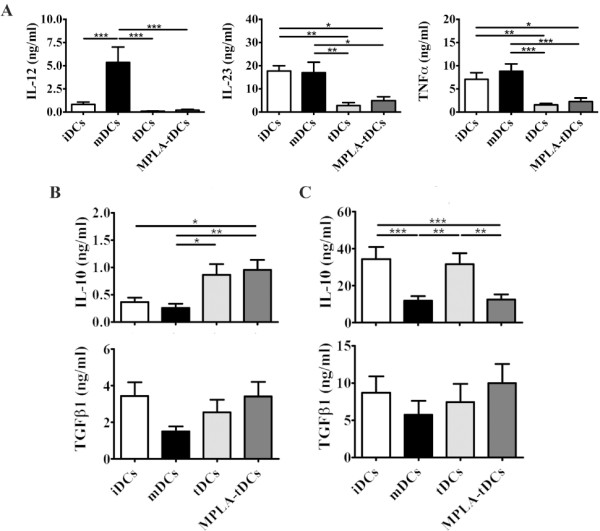
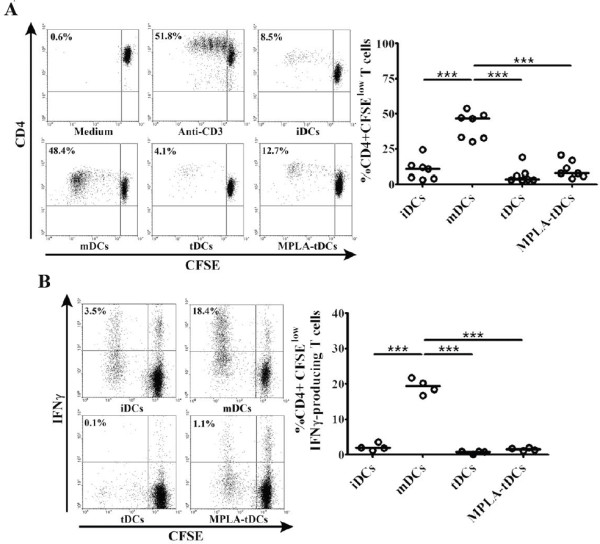
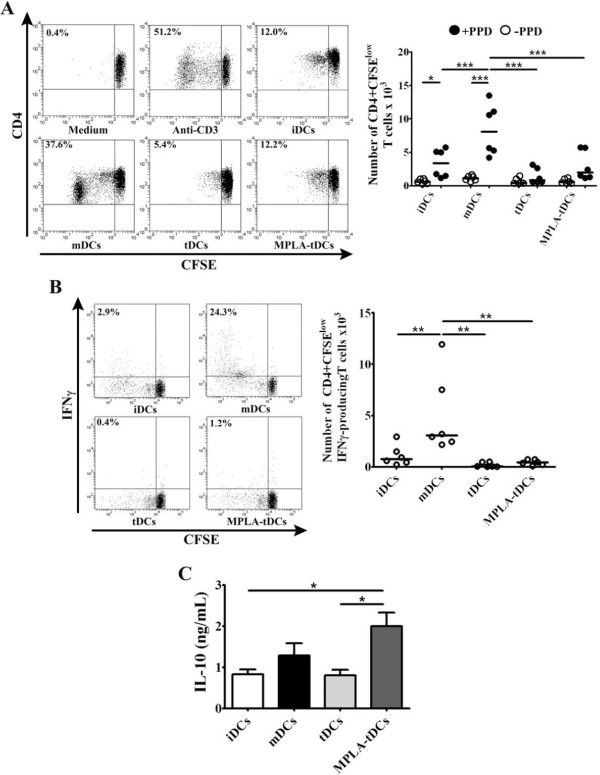
After a 5-day culture, MPLA-tDCs displayed reduced expression of costimulatory and maturation molecules together to an anti-inflammatory cytokines secretion profile, being able to maintain these tolerogenic features even after the engagement of CD40 by its cognate ligand. In addition, MPLA-tDCs exhibited reduced capabilities to stimulate allogeneic and antigen-specific CD4+ T cell proliferation, and induced an anti-inflammatory cytokine secretion pattern. Among potential tolerogenic markers studied, only TLR-2 was highly expressed in MPLA-tDCs when compared to mature and immature DCs. Remarkable, like mature DCs, MPLA-tDCs displayed a high CCR7 and CXCR4 expression, both chemokine receptors involved in migration to secondary lymphoid organs, and even more, in an in vitro assay they exhibited a high migration response towards CCL19 and CXCL12.
We describe a short-term protocol for TolDC generation, which confers them a stable phenotype and migratory capacity to lymphoid chemokines, essential features for TolDCs to be used as therapeutics for autoimmunity and prevention of graft rejection.
由于生成具有免疫耐受能力的树突状细胞(TolDCs)对方案设计具有重要意义,适用于临床应用,这意味着不仅要使用安全的产品,还要定义用于 TolDCs 鉴定的特定生物标志物,开发更短的 DC 分化方法,并获得具有稳定表型的 TolDCs。我们在这里描述了一种 TolDCs 的短期生成方案,该方案从表型标志物、细胞因子分泌谱、CD4+T 细胞刺激能力和迁移能力方面进行了表征。
使用地塞米松加单磷酰脂质 A(MPLA-tDCs)对健康供体的 TolDCs 进行调节。我们分析了 MPLA-tDCs 的产量、活力、形态、表型标志物、细胞因子分泌谱、稳定性、同种异体和抗原特异性 CD4+T 细胞刺激能力和迁移能力。
在 5 天的培养后,MPLA-tDCs 表现出共刺激和成熟分子的表达减少,同时分泌抗炎细胞因子,即使在其同源配体与 CD40 结合后,仍能保持这些免疫耐受特性。此外,MPLA-tDCs 刺激同种异体和抗原特异性 CD4+T 细胞增殖的能力降低,并诱导抗炎细胞因子分泌模式。在所研究的潜在免疫耐受标志物中,只有 TLR-2 在 MPLA-tDCs 中的表达明显高于成熟和未成熟的 DCs。值得注意的是,与成熟的 DCs 一样,MPLA-tDCs 表达高水平的 CCR7 和 CXCR4,这两种趋化因子受体都参与了向次级淋巴器官的迁移,甚至在体外实验中,它们对 CCL19 和 CXCL12 表现出高迁移反应。
我们描述了一种 TolDC 生成的短期方案,该方案赋予 TolDCs 稳定的表型和对淋巴趋化因子的迁移能力,这是 TolDCs 作为自身免疫和预防移植物排斥治疗的必要特征。