Maggi Jaxaira, Schinnerling Katina, Pesce Bárbara, Hilkens Catharien M, Catalán Diego, Aguillón Juan C
Programa Disciplinario de Inmunología, Immune Regulation and Tolerance Research Group, Facultad de Medicina, Instituto de Ciencias Biomédicas (ICBM), Universidad de Chile, Santiago, Chile; Millennium Institute on Immunology and Immunotherapy (MIII), Santiago, Chile.
Programa Disciplinario de Inmunología, Immune Regulation and Tolerance Research Group, Facultad de Medicina, Instituto de Ciencias Biomédicas (ICBM), Universidad de Chile , Santiago , Chile.
Front Immunol. 2016 Sep 19;7:359. doi: 10.3389/fimmu.2016.00359. eCollection 2016.
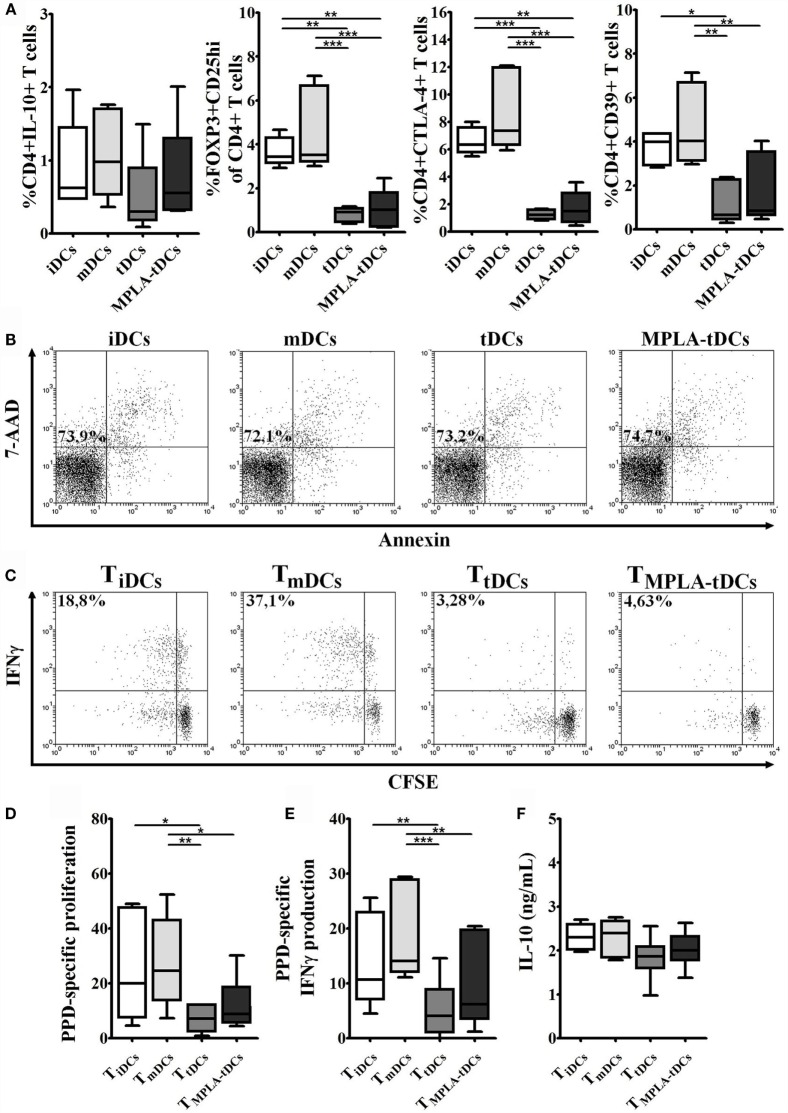
Tolerogenic dendritic cells (DCs) are a promising tool to control T cell-mediated autoimmunity. Here, we evaluate the ability of dexamethasone-modulated and monophosphoryl lipid A (MPLA)-activated DCs [MPLA-tolerogenic DCs (tDCs)] to exert immunomodulatory effects on naive and memory CD4 T cells in an antigen-specific manner. For this purpose, MPLA-tDCs were loaded with purified protein derivative (PPD) as antigen and co-cultured with autologous naive or memory CD4 T cells. Lymphocytes were re-challenged with autologous PPD-pulsed mature DCs (mDCs), evaluating proliferation and cytokine production by flow cytometry. On primed-naive CD4 T cells, the expression of regulatory T cell markers was evaluated and their suppressive ability was assessed in autologous co-cultures with CD4 effector T cells and PPD-pulsed mDCs. We detected that memory CD4 T cells primed by MPLA-tDCs presented reduced proliferation and proinflammatory cytokine expression in response to PPD and were refractory to subsequent stimulation. Naive CD4 T cells were instructed by MPLA-tDCs to be hyporesponsive to antigen-specific restimulation and to suppress the induction of T helper cell type 1 and 17 responses. In conclusion, MPLA-tDCs are able to modulate antigen-specific responses of both naive and memory CD4 T cells and might be a promising strategy to "turn off" self-reactive CD4 effector T cells in autoimmunity.
耐受性树突状细胞(DCs)是控制T细胞介导的自身免疫的一种有前景的工具。在此,我们评估地塞米松调节和单磷酰脂质A(MPLA)激活的DCs[MPLA耐受性DCs(tDCs)]以抗原特异性方式对初始和记忆性CD4 T细胞发挥免疫调节作用的能力。为此,将MPLA-tDCs负载纯化蛋白衍生物(PPD)作为抗原,并与自体初始或记忆性CD4 T细胞共培养。用自体PPD刺激的成熟DCs(mDCs)再次刺激淋巴细胞,通过流式细胞术评估增殖和细胞因子产生。对于致敏的初始CD4 T细胞,评估调节性T细胞标志物的表达,并在与CD4效应T细胞和PPD刺激的mDCs的自体共培养物中评估其抑制能力。我们检测到,由MPLA-tDCs致敏的记忆性CD4 T细胞在对PPD的反应中增殖减少且促炎细胞因子表达降低,并且对随后的刺激具有抗性。初始CD4 T细胞被MPLA-tDCs诱导对抗原特异性再刺激反应低下,并抑制1型和17型辅助性T细胞反应的诱导。总之,MPLA-tDCs能够调节初始和记忆性CD4 T细胞的抗原特异性反应,可能是在自身免疫中“关闭”自身反应性CD4效应T细胞的一种有前景的策略。