Masho Saba W, Bishop Diane L, Munn Meaghan
BMC Pregnancy Childbirth. 2013 May 24;13:120. doi: 10.1186/1471-2393-13-120.
Obesity in pregnant women is a major problem affecting both the mother and her offspring. Literature on the effect of obesity on preterm birth is inconsistent and few studies have investigated the influence of weight gain during pregnancy. This study examined the effect of maternal pre-pregnancy BMI and weight gain during pregnancy on preterm birth.
Data from the Collaborative Perinatal Project (CPP) on 45,824 pregnant women with singleton, live-born infants with no sever congenital anomalies was analyzed. Primary outcome variables included preterm (< 37 weeks of gestation), categorized into spontaneous preterm with and without premature rupture of membrane (PROM) and indicated preterm. Maternal BMI was categorized into underweight (BMI < 18.50), normal weight (BMI =1 8.50 - 24.99), overweight (BMI = 25.00 - 29.99), and obese (BMI ≥ 30.00). Multinomial regression analysis was conducted and OR and 95% CI were calculated.
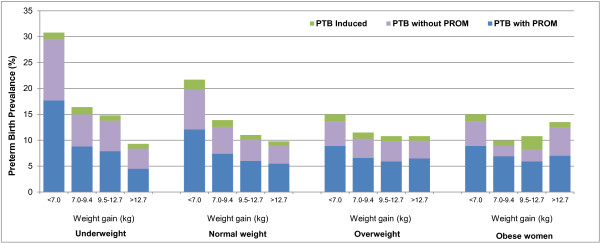
The rate of spontaneous preterm birth with PROM among overweight women decreased with increasing weight gain but increased among women who had excessive weight gain. Similarly, a U-shaped rate of spontaneous preterm birth with and without PROM was observed in obese women. Gaining less weight was protective of spontaneous preterm with and without PROM among overweight and obese women compared to normal weight women. Among underweight women, gaining < 7 kg or 9.5-12.7 kg was associated with increased odds of indicated preterm birth. Appreciable differences were also observed in the association between pre-pregnancy BMI, gestational weight gain and the subtypes of preterm births among African Americans and Caucasian Americans.
Reduced weight gain during pregnancy among overweight and obese women is associated with reduced spontaneous preterm birth with and without PROM. Health care professionals and public health workers should be aware of this risk and adhere to the 2009 IOM guideline that recommended reduced weight gain during pregnancy for obese and overweight women.
孕妇肥胖是一个影响母亲及其后代的主要问题。关于肥胖对早产影响的文献并不一致,很少有研究调查孕期体重增加的影响。本研究探讨了孕妇孕前体重指数(BMI)和孕期体重增加对早产的影响。
分析了协作围产期项目(CPP)中45824名单胎、活产且无严重先天性异常婴儿的孕妇的数据。主要结局变量包括早产(妊娠<37周),分为有胎膜早破(PROM)和无胎膜早破的自发性早产以及医源性早产。孕妇BMI分为体重过轻(BMI<18.50)、正常体重(BMI = 18.50 - 24.99)、超重(BMI = 25.00 - 29.99)和肥胖(BMI≥30.00)。进行多项回归分析并计算比值比(OR)和95%置信区间(CI)。
超重女性中伴有PROM的自发性早产率随体重增加而降低,但在体重过度增加的女性中则升高。同样,在肥胖女性中观察到有无PROM的自发性早产率呈U形。与正常体重女性相比,超重和肥胖女性体重增加较少可预防有无PROM的自发性早产。在体重过轻的女性中,体重增加<7kg或9.5 - 12.7kg与医源性早产几率增加有关。非裔美国人和白人美国人在孕前BMI、孕期体重增加与早产亚型之间的关联也存在明显差异。
超重和肥胖女性孕期体重增加减少与有无PROM的自发性早产减少有关。医疗保健专业人员和公共卫生工作者应意识到这种风险,并遵循2009年美国医学研究所(IOM)的指南,该指南建议肥胖和超重女性孕期减少体重增加。