Heinzelmann Morgan, Gill Jessica
National Institute of Nursing Research, National Institutes of Health, Bethesda, MD 20814, USA.
Nurs Res Pract. 2013;2013:417010. doi: 10.1155/2013/417010. Epub 2013 Apr 17.
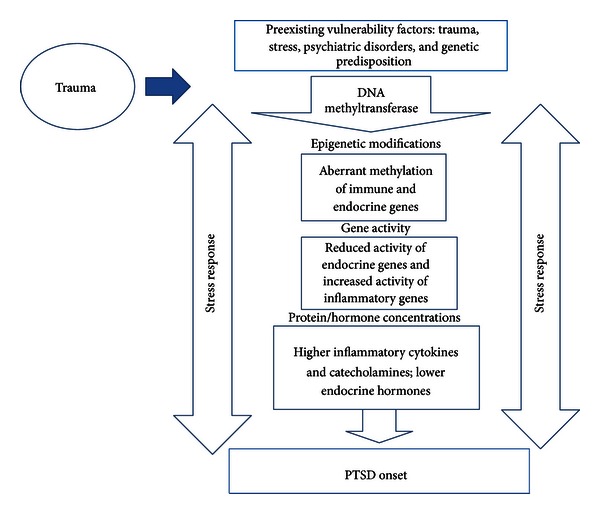
Posttraumatic stress disorder (PTSD) develops in approximately one-quarter of trauma-exposed individuals, leading us and others to question the mechanisms underlying this heterogeneous response to trauma. We suggest that the reasons for the heterogeneity relate to a complex interaction between genes and the environment, shaping each individual's recovery trajectory based on both historical and trauma-specific variables. Epigenetic modifications provide a unique opportunity to elucidate how preexisting risk factors may contribute to PTSD risk through changes in the methylation of DNA. Preexisting risks for PTSD, including depression, stress, and trauma, result in differential DNA methylation of endocrine genes, which may then result in a different biological responses to trauma and subsequently a greater risk for PTSD onset. Although these relationships are complex and currently inadequately described, we provide a critical review of recent studies to examine how differences in genetic and proteomic biomarkers shape an individual's vulnerability to PTSD development, thereby contributing to a heterogeneous response to trauma.
创伤后应激障碍(PTSD)在约四分之一遭受创伤的个体中出现,这促使我们及其他人去探究这种对创伤的异质性反应背后的机制。我们认为,这种异质性的原因与基因和环境之间的复杂相互作用有关,基于历史和创伤特异性变量塑造了每个人的康复轨迹。表观遗传修饰提供了一个独特的机会来阐明先前存在的风险因素如何通过DNA甲基化的变化导致PTSD风险。PTSD的先前风险,包括抑郁、压力和创伤,会导致内分泌基因的DNA甲基化差异,这可能进而导致对创伤的不同生物学反应,随后PTSD发病风险更高。尽管这些关系很复杂且目前描述不足,但我们对近期研究进行了批判性综述,以研究遗传和蛋白质组学生物标志物的差异如何塑造个体对PTSD发展的易感性,从而导致对创伤的异质性反应。