Loffeld R J L F, Dekkers P E P
Department of Internal Medicine and Gastroenterology, Zaans Medical Centre, P.O. BOX 210, 1500 EE Zaandam, The Netherlands.
ISRN Gastroenterol. 2013 Apr 24;2013:205417. doi: 10.1155/2013/205417. Print 2013.
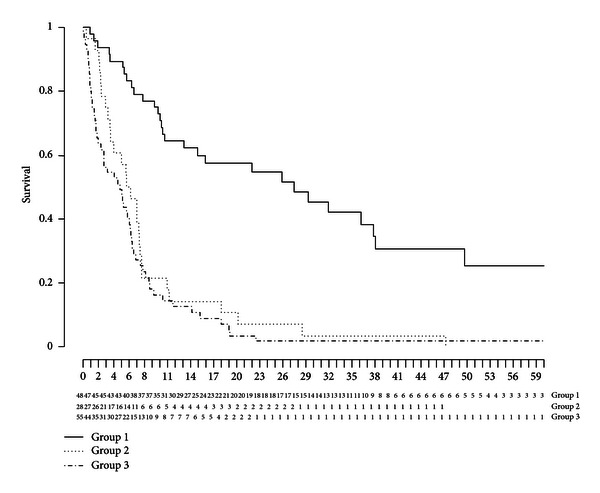
Introduction. Studied patients with oesophageal cancer do not represent normal daily presentation. Aim. A retrospective study was done in all consecutive patients in order to describe presentation, treatment, and survival. Patients. All patients in a ten-year period were included. Patients were grouped in three groups. Group 1: no metastases and potentially curable, dead, or alive at time of evaluation. Group 2: patients presenting with metastases and treated with palliative chemotherapy, and group 3: patients with or without metastases but untreatable because of low Karnofsky index or important comorbidity rendering treatment not feasible. Results. One hundred thirty one evaluable patients were included. There was no difference in histological type of the tumour. Patients in group 3 were significantly older. Survival was not different between groups 2 and 3. Survival in group 1 was significantly longer (P < 0.0001) compared with groups 2 and 3. Patients in group 1 received treatment with chemoradiation and surgery. Patients in groups 2 and 3 were more often treated with palliative chemotherapy and endoscopic stenting. Conclusion. The overall survival of oesophageal cancer in normal daily life is poor. Supportive care seems to be the best treatment option in patients with metastases or low Karnofsky index. Palliative chemotherapy does not add to overall survival.
引言。所研究的食管癌患者并不代表日常的常见病例。目的。对所有连续的患者进行回顾性研究,以描述其临床表现、治疗情况和生存情况。患者。纳入了十年期间的所有患者。患者被分为三组。第1组:无转移且有可能治愈,在评估时已死亡或存活。第2组:出现转移并接受姑息化疗的患者,第3组:有或无转移但因卡诺夫斯基指数低或有严重合并症而无法进行治疗的患者。结果。纳入了131例可评估的患者。肿瘤的组织学类型无差异。第3组患者年龄明显更大。第2组和第3组的生存率无差异。与第2组和第3组相比,第1组的生存时间明显更长(P < 0.0001)。第1组患者接受了放化疗和手术治疗。第2组和第3组患者更多地接受了姑息化疗和内镜支架置入术。结论。食管癌在日常生活中的总体生存率较差。对于有转移或卡诺夫斯基指数低的患者,支持治疗似乎是最佳治疗选择。姑息化疗并不能提高总体生存率。