Department of Epidemiology and Public Health, Swiss Tropical and Public Health Institute, Basel, Switzerland.
BMC Health Serv Res. 2013 May 28;13:198. doi: 10.1186/1472-6963-13-198.
The role of socio-cultural factors in influencing access to HIV/AIDS treatment, care and support is increasingly recognized by researchers, international donors and policy makers. Although many of them have been identified through qualitative studies, the evidence gathered by quantitative studies has not been systematically analysed. To fill this knowledge gap, we did a systematic review of quantitative studies comparing surveys done in high and low income countries to assess the extent to which socio-cultural determinants of access, identified through qualitative studies, have been addressed in epidemiological survey studies.
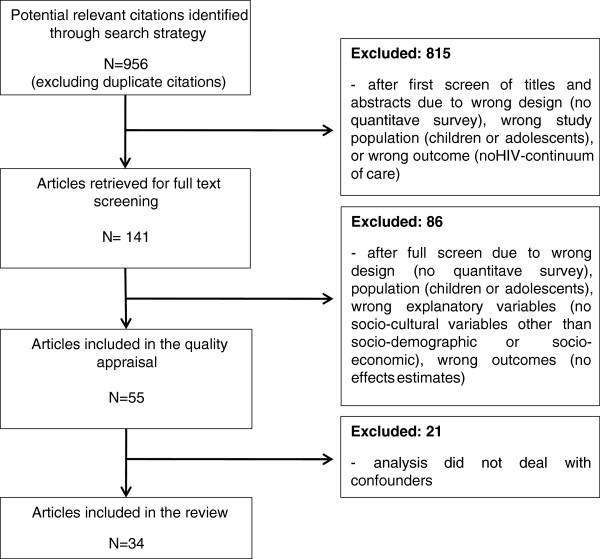
Ten electronic databases were searched (Cinahl, EMBASE, ISI Web of Science, IBSS, JSTOR, MedLine, Psyinfo, Psyindex and Cochrane). Two independent reviewers selected eligible publications based on the inclusion/exclusion criteria. Meta-analysis was used to synthesize data comparing studies between low and high income countries.
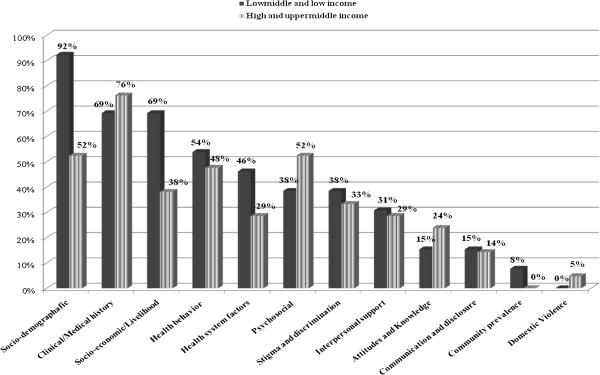
Thirty-four studies were included in the final review, 21 (62%) done in high income countries and 13 (38%) in low income countries. In low income settings, epidemiological research on access to HIV/AIDS services focused on socio-economic and health system factors while in high income countries the focus was on medical and psychosocial factors. These differences depict the perceived different barriers in the two regions. Common factors between the two regions were also found to affect HIV testing, including stigma, high risk sexual behaviours such as multiple sexual partners and not using condoms, and alcohol abuse. On the other hand, having experienced previous illness or other health conditions and good family communication was associated with adherence to ART uptake. Due to insufficient consistent data, a meta-analysis was only possible on adherence to treatment.
This review offers evidence of the current challenges for interdisciplinary work in epidemiology and public health. Quantitative studies did not systematically address in their surveys important factors identified in qualitative studies as playing a critical role on the access to HIV/AIDS services. The evidences suggest that the problem lies in the exclusion of the qualitative information during the questionnaire design. With the changing face of the epidemic, we need a new and improved research strategy that integrates the results of qualitative studies into quantitative surveys.
社会文化因素在影响艾滋病毒/艾滋病治疗、护理和支持的获取方面的作用越来越受到研究人员、国际捐助者和政策制定者的认可。尽管其中许多因素是通过定性研究确定的,但定量研究收集的证据尚未得到系统分析。为了填补这一知识空白,我们对定量研究进行了系统回顾,比较了在高收入和低收入国家进行的调查,以评估通过定性研究确定的获得机会的社会文化决定因素在流行病学调查研究中得到了多大程度的解决。
检索了 10 个电子数据库(CINHAL、EMBASE、ISI Web of Science、IBSS、JSTOR、MedLine、PsycINFO、PsycINDEX 和 Cochrane)。两名独立评审员根据纳入/排除标准选择符合条件的出版物。使用荟萃分析综合比较高收入和低收入国家研究的研究数据。
最终审查包括 34 项研究,其中 21 项(62%)在高收入国家进行,13 项(38%)在低收入国家进行。在低收入环境中,关于获得艾滋病毒/艾滋病服务的流行病学研究侧重于社会经济和卫生系统因素,而在高收入国家,重点是医疗和心理社会因素。这些差异描绘了两个地区不同的感知障碍。两个地区共同发现的影响艾滋病毒检测的因素包括耻辱感、多个性伴侣和不使用避孕套等高危性行为以及酗酒。另一方面,经历过先前疾病或其他健康状况以及良好的家庭沟通与接受抗逆转录病毒治疗的依从性相关。由于缺乏一致的充足数据,仅对治疗的依从性进行了荟萃分析。
本综述提供了当前在流行病学和公共卫生领域跨学科工作面临的挑战的证据。定量研究在其调查中没有系统地解决定性研究确定的重要因素,这些因素被认为在获得艾滋病毒/艾滋病服务方面发挥着关键作用。这些证据表明,问题在于在问卷设计过程中排除了定性信息。随着疫情形势的变化,我们需要一种新的、改进的研究策略,将定性研究的结果纳入定量调查。