Institute of Psychiatric Research, Department of Psychiatry, Indiana University School of Medicine, Indiana University-Purdue University at Indianapolis, Indianapolis, IN 46202, USA.
Alcohol. 2013 Aug;47(5):367-80. doi: 10.1016/j.alcohol.2013.04.002. Epub 2013 May 25.
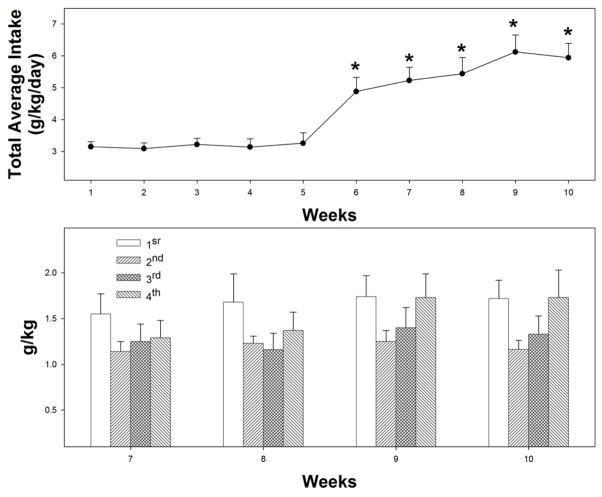
The objective of this study was to detect changes in gene expression in the ventral tegmental area (VTA) following repeated excessive binge-like ('loss-of-control') alcohol drinking by alcohol-preferring (P) rats. Adult female P rats (n = 7) were given concurrent access to 10, 20, and 30% EtOH for 4 1-h sessions daily for 10 weeks followed by 2 cycles of 2 weeks of abstinence and 2 weeks of EtOH access. Rats were sacrificed by decapitation 3 h after the 4th daily EtOH-access session at the end of the second 2-week relapse period. A water-control group of female P rats (n = 8) was also sacrificed. RNA was prepared from micro-punch samples of the VTA from individual rats; analyses were conducted with Affymetrix Rat 230.2 GeneChips. Ethanol intakes were 1.2-1.7 g/kg per session, resulting in blood levels >200 mg% at the end of the 4th session. There were 211 unique named genes that significantly differed (FDR = 0.1) between the water and EtOH groups. Bioinformatics analyses indicated alterations in a) transcription factors that reduced excitation-coupled transcription and promoted excitotoxic neuronal damage involving clusters of genes associated with Nfkbia, Fos, and Srebf1, b) genes that reduced cholesterol and fatty acid synthesis, and increased protein degradation, and c) genes involved in cell-to-cell interactions and regulation of the actin cytoskeleton. Among the named genes, there were 62 genes that showed differences between alcohol-naïve P and non-preferring (NP) rats, with 43 of the genes changing toward NP-like expression levels following excessive binge-like drinking in the P rats. These genes are involved in a pro-inflammatory response, and enhanced response to glucocorticoids and steroid hormones. Overall, the results of this study indicate that the repeated excessive binge-like alcohol drinking can change the expression of genes that may alter neuronal function in several ways, some of which may be deleterious.
这项研究的目的是检测在反复过度 binge-like(“失控”)酒精摄入后,腹侧被盖区(VTA)中的基因表达变化。成年雌性 P 大鼠(n=7)每天同时接受 10%、20%和 30% EtOH 的连续访问,持续 10 周,然后进行 2 个周期的 2 周禁欲和 2 周 EtOH 访问。在第二次 2 周复发期间结束时的第 4 个每日 EtOH 访问后的 3 小时,通过断头处死大鼠。雌性 P 大鼠的水对照组(n=8)也被处死。从个别大鼠的 VTA 微穿刺样本中制备 RNA;使用 Affymetrix Rat 230.2 GeneChips 进行分析。乙醇摄入量为每次 1.2-1.7 g/kg,在第 4 次会议结束时血液水平> 200 mg%。在水和 EtOH 组之间有 211 个独特的命名基因显著不同(FDR=0.1)。生物信息学分析表明,转录因子的改变减少了兴奋耦合转录,并促进了涉及与 Nfkbia、Fos 和 Srebf1 相关基因簇的兴奋性神经元损伤,b)减少胆固醇和脂肪酸合成,增加蛋白质降解的基因,和 c)参与细胞间相互作用和肌动蛋白细胞骨架调节的基因。在命名基因中,有 62 个基因在酒精-naïve P 和非偏好(NP)大鼠之间存在差异,其中 43 个基因在 P 大鼠过度 binge-like 饮酒后向 NP 样表达水平变化。这些基因参与炎症反应,并增强对糖皮质激素和类固醇激素的反应。总的来说,这项研究的结果表明,反复过度 binge-like 酒精摄入会改变基因的表达,这些基因的表达可能以多种方式改变神经元功能,其中一些可能是有害的。