Division of Pulmonary, Critical Care and Sleep Medicine, Department of Internal Medicine, University of Cincinnati, 231 Albert Sabin Way, MSB Room 6053, ML 0564, Cincinnati, OH, 45267, USA,
Fam Cancer. 2013 Sep;12(3):387-96. doi: 10.1007/s10689-013-9660-9.
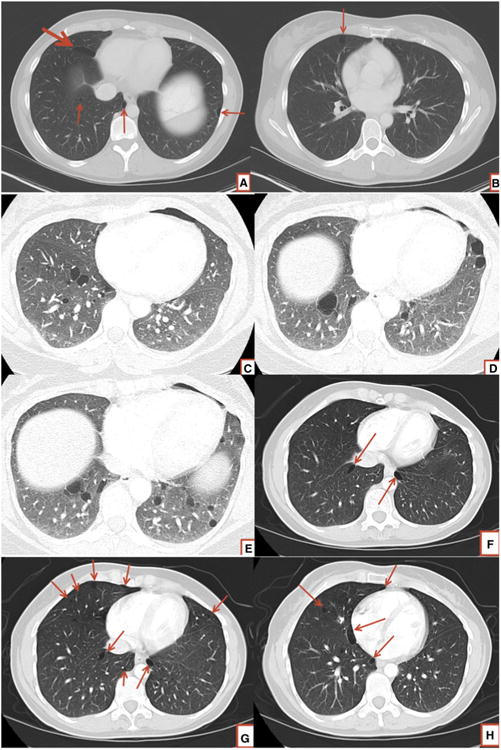
Birt-Hogg-Dubé syndrome (BHD) is a rare, autosomal dominant disorder characterized by the development of hair follicle tumors, renal tumors and pulmonary cysts. BHD is caused by heterozygous, predominantly truncating mutations in the folliculin (FLCN) gene located on chromosome 17, which encodes a highly conserved tumor suppressor protein. Although management of renal tumors of low malignant potential is the primary focus of longitudinal care, pulmonary manifestations including cyst formation and spontaneous pneumothorax are among the most common manifestations in BHD. Due to the lack of awareness, there is commonly a delay in the pulmonary diagnosis of BHD and patients are frequently mislabeled as having chronic obstructive lung disease, emphysema or common bullae/blebs. A family history of pneumothorax is present in 35 % of patients with BHD. Certain imaging characteristics of the cysts, including size, basilar and peripheral predominance, perivascular and periseptal localization, and elliptical or lentiform shape can suggest the diagnosis of BHD based on inspection of the chest CT scan alone. Recurrent pneumothoraces are common and early pleurodesis is recommended. A better understanding of role of FLCN in pulmonary cyst formation and long term studies to define the natural history of the pulmonary manifestations of BHD are needed.
Birt-Hogg-Dubé 综合征(BHD)是一种罕见的常染色体显性遗传疾病,其特征为毛囊肿瘤、肾肿瘤和肺囊肿的发展。BHD 由位于 17 号染色体上的滤泡素(FLCN)基因突变引起,该基因突变杂合,主要为截断突变,编码一种高度保守的肿瘤抑制蛋白。虽然低恶性潜能肾肿瘤的管理是纵向护理的主要重点,但包括囊肿形成和自发性气胸在内的肺部表现是 BHD 中最常见的表现之一。由于缺乏认识,BHD 的肺部诊断通常存在延迟,患者经常被误诊为慢性阻塞性肺病、肺气肿或常见大疱/疱。35%的 BHD 患者有气胸家族史。根据胸部 CT 扫描的单独检查,囊肿的某些影像学特征,包括大小、基底和周边优势、血管周围和血管周围定位以及椭圆形或半月形形状,可提示 BHD 的诊断。复发性气胸很常见,建议早期胸膜固定术。需要更好地了解 FLCN 在肺囊肿形成中的作用,并进行长期研究以确定 BHD 肺部表现的自然史。