Department of Oriental Medical Food & Nutrition, Semyung University, Jecheon 390-711, Korea.
J Ginseng Res. 2012 Jan;36(1):102-6. doi: 10.5142/jgr.2012.36.1.102.
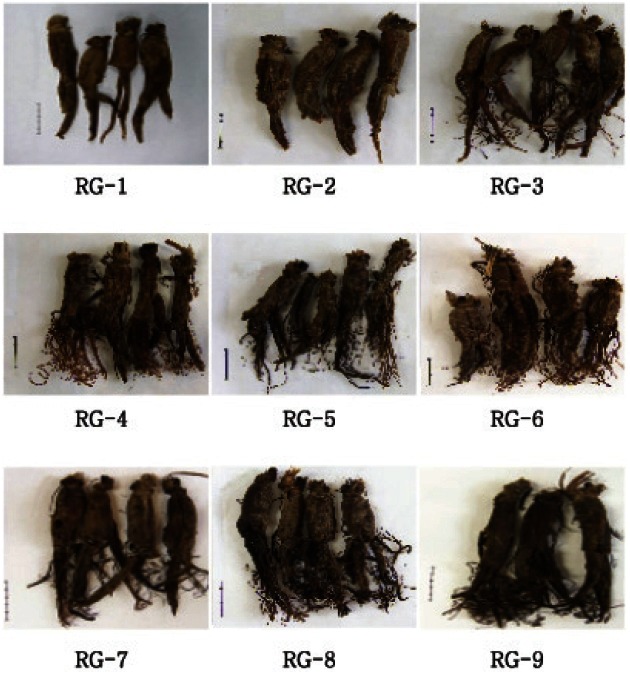
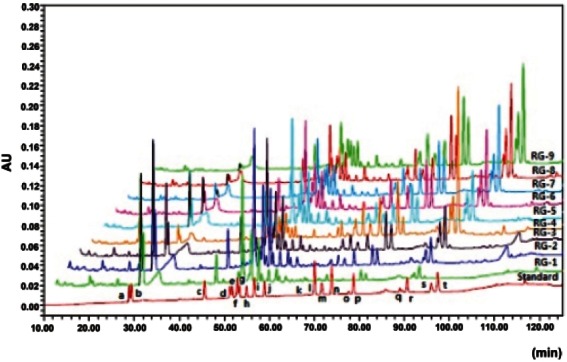
This study compared the contents of ginsenosides depending on steaming conditions of red ginsengs to provide basic information for developing functional foods using red ginsengs. The red ginseng steamed eight times at 98℃ ranked atop the amounts of prosapogenins ever detected in red ginsengs (ginsenoside Rg2, Rg3, Rg5, Rg6, Rh1, Rh4, Rk1, Rk3, F1, F4, 1.15%) among red ginsengs steamed more than twice. When steamed eight times at 98℃, 2.7 times as much prosapogenins such as ginsenosides Rg2, Rg3, Rg5, Rg6, Rh1, Rh4, Rk1, Rk3, F1, and F4 as those steamed just once at 98℃ was collected. In addition, the red ginsengs steamed eight times at 98℃ contained more amounting ginsenoside Rg3 (0.28%) than that in the red ginseng steamed several times at random. Accordingly, it is recommendable that red ginsengs steamed 8 times, which proved to be the optimal steaming condition, be used rather than those steamed 9 times (black ginsengs), in order to develop red ginseng products of high prosapogenin concentration and high functions.
本研究比较了不同蒸制条件下红参中人参皂苷的含量,为开发红参功能性食品提供了基础信息。在 98℃条件下蒸制 8 次的红参中,从前几代人参皂苷中检测到的人参皂苷含量最高(人参皂苷 Rg2、Rg3、Rg5、Rg6、Rh1、Rh4、Rk1、Rk3、F1、F4、1.15%),超过了两次以上蒸制的红参。在 98℃条件下蒸制 8 次,可收集到比在 98℃条件下蒸制一次多 2.7 倍的前体皂苷,如人参皂苷 Rg2、Rg3、Rg5、Rg6、Rh1、Rh4、Rk1、Rk3、F1 和 F4。此外,在 98℃条件下蒸制 8 次的红参中,人参皂苷 Rg3(0.28%)的含量高于随机蒸制多次的红参。因此,为了开发高浓度前体皂苷和高功能的红参产品,建议使用经过验证的最佳蒸制条件(8 次)的红参,而不是 9 次蒸制(黑参)的红参。