National Engineering Laboratory for Tree Breeding, College of Biological Sciences and Biotechnology, Beijing Forestry University, Beijing, 100083, China.
Sci Rep. 2021 Jan 15;11(1):1513. doi: 10.1038/s41598-021-81079-w.
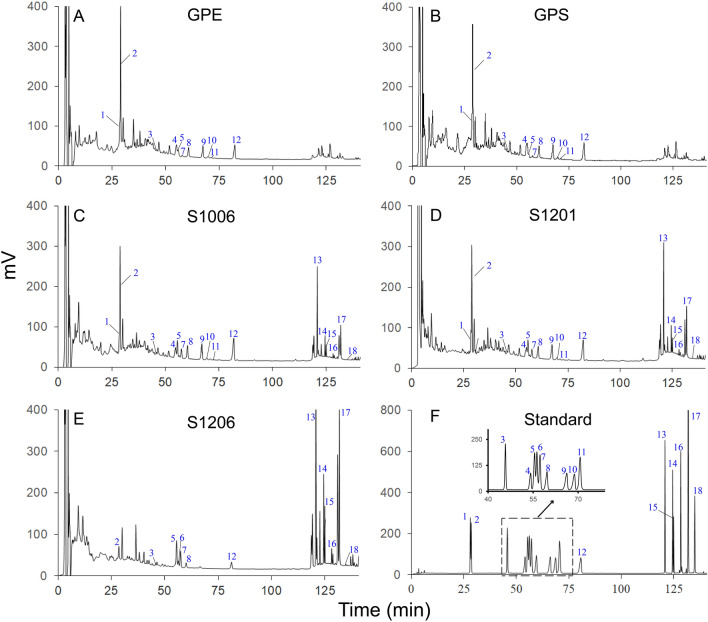
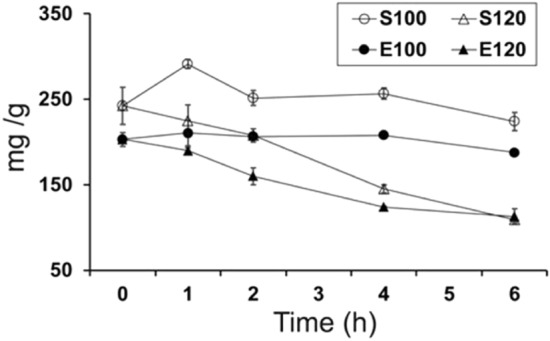
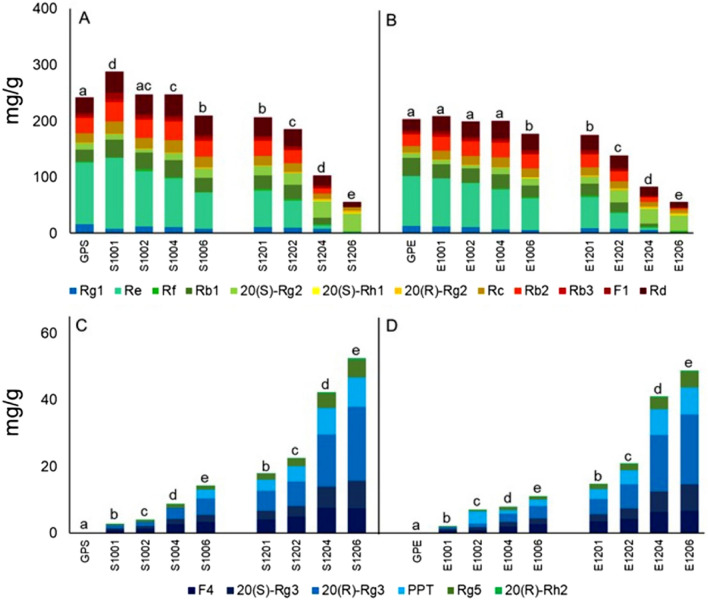
The present study was conducted to qualitatively and quantitatively elucidate dynamic changes of ginsenosides in ginseng pulp steamed under different temperatures (100 or 120 °C) for different durations (1-6 h) through UPLC-QTOF-MS/MS and HPLC with the aid of as numerous as 18 authentic standards of ginsenosides. Results show that levels of eight polar ginsenosides (i.e., Rg, Re, Rb, Rc, Rb, Rb, F, and Rd) declined but those of 10 less-polar ginsenosides [i.e., Rf, Rg, 20(S)-Rh, 20(R)-Rg, F, 20(S)-Rg, 20(R)-Rg, PPT, Rg, and 20(R)-Rh] elevated with increases of both steaming temperature and duration; the optimum steaming conditions for achieving the highest total ginsenosides were 100 °C for 1 h. Particular, 20(R)-Rg, a representative less-polar ginsenoside with high bioactivity such as potent anti-cancer effect, increased sharply but Re, the most abundant polar ginsenoside in fresh ginseng pulp, decreased dramatically. More importantly, ginsenoside species enhanced from 18 to 42 after steaming, mainly due to transformation of polar into less-polar ginsenosides. Furthermore, four malonyl-ginsenosides were detected in fresh ginseng pulps and ten acetyl-ginsenosides were formed during steaming, demonstrating that demalonylation and acetylation of ginsenosides were the dominant underling mechanisms for transformation of polar into less-polar ginsenosides.
本研究通过 UPLC-QTOF-MS/MS 和 HPLC 结合多达 18 种人参皂苷标准品,定性和定量阐明了不同温度(100 或 120°C)和不同时间(1-6 小时)下蒸制的人参果肉中人参皂苷的动态变化。结果表明,八种极性人参皂苷(Rg、Re、Rb、Rc、Rd、Rb、Rb、F)的水平下降,但十种非极性人参皂苷[Rf、Rg、20(S)-Rh、20(R)-Rg、F、20(S)-Rg、20(R)-Rg、PPT、Rg、20(R)-Rh]的水平随着蒸制温度和时间的增加而升高;达到最高总人参皂苷的最佳蒸制条件为 100°C 1 小时。特别是 20(R)-Rg,一种具有高生物活性的代表性非极性人参皂苷,如具有强大的抗癌作用,急剧增加,但 Re,新鲜人参果肉中最丰富的极性人参皂苷,急剧减少。更重要的是,蒸制后人参皂苷种类从 18 种增加到 42 种,主要是由于极性人参皂苷向非极性人参皂苷转化。此外,在新鲜人参果肉中检测到四种丙二酰基人参皂苷,在蒸制过程中形成了十种乙酰基人参皂苷,表明人参皂苷的脱丙二酰基和乙酰化是极性人参皂苷向非极性人参皂苷转化的主要内在机制。