Section of Geriatric Psychiatry, Department of Clinical Sciences, Lund University Hospital, Klinikgatan 22, Lund SE-221 85, Sweden.
BMC Neurol. 2013 May 29;13:54. doi: 10.1186/1471-2377-13-54.
Frontotemporal dementia (FTD) is recognised as a clinically and morphologically heterogeneous group of interrelated neurodegenerative conditions. One of the subtypes within this disease spectrum is the behavioural variant FTD (bvFTD). This is known to be a varied disorder with a mixture of tau-positive and tau-negative underlying pathologies. The other subtypes include semantic dementia (SD), which generally exhibits tau-negative pathology, and progressive non-fluent aphasia (PNFA), which is usually tau-positive. As the clinical presentation of these subtypes may overlap, a specific diagnosis can be difficult to attain and today no specific biomarker can predict the underlying pathology. Neurofilament light chain protein (NFL), a cytoskeletal constituent of intermediate filaments, is thought to reflect neuronal and axonal death when appearing in the cerebrospinal fluid (CSF). NFL has been shown to be elevated in CSF in patients with FTD compared with AD and controls. Our hypothesis was that the levels of NFL also differ between the subtypes of FTD and may indicate the underlying pathological subtype.
We retrospectively analysed data from previous CSF analyses in 34 FTD cases (23 bvFTD, seven SD, four PNFA), 20 AD cases, and 26 healthy controls. A separate group of 10 neuropathologically verified and subtyped FTD cases (seven tau-negative, three tau-positive) were also analysed.
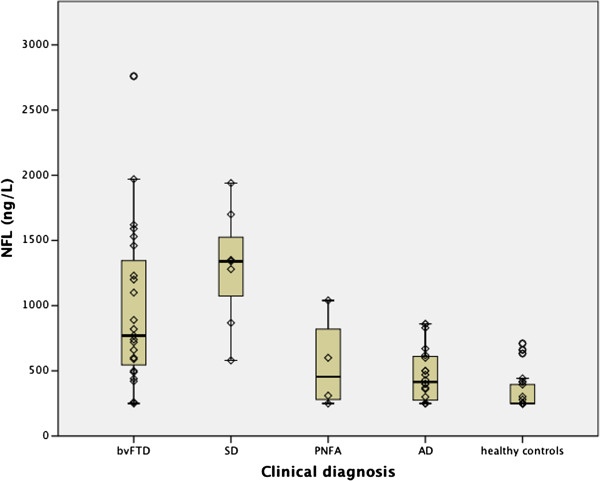
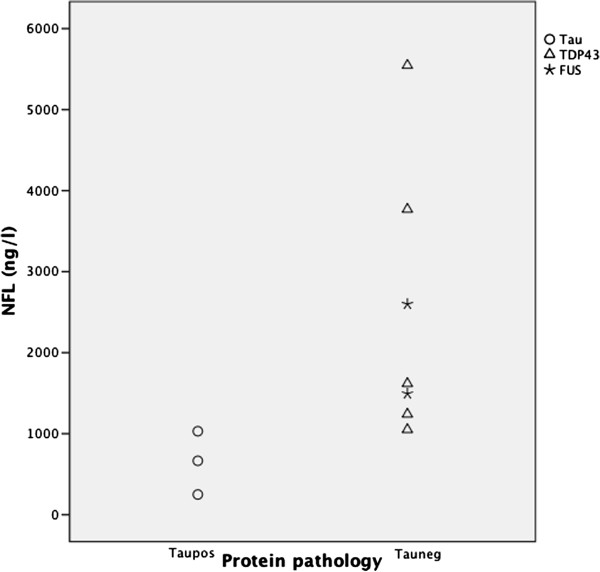
NFL levels were significantly higher in FTD compared with both AD (p<0.001) and controls (p<0.001). The NFL levels of SD and bvFTD were significantly higher (p<0.001) compared with AD. The biomarker profiles of PNFA and AD were similar. In the neuropathologically verified FTD cases, NFL was higher in the tau-negative than in the tau-positive cases (exact p=0.017).
The marked NFL elevation in some but not all FTD cases is likely to reflect the different underlying pathologies. The highest NFL values found in the SD group as well as in the neuropathologically verified tau-negative cases may be of subtype diagnostic value, if corroborated in larger patient cohorts. In bvFTD, a mixture of tau-positive and tau-negative underlying pathologies could possibly explain the intermediate NFL values.
额颞叶痴呆(FTD)被认为是一组具有临床和形态学异质性的相关神经退行性疾病。该病谱中的一个亚型是行为变异型额颞叶痴呆(bvFTD)。这种疾病表现多样,既有 tau 阳性也有 tau 阴性的潜在病理。其他亚型包括语义性痴呆(SD),通常表现为 tau 阴性病理,以及进行性非流利性失语症(PNFA),通常为 tau 阳性。由于这些亚型的临床表现可能重叠,因此很难做出特定的诊断,目前也没有特定的生物标志物可以预测潜在的病理。神经丝轻链蛋白(NFL)是中间丝的细胞骨架成分,当出现在脑脊液(CSF)中时,被认为反映了神经元和轴突的死亡。与 AD 和对照组相比,FTD 患者的 CSF 中 NFL 升高。我们的假设是,FTD 各亚型之间的 NFL 水平也不同,可能表明潜在的病理亚型。
我们回顾性分析了 34 例 FTD 病例(23 例 bvFTD、7 例 SD、4 例 PNFA)、20 例 AD 病例和 26 例健康对照的 CSF 分析数据。还分析了一组 10 例经神经病理学证实并分型的 FTD 病例(7 例 tau 阴性,3 例 tau 阳性)。
FTD 患者的 NFL 水平明显高于 AD(p<0.001)和对照组(p<0.001)。SD 和 bvFTD 的 NFL 水平明显高于 AD(p<0.001)。PNFA 和 AD 的生物标志物谱相似。在神经病理学证实的 FTD 病例中,tau 阴性病例的 NFL 水平高于 tau 阳性病例(确切 p=0.017)。
一些而非所有 FTD 病例中明显的 NFL 升高可能反映了不同的潜在病理。在 SD 组以及神经病理学证实的 tau 阴性病例中发现的最高 NFL 值可能具有亚型诊断价值,如果在更大的患者队列中得到证实。在 bvFTD 中,tau 阳性和 tau 阴性潜在病理的混合可能可以解释中间 NFL 值。