Department of Biological and Environmental Science, University of Sannio Benevento, Italy.
Front Physiol. 2013 May 16;4:112. doi: 10.3389/fphys.2013.00112. eCollection 2013.
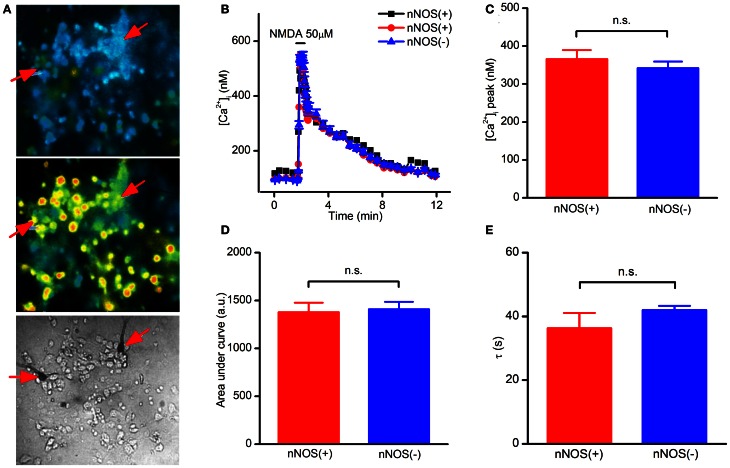
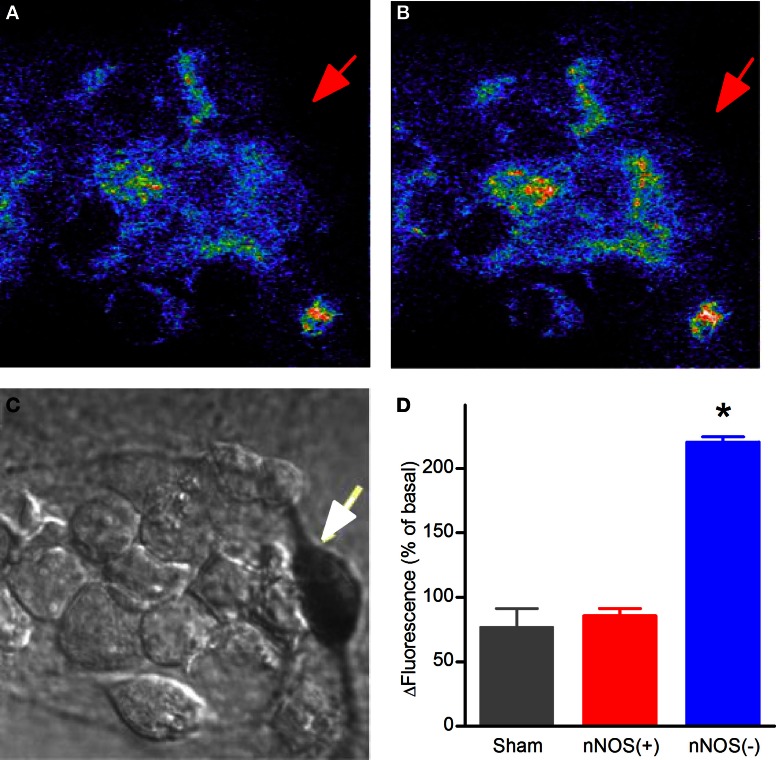
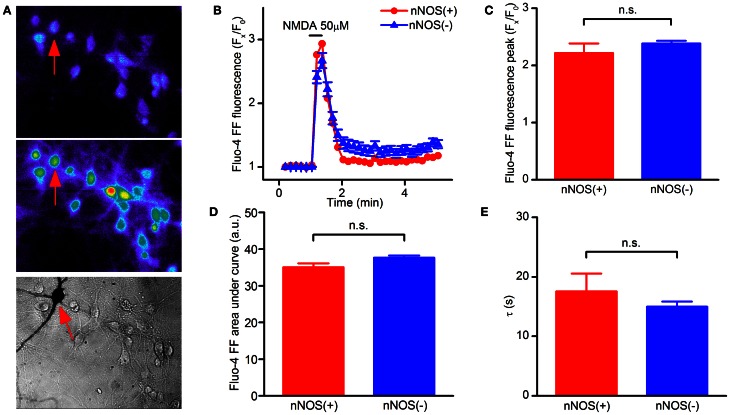
Huntington's disease (HD) is a neurodegenerative condition characterized by severe neuronal loss in the cortex and striatum that leads to motor and behavioral deficits. Excitotoxicity is thought to be involved in HD and several studies have indicated that NMDA receptor (NMDAR) overactivation can play a role in the selective neuronal loss found in HD. Interestingly, a small subset of striatal neurons (less than 1% of the overall population) is found to be spared in post-mortem HD brains. These neurons are medium-sized aspiny interneurons that highly express the neuronal isoform of nitric oxide synthase (nNOS). Intriguingly, neurons expressing large amounts of nNOS [hereafter indicated as nNOS(+) neurons] show reduced vulnerability to NMDAR-mediated excitotoxicity. Mechanisms underlying this reduced vulnerability are still largely unknown and may shed some light on pathogenic mechanisms involved in HD. One untested possibility is that nNOS(+) neurons possess fewer or less functioning NMDARs. Employing single cell calcium imaging we challenged this hypothesis and found that cultured striatal nNOS(+) neurons show NMDAR-evoked responses that are identical to the ones observed in the overall population of neurons that express lower levels of nNOS [nNOS(-) neurons]. NMDAR-dependent deregulation of intraneuronal Ca(2+) is known to generate high levels of reactive oxygen species of mitochondrial origin (mt-ROS), a crucial step in the excitotoxic cascade. With confocal imaging and dihydrorhodamine (DHR; a ROS-sensitive probe) we compared mt-ROS levels generated by NMDAR activation in nNOS(+) and (-) cultured striatal neurons. DHR experiments revealed that nNOS(+) neurons failed to produce significant amounts of mt-ROS in response to NMDA exposure, thereby providing a potential mechanism for their reduced vulnerability to excitotoxicity and decreased vulnerability in HD.
亨廷顿病(HD)是一种神经退行性疾病,其特征是皮质和纹状体中严重的神经元丧失,导致运动和行为缺陷。兴奋性毒性被认为与 HD 有关,几项研究表明 NMDA 受体(NMDAR)过度激活可能在 HD 中发现的选择性神经元丧失中发挥作用。有趣的是,在死后的 HD 大脑中发现一小部分纹状体神经元(不到总体人群的 1%)幸免遇难。这些神经元是中等大小的无棘突中间神经元,高度表达神经元型一氧化氮合酶(nNOS)。有趣的是,表达大量 nNOS 的神经元 [以下简称 nNOS(+)神经元] 表现出对 NMDAR 介导的兴奋性毒性的降低易感性。这种降低易感性的机制在很大程度上仍然未知,并且可能为 HD 中涉及的发病机制提供一些线索。一个未经测试的可能性是 nNOS(+)神经元具有较少或较少功能的 NMDAR。我们采用单细胞钙成像技术来检验这一假说,结果发现培养的纹状体 nNOS(+)神经元表现出与表达较低水平 nNOS 的神经元总体群体 [nNOS(-)神经元] 观察到的相同的 NMDAR 诱发反应。众所周知,NMDAR 依赖性的神经元内 Ca(2+) 失调会产生高水平的线粒体来源的活性氧物种(mt-ROS),这是兴奋性级联反应中的一个关键步骤。通过共聚焦成像和二氢罗丹明(DHR;一种 ROS 敏感探针),我们比较了 NMDAR 激活在 nNOS(+)和 (-)培养的纹状体神经元中产生的 mt-ROS 水平。DHR 实验表明,nNOS(+)神经元在 NMDA 暴露下未能产生大量的 mt-ROS,从而为它们对兴奋性毒性的降低易感性和 HD 中的降低易感性提供了潜在的机制。