Burkovski Andreas
Lehrstuhl für Mikrobiologie, Friedrich-Alexander-Universität Erlangen-Nürnberg, Staudtstr β e 5, 91058 Erlangen, Germany.
ISRN Microbiol. 2013 Jan 21;2013:935736. doi: 10.1155/2013/935736. Print 2013.
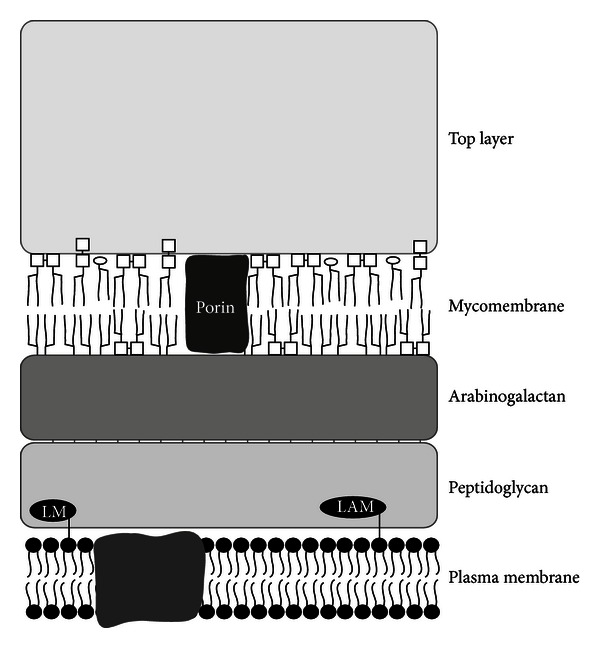
To date the genus Corynebacterium comprises 88 species. More than half of these are connected to human and animal infections, with the most prominent member of the pathogenic species being Corynebacterium diphtheriae, which is also the type species of the genus. Corynebacterium species are characterized by a complex cell wall architecture: the plasma membrane of these bacteria is followed by a peptidoglycan layer, which itself is covalently linked to a polymer of arabinogalactan. Bound to this, an outer layer of mycolic acids is found which is functionally equivalent to the outer membrane of Gram-negative bacteria. As final layer, free polysaccharides, glycolipids, and proteins are found. The composition of the different substructures of the corynebacterial cell envelope and their influence on pathogenicity are discussed in this paper.
迄今为止,棒状杆菌属包含88个物种。其中一半以上与人类和动物感染有关,致病物种中最突出的成员是白喉棒状杆菌,它也是该属的模式种。棒状杆菌属物种的特点是具有复杂的细胞壁结构:这些细菌的质膜之后是肽聚糖层,肽聚糖层本身与阿拉伯半乳聚糖聚合物共价连接。与之相连的是一层分枝菌酸外层,其功能等同于革兰氏阴性菌的外膜。作为最后一层,可发现游离多糖、糖脂和蛋白质。本文讨论了棒状杆菌细胞包膜不同亚结构的组成及其对致病性的影响。