From the Division of Treatment and Recovery Research (RZL, MLR, JBF DEF), National Institute on Alcohol Abuse and Alcoholism, Bethesda, MD; Department of Psychiatric Medicine (BJ, NAT), University of Virginia, Charlottesville, VA; Johns Hopkins University School of Medicine (KED, ECS), Baltimore, MD; Geisel School of Medicine at Dartmouth (AIG, MFB), Lebanon, NH; University of Pennsylvania Treatment Research Center (HMP, KK), Philadelphia, PA; Boston University School of Medicine (DAC, OS-S), Boston, MA; Fast Track Drugs and Biologics (JR, CS), North Potomac, MD; and Decision Sciences Institute/Pacific Institute for Research and Evaluation (RS), Pawtucket, RI. NCIG Study Group members are as follows: Boston Medical Center, Boston, MA and Quincy, MA (Joanna Piechniczek-Buczek, MD, Chris Streeter, MD, Eric Devine, PhD, Courtney Richambault, Laurie Sickles-Colaneri, RN); University of Virginia, Charlottesville, VA (Eva Jenkins-Mendoza, Sean Sembrowich, RN, Jennifer Kim Penberthy, PhD, Amanda Nizam, Nicole Fischer, Shari Steinman, Mindy Borszich); University of Virginia, Richmond, VA (Esther Makanjuola, RN, Tricia Schirmer, Kathryn Polak, Christina Hill, Kathryn Conley, Alison Eonta, Kasy Serdar, Aubrey Gartner, Amy Madigan); Geisel School of Medicine at Dartmouth, Hanover, NH and Bedford, NH (Audrey Kern, MD, Christopher O'Keefe, MS, Mirranda Boshart, Suzanne Miller, Shannon Rondeau, RN, Marjorie Weeks, Pamela Geiger); University of Pennsylvania, Treatment Research Center, Philadelphia, PA (Jennifer Plebani, PhD, William Dundon, PhD, Elizabeth Mahoney, MA, Gail Kaempf, CRPN, Brenda Beitler, APRN, Cynthia Clark, CPRN, Kelly Griffin, Joshua Lachewitz, Elizabeth Wilson, Margo Hendrickson, Tamara Roth, Laurie Downing, NP); and Johns Hopkins University School of Medicine (Joseph Harrison, MS, Kimberly Nelson, LPN, Ashley Bathgate, Connie Lowery, RN, Elana Schwartz, Torran Claiborne, Sarah Hersh).
J Addict Med. 2013 Jul-Aug;7(4):277-86. doi: 10.1097/ADM.0b013e31829623f4.
To assess the efficacy and safety of varenicline (Chantix) for the treatment of alcohol dependence. Varenicline is a partial α4β2 nicotinic acetylcholine agonist approved by the Food and Drug Administration for smoking cessation. It has reduced drinking in animal studies and in small studies of humans who were both heavy drinkers and smokers. This is the first multisite clinical trial of varenicline in a population of smokers and nonsmokers with alcohol dependence.
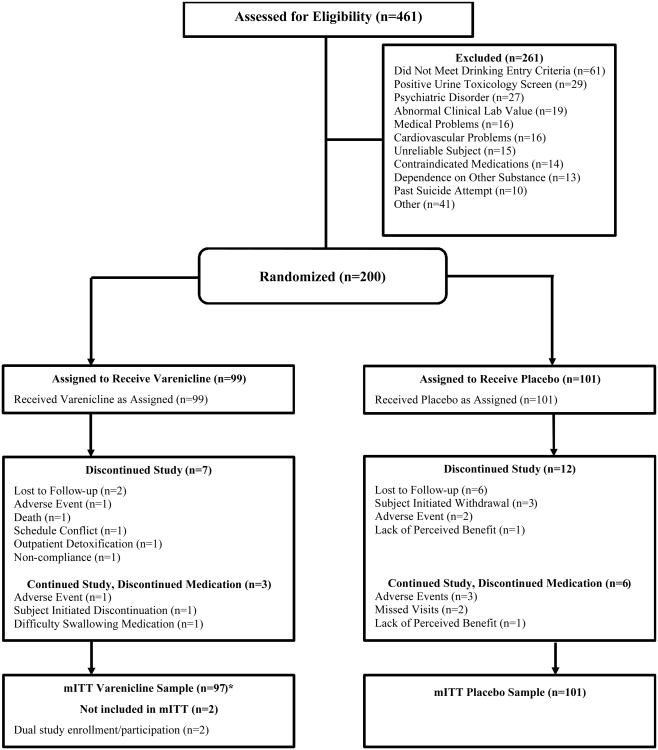
Men and women (n = 200) meeting the criteria for alcohol dependence were recruited across 5 clinical sites. Patients received double-blind varenicline or placebo and a computerized behavioral intervention. Varenicline was titrated during the first week to 2 mg/d, which was maintained during weeks 2 to 13.
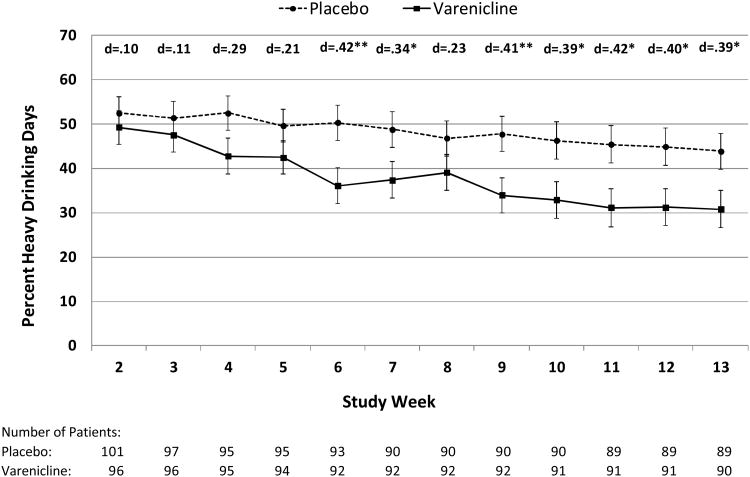
The varenicline group had significantly lower weekly percent heavy drinking days (primary outcome) (adjusted mean difference = 10.4), drinks per day, drinks per drinking day, and alcohol craving compared with the placebo group (P < 0.05). The average treatment effect on alcohol use was similar for smokers and nonsmokers. Varenicline was well-tolerated; adverse events were expected and mild.
Varenicline significantly reduced alcohol consumption and craving, making it a potentially viable option for the treatment of alcohol dependence.
评估伐伦克林(Chantix)治疗酒精依赖的疗效和安全性。伐伦克林是一种 α4β2 烟碱型乙酰胆碱受体部分激动剂,已被美国食品和药物管理局批准用于戒烟。它已在动物研究和同时酗酒和吸烟的少量人类研究中减少了饮酒量。这是首次在吸烟者和非吸烟者中有酒精依赖的人群中进行的伐伦克林多中心临床试验。
符合酒精依赖标准的男性和女性(n = 200)在 5 个临床中心招募。患者接受双盲伐伦克林或安慰剂和计算机化行为干预。在第一周内将伐伦克林滴定至 2mg/d,在第 2 周到第 13 周维持该剂量。
与安慰剂组相比,伐伦克林组每周重度饮酒天数(主要结局)(调整平均差异= 10.4)、每天饮酒量、每次饮酒日饮酒量和酒精渴求显著降低(P < 0.05)。吸烟者和非吸烟者的平均治疗效果相似。伐伦克林耐受性良好;不良反应是预期的,且为轻度。
伐伦克林显著减少了饮酒量和渴求,使其成为治疗酒精依赖的潜在可行选择。