Life Sciences Division, Lawrence Berkeley National Laboratory, Berkeley, California 94720, USA.
Nat Cell Biol. 2013 Jul;15(7):807-17. doi: 10.1038/ncb2767. Epub 2013 Jun 2.
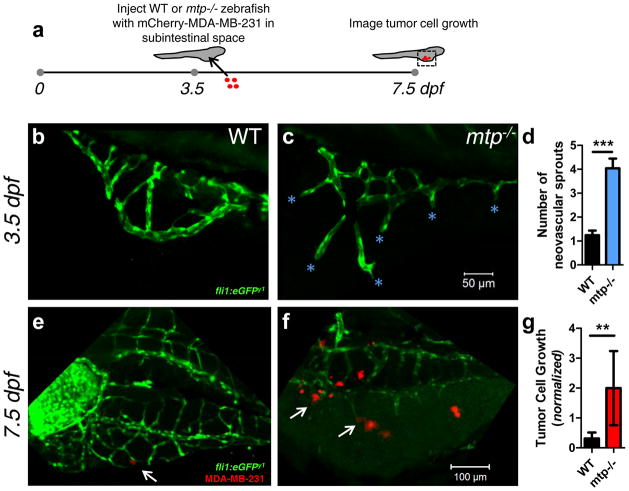
In a significant fraction of breast cancer patients, distant metastases emerge after years or even decades of latency. How disseminated tumour cells (DTCs) are kept dormant, and what wakes them up, are fundamental problems in tumour biology. To address these questions, we used metastasis assays in mice and showed that dormant DTCs reside on microvasculature of lung, bone marrow and brain. We then engineered organotypic microvascular niches to determine whether endothelial cells directly influence breast cancer cell (BCC) growth. These models demonstrated that endothelial-derived thrombospondin-1 induces sustained BCC quiescence. This suppressive cue was lost in sprouting neovasculature; time-lapse analysis showed that sprouting vessels not only permit, but accelerate BCC outgrowth. We confirmed this surprising result in dormancy models and in zebrafish, and identified active TGF-β1 and periostin as tumour-promoting factors derived from endothelial tip cells. Our work reveals that stable microvasculature constitutes a dormant niche, whereas sprouting neovasculature sparks micrometastatic outgrowth.
在相当一部分乳腺癌患者中,远处转移在潜伏期数年甚至数十年后才出现。播散性肿瘤细胞(DTCs)是如何处于休眠状态的,以及是什么唤醒了它们,这些都是肿瘤生物学中的基本问题。为了解决这些问题,我们在小鼠中进行了转移实验,结果表明休眠的 DTC 存在于肺、骨髓和脑的微血管上。然后,我们设计了器官型微血管小生境来确定内皮细胞是否直接影响乳腺癌细胞(BCC)的生长。这些模型表明,内皮衍生的血栓素-1诱导 BCC 持续静止。这种抑制信号在新形成的血管中丢失;延时分析表明,新形成的血管不仅允许,而且加速了 BCC 的生长。我们在休眠模型和斑马鱼中证实了这一令人惊讶的结果,并鉴定出源自内皮尖端细胞的活性 TGF-β1 和 periostin 是促进肿瘤生长的因素。我们的工作揭示了稳定的微血管构成了休眠小生境,而新形成的新生血管则引发了微转移的生长。