School of Biosciences, University of Birmingham, Edgbaston, Birmingham, B15 2TT, UK.
J Am Soc Mass Spectrom. 2013 Aug;24(8):1242-9. doi: 10.1007/s13361-013-0658-1. Epub 2013 Jun 1.
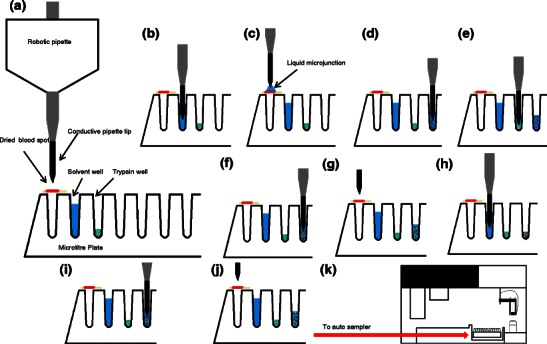
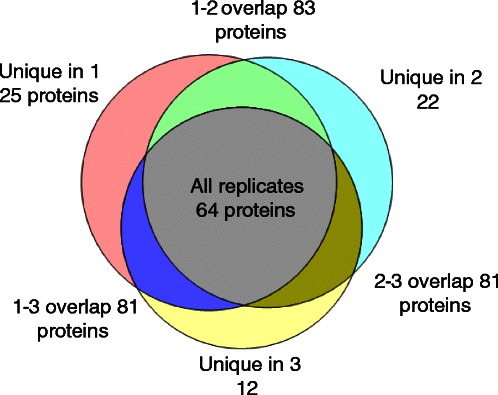
Dried blood spots offer many advantages as a sample format including ease and safety of transport and handling. To date, the majority of mass spectrometry analyses of dried blood spots have focused on small molecules or hemoglobin. However, dried blood spots are a potentially rich source of protein biomarkers, an area that has been overlooked. To address this issue, we have applied an untargeted bottom-up proteomics approach to the analysis of dried blood spots. We present an automated and integrated method for extraction of endogenous proteins from the surface of dried blood spots and sample preparation via trypsin digestion by use of the Advion Biosciences Triversa Nanomate robotic platform. Liquid chromatography tandem mass spectrometry of the resulting digests enabled identification of 120 proteins from a single dried blood spot. The proteins identified cross a concentration range of four orders of magnitude. The method is evaluated and the results discussed in terms of the proteins identified and their potential use as biomarkers in screening programs.
干血斑作为一种样本形式,具有易于运输和处理的优势。迄今为止,大多数针对干血斑的质谱分析都集中在小分子或血红蛋白上。然而,干血斑是蛋白质生物标志物的潜在丰富来源,这一领域一直被忽视。为了解决这个问题,我们采用了一种非靶向的自上而下的蛋白质组学方法来分析干血斑。我们提出了一种自动化和集成的方法,用于从干血斑表面提取内源性蛋白质,并通过使用 Advion Biosciences Triversa Nanomate 机器人平台上的胰蛋白酶消化进行样品制备。所得消化物的液相色谱串联质谱分析能够从单个干血斑中鉴定出 120 种蛋白质。鉴定出的蛋白质跨越四个数量级的浓度范围。该方法从鉴定出的蛋白质及其在筛选计划中作为生物标志物的潜在用途方面进行了评估和讨论。