Joh Ju Youn, Kim Sun, Park Jun Li, Kim Yeon Pyo
Department of Family Medicine, Chonnam National University Hwasun Hospital, Chonnam National University Medical School, Hwasun, Korea.
Korean J Fam Med. 2013 May;34(3):169-77. doi: 10.4082/kjfm.2013.34.3.169. Epub 2013 May 24.
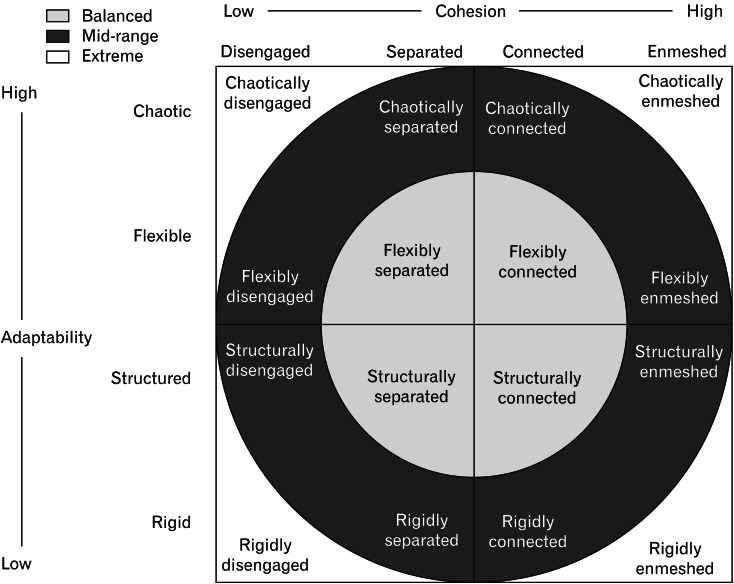
The Family Adaptability and Cohesion Evaluation Scale (FACES) III using the circumplex model has been widely used in investigating family function. However, the criticism of the curvilinear hypothesis of the circumplex model has always been from an empirical point of view. This study examined the relationship between adolescent adaptability, cohesion, and adolescent problem behaviors, and especially testing the consistency of the curvilinear hypotheses with FACES III.
We used the data from 398 adolescent participants who were in middle school. A self-reported questionnaire was used to evaluate the FACES III and Youth Self Report.
According to the level of family adaptability, significant differences were evident in internalizing problems (P = 0.014). But, in externalizing problems, the results were not significant (P = 0.305). Also, according to the level of family cohesion, significant differences were in internalizing problems (P = 0.002) and externalizing problems (P = 0.004).
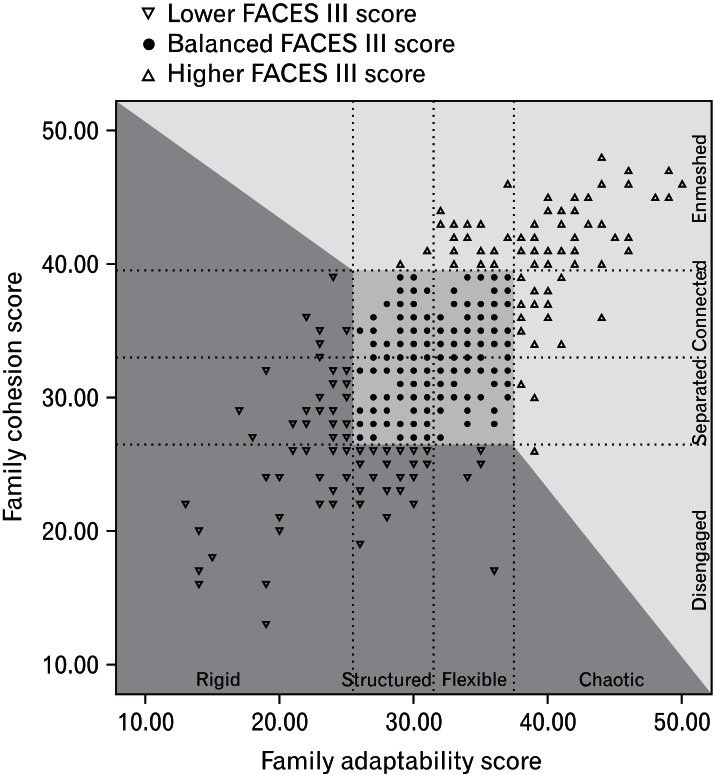
The relationship between the dimensions of adaptability, cohesion and adolescent problem behaviors was not curvilinear. In other words, adolescents with high adaptability and high cohesion showed low problem behaviors.
采用环状模型的家庭适应性和凝聚性评估量表(FACES)III已被广泛用于调查家庭功能。然而,对环状模型曲线假设的批评一直来自实证角度。本研究考察了青少年适应性、凝聚性与青少年问题行为之间的关系,尤其检验了FACES III曲线假设的一致性。
我们使用了398名初中青少年参与者的数据。采用自填问卷来评估FACES III和青少年自评量表。
根据家庭适应性水平,内化问题存在显著差异(P = 0.014)。但是,在外化问题方面,结果不显著(P = 0.305)。此外,根据家庭凝聚性水平,内化问题(P = 0.002)和外化问题(P = 0.004)均存在显著差异。
适应性、凝聚性维度与青少年问题行为之间的关系并非曲线关系。换句话说,适应性高且凝聚性高的青少年表现出较低的问题行为。