Research Center Adolescent Development, Utrecht University, Utrecht, The Netherlands.
Department of Psychology, University of Athens, Athens, Greece.
J Youth Adolesc. 2020 Apr;49(4):804-817. doi: 10.1007/s10964-019-01094-z. Epub 2019 Aug 5.
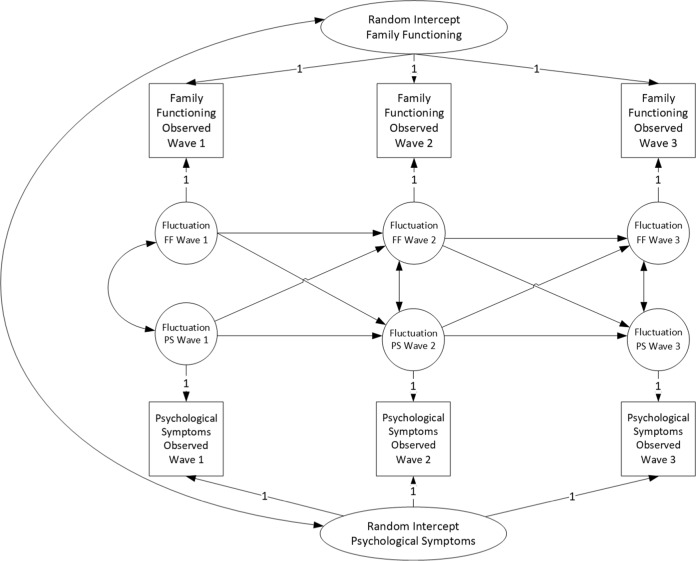
Adolescence is often a period of onset for internalizing and externalizing problems. At the same time, adolescent maturation and increasing autonomy from parents push for changes in family functioning. Even though theoretically expected links among the changes in family functioning and adolescent internalizing and externalizing problems exist, studies examining this link on the within-family level are lacking. This longitudinal, pre-registered, and open-science study, examined the within-family dynamic longitudinal associations among family functioning, and internalizing and externalizing problems. Greek adolescents (N = 480, M = 15.73, 47.9% girls, at Wave 1) completed self-report questionnaires, three times in 12 months. Random-Intercept Cross-Lagged Panel Models (RI-CLPM) were applied; such models explicitly disentangle between-family differences from within-family processes, thereby offering a more stringent examination of within-family hypotheses. Results showed that family functioning was not significantly associated with internalizing or externalizing problems, on the within-family level. Also, alternative standard Cross-Lagged Panel Models (CLPM) were applied; such models have been recently criticized for failing to explicitly disentangle between-family variance from within-family variance, but they have been the standard approach to investigating questions of temporal ordering. Results from these analyses offered evidence that adolescents with higher internalizing and externalizing problems compared to their peers, tended to be those who later experienced worse family functioning, but not vice versa. Implications for theory and practice are discussed.
青春期通常是内化和外化问题开始出现的时期。与此同时,青少年的成熟和对父母的独立性的增强推动了家庭功能的变化。尽管理论上预期家庭功能的变化与青少年的内化和外化问题之间存在联系,但在家庭内部水平上研究这种联系的研究还很缺乏。本纵向、预先注册和开放科学研究考察了家庭功能以及内化和外化问题之间的家庭内动态纵向关联。希腊青少年(N=480,M=15.73,47.9%为女孩,第 1 波)在 12 个月内完成了 3 次自我报告问卷。应用了随机截距交叉滞后面板模型(RI-CLPM);这种模型明确区分了家庭间差异和家庭内过程,从而更严格地检验了家庭内假设。结果表明,家庭功能与内化或外化问题之间没有显著的相关性,这是在家庭内水平上的。此外,还应用了替代的标准交叉滞后面板模型(CLPM);这些模型最近因未能明确区分家庭间方差和家庭内方差而受到批评,但它们一直是研究时间顺序问题的标准方法。这些分析的结果提供了证据表明,与同龄人相比,内化和外化问题较高的青少年往往是那些后来家庭功能较差的人,而不是相反。讨论了对理论和实践的影响。